F1 Arcade, curling and axes: Inside London’s sport experience economy

Whether it’s Formula 1, pool, axe throwing or curling; London’s experience economy is thriving as City social habits change.
Earlier this month, Formula 1 ended a five-week hiatus in Miami. But over 4,000 miles away in the shadow of St Paul’s Cathedral in London, hundreds of fans gathered – at the last minute due to late changes to stateside schedules – to race in simulators and whoop, holler and jeer every overtake around the Hard Rock Stadium.
This is the experience economy, which is booming across the capital and the country. Name a sport, and there’s a social version of it popping up in the capital’s vacant commercial space.
Clay pigeon shooting, football, cricket, darts, golf, curling and even axe throwing; their socialising siblings are everywhere.
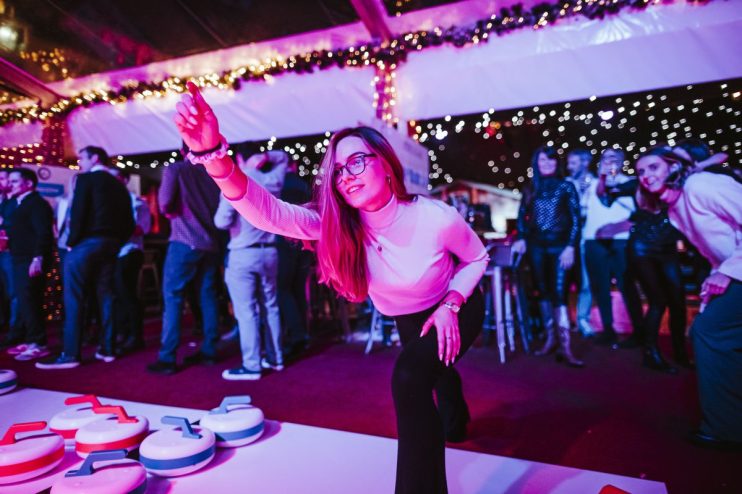
“People are looking for something more interactive when they go out now,” The Curling Club chief Dylan Salamon tells City AM. “It’s not just about standing around with a drink, it’s about doing something together.
“That’s where curling really works. It’s familiar enough – people have seen it at the Winter Olympics – but sociable floor curling is still a new format, so there’s no real blueprint. That’s part of the appeal, and it makes it incredibly accessible. People can figure out their own style, be competitive, but not take it too seriously.”
And while familiar names such as Pitch and Flight Club continue to be proliferate across the hospitality sector, new iterations are coming to light.
Poolhouse, a Liverpool Street site with art deco-style tables and AI potting assistants, has millions in backing from across business and sport. Its co-founder Andrew O’Brien believes there has been a clear shift in what people want in the City.
Experience economy thriving
“The scale of demand is already proven. More people played at Topgolf venues than on traditional golf courses in the US last year, which speaks volumes about how audiences are choosing to engage with these kinds of experiences,” he said.
“Like Topgolf, Poolhouse has taken an existing sport and reimagined it for the modern consumer. What we are doing is elevating the experience, so it’s no longer just about a single table in your local boozer – though there’s absolutely a place for that.”
It is a sentiment echoed by multi-sport venue Rocket Room, which took a former derelict restaurant in Leicester Square and turned it into an axe throwing, beer ponging site just feet from global movie premieres.
Its founder, Mike Pearson, reckons London is unique and its demanding residents and visitors are forcing businesses to look beyond the basic bar.
“There’s been a clear shift in how people want to spend their time and money. Traditional nightlife and dining alone aren’t always enough,” he says.
“People are actively seeking experiences that are social, interactive and memorable. London, in particular, is a market where consumers are highly experience-driven and time-conscious. They want something that justifies going out, especially in a city with so much competition.
“Competitive socialising taps directly into that demand by combining entertainment, hospitality and shared experiences in one setting. At the same time, operators are looking for ways to diversify revenue and stand out in a crowded market.”
On our doorstep
The number of pubs in the capital has, thankfully, remained stable despite national decline. But the number of nightclubs has sharply fallen since the Covid-19 pandemic, while London has been criticised for early closing times and restrictive operating licenses across the hospitality sector.
F1 Arcade’s CMO, Rhiannon Scarlett, said: “The competitive socialising sector is expanding at pace, but what sets F1 Arcade apart is the strength of our official Formula 1 licensing. Alongside the racing, our elevated lifestyle offering and a high-energy social atmosphere delivers a complete night out. It’s this combination that is driving exceptional demand for more immersive and memorable experiences.”
There’s a case to be made for the experience economy, and it is an obvious one. Where licenses can be restrictive for pubs, these operations can keep the City’s Thursday night economy thriving.
The capital is a hotbed of innovation, and that has extended into the hospitality sector, demonstrating that sport is no longer restricted to golf courses in Hertfordshire or curling in Scotland. It is on our doorstep.