Labour will regret the Renters’ Rights Act
There were celebrations across the Labour frontbench as the Renters’ Rights Act came into force today. That won’t last for long, writes Ben Hopkinson
Swedish economist Assar Lindbeck famously called rent control “the most efficient technique presently known to destroy a city – except for bombing”. Somebody must have communicated this to No 10 and the Housing Ministry last week, given how quickly they shut down the rumours that Rachel Reeves was mulling a rent freeze ahead of the local elections.
It’s just a shame that the government’s very own Renters’ Rights Act, which came into force today, will have similarly devastating consequences. More rights for renters rights might sound great – but they are useless if there are no properties available to actually rent.
What does the Renters’ Rights Act actually do?
The headline policy of the Act abolishes Section 21 evictions, also known as ‘no fault’ evictions. These enabled fixed-term tenancies by giving landlords the power to regain possession of their property once the agreed term expires. Since the Act went into force, every tenancy is effectively indefinite.c
There’s a principled argument against this: why shouldn’t tenants and landlords be able to agree a contract length between them? But there’s also a practical one: if landlords are confident that they can easily regain possession, they will be much more likely to let out their properties in the first place.
With this protection gone, landlords have no certainty about getting their property back at an agreed point. Instead they may have to jump through multiple hoops, including backlogged courts and the queue to get a bailiff, with a huge potential for lost income.
It’s little surprise, then, that thousands of landlords put in last-minute Section 21 notices in the final weeks of April. They knew how damaging this change will be.
Landlords will be more likely to pass over first-time renters
But the Act also changes who will actually get to rent flats. The Act stops tenants from paying rent in advance and bans landlords from accepting an offer above their initial asking price. Without the ability to compete on price, prospective renters will be forced to compete on other grounds. That could mean CV checks, references from previous landlords and renting within personal networks.
This will be disastrous for young people who are trying to move out of their childhood home into their first tenancy. Without a rental history, and probably on a lower income than those further along in their career paths, they will look riskier on paper, which will mean landlords are more likely to pass them over.
Perhaps most significant of all, the act brings in rent control through the backdoor. No longer will rents be set by agreements between tenant and landlord. Instead, tenants will be empowered to challenge any rental increase through a tribunal.
Until the tribunal makes its decision, the tenant will pay the existing rent – and any tribunal decision will not be backdated. The tribunal is also banned from suggesting a rent higher than the one the landlord proposed. So there’s literally no reason for a tenant not to go to a tribunal.
With 11m private renters and only 34 tribunal judges, the system is likely to be overwhelmed almost instantly. That will mean Rachel Reeves gets her rent freeze wish after all.
Landlord exodus will not improve the rental sector
If we want a functioning private rental sector, it needs to be in the interest of both tenants and landlords to enter into agreements. Over the past decade there’s been increased stamp duty for landlords, tax changes that mean they can no longer deduct mortgage interest from their taxes and increased regulatory requirements like improved energy efficiency, which have all added costs. The result has been a net loss of 300,000 homes in the private rental market between 2016 and 2023.
The Renters’ Rights Act is supercharging this shift. Over the last year, 254,000 buy-to-let properties have been put up to sale. This will only get worse as the full impacts of the Act become clear.
Instead of introducing rent control through the backdoor and inadvertently destroying the rental market, the government needs to get out of the way to make renting a better deal for both tenants and landlords.
There were celebrations across the Labour frontbench when the Renters’ Rights Act came into force. In a few years time, when they’re left staring at cityscapes denuded of rental properties, the mood will probably be one of shellshock rather than jubilation.
Ben Hopkinson is the head of housing and infrastructure at the Centre for Policy Studies
Nautical and Maestro will be Forces to be reckoned with at Sha Tin
RACING in Hong Kong returns to Sha Tin on Sunday with an exciting and informative 11-race programme, featuring the Group Three Queen Mother Memorial Cup, a handicap over a mile and a half, at 8:40pm.
The race for the Trainers’ Championship continues to make the headlines on a weekly basis, with the lead chopping and changing, often likened to a game of musical chairs. With half a dozen stables in with a chance of claiming the coveted prize, and with just a quarter of the season remaining, it is anyone’s guess who will come out on top.
One trainer who has downplayed his chances of retaining the trophy, however, is current champion and 13-time winner John Size, who is presently nine winners behind joint leaders Caspar Fownes and Mark Newnham.
Size has just come out of a highly successful month in April, with eight winners, including a four-timer in the middle of the month. This is the time of the season when the Size stable slips into overdrive, with a host of exciting newcomers, so to write off his chances would be premature, and you can guarantee his rivals will be keeping a watchful eye on his progress.
The stable sends out a strong raiding party of nine gallopers, including a couple of future Group-class candidates, judged by their recent winning form.
There was plenty to like about the diminutive NAUTICAL FORCE, who made a winning debut in a fiercely contested nine-furlong handicap last month and now steps up into deeper waters in the feature race on the card. While many of his half-dozen rivals are untested over the 12-furlong trip, this former UK galloper was fourth over the distance in the red-hot King George V Handicap at Royal Ascot last June and will appreciate returning to his optimum trip.
Stable companion SKY JEWELLERY is another who will have serious aspirations of dining at the top table in the future, provided he can come through his test in the mile Members Cup Handicap (9:40pm).
Health issues have so far curtailed his short career, he was once rated a serious contender for the Four-Year-Old Classic Series, but his comeback run, when demolishing a smart set of rivals over seven furlongs last month, was full of promise, and he can make the most of the 16 pounds he receives from main threat Stormy Grove.
Finally, keep an eye on RED MAESTRO in the seven-furlong Shenzhen Centre Handicap (10:45pm). Size has always had a lot of time for this son of Ten Sovereigns, who was given a thorough preparation before his first appearance over an inadequate six-furlong trip in March. He has improved plenty since that performance and, despite facing stiff opposition, can go close.
POINTERS
Nautical Force 8.40am Sha Tin
Sky Jewellery 9.40am Sha Tin
Red Maestro (e/w) 10.45am Sha Tin
Cody can provide Sha Tin winner for excellent Orman
WITH the form of the BMW Hong Kong Derby given a boost by the performance of winner Invincible Ibis, who subsequently finished a close-up fourth to My Wish in the Group One FWD Champions Mile last weekend, it could be a form race to follow for the future.
Finishing sixth, beaten just over three lengths by Invincible Ibis in the HK Derby, was the Me Tsui-trained POPE CODY, who looks to have an outstanding opportunity to gain some compensation in the ten-furlong Conghua Racecourse Handicap (10:10am).
The son of Showtime, and a winner over a mile earlier in the season, has raced a handful of times since the New Year without his handicap mark changing, such is his consistency, but without success. He did, however, prove the ten-furlong distance is going to be his forte, coming from a mile back from an awkward draw in the HK Derby and producing the second-fastest closing sectional times in the race.
With blinkers equipped for the first time, though he did wear them in an eye-catching trial behind Numbers and Romantic Warrior over a mile on turf recently, he looks ready to resume winning form and can be a welcome winner for the excellent pilot Jimmy Orman.
Dangers are aplenty, notably top-weight Aerodynamics, back again after a pillar-to-post victory from an inspired Zac Purton ride last month, and lightweight Shamus Storm representing the David Hayes stable, both catching the eye. Consistent Money Catcher and the John Size-trained Enthusiasm are others that make the shortlist, but Pope Cody, provided he is within a few lengths of the leaders turning into the home straight, will be hard to stop when making his bid for glory.
POINTER
Pope Cody 10.10am Sha Tin
NBA-EuroLeague talks at an impasse, adding uncertainty to bidding process
With a former NBA man installed at the top of EuroLeague, conciliatory noises coming from both camps and fresh talks held this week about cooperation, the prospects of a peace deal between basketball’s two biggest club organisers looked to be better than ever.
But following the meeting, at the headquarters of world governing body Fiba in Geneva on Tuesday, those hopes appear to have been checked. Despite a joint statement from all parties hailing “constructive discussions”, an impasse between the NBA and EuroLeague remains.
The NBA is determined to launch its own European league in October 2027, in collaboration with Fiba, and has been emboldened by the breadth and size of bids for the 12 permanent franchises which were lodged by institutional investors and existing clubs in recent weeks.
It has invited EuroLeague to join the venture but, as it stands, only on the NBA’s terms. In practice, this means that EuroLeague’s biggest teams, like Real Madrid, Barcelona, Fenerbahce and Olympiacos, could buy their way in but the smaller teams would likely be left out.
The NBA’s vision is to combine the current giants of European basketball with new teams in key markets that are currently underserved, including London and Manchester. Milan, Rome, Berlin and Munich have also been identified as bases for franchises.
EuroLeague’s position is understood to be that it will only agree to cooperate on NBA Europe, as the new competition is provisionally being called, if all 20 of its teams are assured of places. That, however, would mean the new league being much bigger than the NBA had intended.
Sources close to this week’s talks described them as polite and respectful but lacking in progress. For all of the encouraging noises made by NBA commissioner Adam Silver lately, its proposal to EuroLeague was essentially the same as the one it rejected last year, sources said.
Further talks are planned. The NBA’s top man in Europe, George Aivazoglou, is due to attend the BCL Final Four in Spain next week. EuroLeague bosses are focused on its season climax in Athens later this month, however, and the plans for NBA Europe may need to advance before then to meet its ambitious timeline.
The state of bidding for NBA Europe teams
The NBA and its advisors, JPMorgan and the Raine Group, are currently firming up the non-binding bids made at the end of March. They are said to have received interest from 120 parties, with some bids valuing the most popular franchises at more than $1bn.
It is expected that some potential investors will withdraw, while others may be knocked back if their valuations do not meet those of the NBA. The US giant is said to be conscious that any new owners will be guardians of its brand, so will be mindful of achieving a good fit.
Questions remain over some of the most prestigious franchises, however. Real Madrid are yet to commit to either staying in EuroLeague or joining NBA Europe, while Qatar’s expected bid for a Paris franchise to sit alongside football club PSG is understood to have not materialised yet.
Bidders attached to football teams are known to have pushed back strongly against the demand for licence fees of $500m to $1bn. That haggling continues, while there is also robust debate over the proportion of revenue from the new league that is retained by the NBA.
There are suggestions, unconfirmed at this stage, that the deadline for binding bids for NBA Europe franchises has been set for the end of May. That raises the prospect of investors having to commit before they know whether the new league will have a direct rival or not.
Will NBA and EuroLeague find a compromise?
The NBA is understood to retain hope that, with its former executive Chus Bueno now at the helm of EuroLeague, there is more will than ever on both sides to do a deal. The meeting in Geneva was the first since Bueno’s election as chief executive in January.
The US league is also relaxed at what it considers inevitable bartering and horse trading as part of the bidding process for NBA Europe licences. In that context, EuroLeague holding out gives the likes of Real Madrid and Barcelona some leverage on entry price.
EuroLeague, on the other hand, has made clear that it will not accept some of its teams being forced to qualify for NBA Europe on an annual basis. With the new league set to number 16 teams, that would ensure some of its current members were excluded.
As it stands, then, the NBA’s position can be summed up as: it is pressing ahead, with or without EuroLeague, while EuroLeague’s is that it doesn’t need the NBA and will continue operating its own competition regardless – unless it receives the concessions it wants.
There is thought to be an acceptance at EuroLeague that the NBA’s commercial nous and brand value would be an asset, and that it would be willing to let its US partners take charge of attracting eyeballs. But before then, it appears to be a question of who will blink first.
Petrol retailers vindicated after Reeves ‘profiteering’ claims
Petrol retailers have been vindicated of “price gouging”, pouring cold water on the government’s accusations of profiteering from the war in Iran.
The Competition and Markets Authority (CMA) found that higher fuel prices in the UK were caused by the rising cost of oil, rather than by retailers expanding their margins to profit from the disruption caused by the Iran war.
A bitter row erupted between forecourt operators and the government after ministers said they would “not tolerate” so-called “price gouging”.
Chancellor Rachel Reeves and energy secretary Ed Miliband met with petrol retailers to crackdown on fears that the price of petrol was being inflated to line bosses’ pockets.
“I will not tolerate any company exploiting the current situation to make excess profits at consumers’ expense. I’m backing drivers and families — and I expect a fair deal at the pump,” Reeves had said.
The comments were met with a furious rebuttal by the Petrol Retailers’ Association, who accused Reeves of “inflammatory” language which they linked to incidents of violence against forecourt staff.
Majority of retailers ‘acted responsibly’
Delivering the results of an investigation commissioned by Reeves, the CMA said on Friday that the difference between the price petrol retailers are paying for fuel and the price at which they are selling it is “broadly unchanged” since the Iran war began.
The watchdog said it had noticed some wider margins for a “minority of retailers,” which it said it intended to pursue.
Sarah Cardell, chief executive at the CMA, said: “The conflict in the Middle East has driven sharp increases in road fuel prices, putting real pressure on households and businesses across the UK.
“That’s why we’ve stepped up our monitoring. This scrutiny is working: on average, retailer fuel margins did not increase.”
Martin McCluskey, minister for energy consumers, said the report showed most retailers have “avoided boosting their margins and acted responsibly”.
“However, there are some that haven’t. We fully support the CMA in asking questions of those and, alongside them, will hold them to account,” he said.
Surging oil is economic blow
It comes after the price of oil spiked above $126 earlier this week, following reports Donald Trump was being briefed on fresh military action in Iran. Whilst they have since slipped back a touch, Brent crude – the international benchmark for oil – remains up nearly 90 per cent for the year-to-date.
Much of the relentless rise in oil prices have come from traffic through the Strait of Hormuz being all-but-halted since the war broke out in late February.
The narrow waterway, which sits between Iran to the North and the UAE to the south, sees around a fifth of the world’s oil supply flow through.
The Bank of England gave a major warning on Thursday on the inflationary impact triggered by soaring oil prices.
The spike in prices have triggered a global energy shock, which have quickly fanned the flames of inflation.
In a medium-risk scenario where oil and gas prices cause inflation to rise for the next two years, the Bank warned interest rates could be hiked to 4.25 per cent.
Many of the members of the Monetary Policy Committee – who held rates at 3.75 per cent this week – expect inflation only to fall back to the target of two per cent until 2028.
What’s on in London in May
May in London is bursting with energy, and Central London Alliance’s go-to guide is here to help you make the most of it. From hands-on workshops and thrilling sporting events to activities the whole city can enjoy, this is your monthly roundup of the very best London has to offer. Whether you’re a seasoned local or experiencing the capital for the first time, now is the perfect time to try something new and discover everything this incredible city has in store.
Activities and Performances
Les Ballets Trockadero de Monte Carlo
5 – 6 May
Ballet mastery meets comedy and drag – The Trocks are back! For almost 50 years, the all-male comedy ballet company Les Ballets Trockadero de Monte Carlo have been delighting audiences of all ages at sell-out performances featuring their fabulous sense of fun and their flawless dance. Featuring a fierce repertoire of classics and modern work – including Swan Lake; Metal Garden (UK premiere); Dying Swan; Paquita – the beloved company are back at Sadler’s Wells Theatre with their sassy spoofs, daring physicality and dazzling theatrical flair.
Location: Sadler’s Wells Theatre in Angel at Rosebery Avenue, EC1R 4TN
For more information visit here.
Celebrity Organ Recital by Nicolas Berndt at St Paul’s Cathedral
7 May, 6:30pm
Every year, some of the world’s finest organists come to St Paul’s to play the world-famous Grand Organ in a series of recitals. This year’s theme is ‘Legacy of Legends’, and they will be starting with a classic – the legendary composer and teacher J. S. Bach. Under Sir Christopher Wren’s iconic Dome, Nicolas Berndt will give a recital honouring Bach’s legacy, both through the composer’s own works as well as other original works inspired by his music.
Location: St Paul’s Cathedral, EC4M 8AD
For more information and to book visit here.
Family Days at Guildhall Art Gallery
9 May and 27 May
Enjoy twice the family fun at Guildhall Art Gallery this May. Second Saturday (9 May) offers relaxed, drop-in creative activities, storytelling, and play inspired by the Gallery’s collections, while the Half-Term Family Day (27 May) transforms the whole building with hands-on arts, crafts, and performances for children and their grown-ups.
Location: Guildhall Art Gallery at Guildhall Yard, EC2V 5AE
For more information visit here.
A Court of Paper – Documentary Theatre
13 May
A powerful documentary theatre performance responding to newly released archives on Dutch collaboration during the Second World War. Blending personal family histories with multimedia, live translation, and audience participation, ‘A Court of Paper’ invites audiences to confront hidden histories and consider how the past shapes the present.
Location: The Dutch Centre at 7 Austin Friars, EC2N 2HA
For more information visit here.
Exhibitions and Workshops
(Extra)ordinary: an exhibition by Darcey Fleming
Now – 31 July
Darcey Fleming’s first solo exhibition transforms the reception at 99 Bishopsgate with vibrant, large-scale weavings made from discarded baling twine. The work reimagines agricultural waste as bold, tactile sculpture, exploring the balance between structure, freedom, and material transformation.
Location: 99 Bishopsgate, EC2M 3XF
For more information visit here.
Gabriel Chaile in Conversation
14 May, 5:00pm – 6:30pm
Accompanying his new commission Archaeology of Memory, join Gabriel Chaile and the exhibition’s curator Carolina Jozami, as they speak to the key questions in the work, inviting conversations around the memory making and retentive potential of cultural artefacts, the agency of objects, and ways of knowing and relating to each across time and place.
Location: Whitechapel Gallery at 77-82 Whitechapel High Street, E1 7QX
For more information visit here.
Journey Through DoodleLand: A Mr Doodle Draw-Along
26 May, 11:00am – 12:30pm & 2:00pm – 3:30pm
During the workshop, Mr. Doodle, also known as Sam Cox, will discuss his artistic influences, take part in a Q&A, and demonstrate a live “draw along,” offering a unique real-time glimpse into his extraordinary imagination. Materials will be provided and participants will come out of the session with their own doodles.
This workshop is aimed at children aged 7 and upwards. Please note that participating adults must book and pay for their own space. Non-participating adults are encouraged to purchase a museum ticket and enjoy the exhibitions while their child takes part.
Location: The Cartoon Museum at 63 Wells Street, W1T 3PZ
For more information visit here.
Sports and Wellness
Padel at London Sports Festival
Now – 23 August, 6:00am – 10:00pm at Hay’s Galleria.
Now – 25 October, 8:00am to 8:45pm at Tower Hill Terrace.
Two of London’s most iconic padel venues are open and calling your name. Play against the legendary backdrop of the Tower of London at Tower Hill Terrace, or step inside the beautiful Hay’s Galleria on the Riverside — both welcoming players of all abilities, from first timers to seasoned pros. Evening sessions are available at both venues with lighting, equipment is provided and each location is wheelchair-accessible.
Also, a Rise and Rally offer is now available for those interested in playing padel at Hay’s Galleria on either Saturday or Sunday mornings from 6:00am to 8:00am. Over a 30% discount will be added at checkout.
Location: Hay’s Galleria at 1 Battle Bridge Lane, SE1 2HD
To book the Hay’s court visit here.
Location: Tower Hill Terrace, EC3N 4EETo book the Tower Hill Terrace court visit here.
Pickleball Extension at St James’s Park (Palmer Street)
Now – 17 May, 8:00am to 8:45pm
Pickleball
London’s love for pickleball is growing and now you can be part of it. The London Sports Festival pickleball court, brought to you by Central London Alliance, is open and ready to welcome players of all abilities. The venue is indoors, fully wheelchair-accessible and fully equipped. It’s perfect for everything from a fun catch-up with friends to memorable corporate events.
Location: St. James’s Park (Palmer Street), SW1H 0AA
To book your spot visit here.
Padel Table Tennis at St Paul’s Cathedral Churchyard
Now – 4 June, 8:00am to 8:00pm
Padel table tennis has taken over the breathtaking St Paul’s Cathedral Churchyard and the result is something truly special. This magnificent historic landmark is now the proud home of one of London’s most talked-about emerging sports. Play off the walls, soak up the incredible atmosphere with friends and be completely hooked on a fresh and exciting twist on a much-loved classic, all against one of the most iconic skylines the city has to offer.
Up to 4 players per session. All equipment provided.
Location: St. Paul’s Cathedral Churchyard, EC4M 8AD
To book your spot visit here.
Rooftop Yoga at The Skyline London
16 May, 9:30am to 11:00am
Elevate your wellness routine with rooftop yoga overlooking the Tower of London, the Thames and Tower Bridge. These classes are designed to help you connect with your body, breath and mind, and to create a sense of inner peace and harmony that you can carry with you throughout your day. Post-flow, enjoy a nutritious social brunch with fellow yogis, the perfect way to refuel, unwind, and soak in the iconic skyline.
Location: The Skyline London at 100 Minories London EC3N 1LA
Book your spot today.
Taster 3×3 Basketball
26 May, 1:00pm – 7:00pm
London Sports Festival is bringing the energy of 3×3 basketball to the city this May, uniting workers, residents and visitors in a celebration of the world’s fastest growing urban sport. Mark your calendars for 26 May, this unmissable one-day event promises something for everyone – from competitive play and corporate challenges to free wheelchair basketball taster sessions and pay-and-play options for private use.
Enjoy this one-day event with free giveaways and an electric atmosphere, the perfect opportunity to experience the fast-paced excitement of 3×3 basketball while connecting with a vibrant community ahead of what’s set to be a landmark summer of sport in London.
Location: Paternoster Square, EC4M 7DXBookings are now open, book your spot here.
Death of Football Focus is a signal for every brand at the World Cup
Brands will spend fortunes on this summer’s World Cup but they should heed the BBC’s warning when scrapping Football Focus, writes Amar Singh.
I grew up with Football Focus. Saturday lunchtime, Bob Wilson in a grey suit, grainy footage of some Division Two ground in the rain. It was the traditional seat-warmer for a weekend of football.
Last week, the BBC axed the magazine-style show after 52 years. The official explanation cited “changing audience behaviours” and the need to “reach fans wherever they are.” Buried inside that institutional language is a message that every brand, sponsor and rights holder planning their World Cup summer needs to hear.
The cancellation of Football Focus is a signal which the sponsorship industry should be paying attention to.
Audience is bigger than ever but it’s migrated
It would be convenient to blame budget cuts. The BBC needs to find £500m in savings over two years and a 52-year-old Saturday lunchtime programme was always going to struggle to justify itself in that context. But that lets everyone off the hook.
I have spent more than a decade in sports marketing, including two years running global football strategy for Budweiser across the Premier League, LaLiga and Lionel Messi partnerships. In that time I have sat in a lot of rooms where brands obsess over their broadcast presence while their target audience has migrated somewhere else entirely.
The fact is, football fans have never been more engaged. Research by insights specialists Dentsu Sports Analytics conducted with 3,000 fans in six markets found that 78 per cent are extremely or very interested in this summer’s World Cup.
Engagement with football content is not declining. The problem for the industry is keeping pace as the audience moves.
YouTube is now the primary destination for catching up on missed matches across every age group. Under 35s are two to three times more likely than over 35s to use social platforms to follow the game.
And the finding that should stop every brand strategist in their tracks: 52 per cent of fans now trust creator match insights more than pundits on TV broadcasts.
That alone should worry anyone building their strategy around broadcast-first thinking when more than half of football fans trust someone with a ring light and a YouTube channel over a former professional footballer sitting behind a desk.
The institutional Football Focus was not axed because of a so-called woke rebrand, it was because its core audience – the fan who sat down at midday on Saturday for considered analysis – has fragmented beyond recovery.
Established figures saw this coming
The strongest indication of this shift is what established voices have started doing in response.
The Overlap, Gary Neville’s media company, recently acquired the YouTuber Mark Goldbridge’s That’s Football – one of the most followed fan channels in UK football. The people who built their profile through traditional punditry are now buying creator culture rather than competing with it.
Look at what they are making. Neville’s Stick to Football mimics the aesthetic fan channels pioneered – banter, loose conversation, impassioned views, no autocue (unless Neville is reading one of his Huel ads). Gary Lineker’s The Rest is Football is formulated to sound like three mates catching up to chat footy rather than three pundits on a set. The casualness is the point.
This is not punditry and it is certainly not journalism. It is something newer and harder to categorise: content built for an audience that wants to feel something alongside someone they trust, rather than be informed by someone with authority.
The BBC saw this coming. Alex Kay-Jelski, head of BBC Sport and someone with a strong track record for growing digital audiences at The Athletic and The Times, said the decision to axe Football Focus reflected “the continued shift in how audiences engage with football.” That’s a frank admission that the format had been left behind by the people it was built to serve.
Football Focus is the institutional version of the same reckoning Neville and Lineker navigated by reinventing themselves. Unfortunately the BBC could not reinvent a 52-year-old format fast enough.
What brands must do before World Cup starts
The 2026 World Cup will generate more sponsorship spend than any event in the history of sport. Official Fifa partners alone will commit hundreds of millions to pitchside LEDs, broadcast spots and activation rights negotiated over years.
A lot of that money will reach an audience with at least one eye on another screen.
Seventy-three per cent of fans say they will follow content creators at the tournament. In the United States, one of three host nations, that rises to 85 per cent. More tellingly, 57 per cent say they will keep following the creators they discover during the World Cup long after the final whistle. This tournament is a creator acquisition moment on a scale the industry has never seen before.
The mistake brands keep making is investing heavily in official status without extending that investment into reaching the right audiences. The Football Focus cancellation is the clearest possible signal that the media landscape has shifted, permanently, toward digital and creator-led content.
The response must be to rebalance priorities rather than abandon broadcast. To build genuine partnerships with creators whose audiences already trust them. To think less about tentpole moments and more about sustained presence – content that earns a place in the daily habits of football fans rather than interrupting them once and disappearing.
The lesson Football Focus leaves behind
Dan Walker, who hosted the show for 12 years, called it “disappointing that there isn’t space for a show that has meant so much to so many people for so many years.”
He is wrong that it is disappointing. There is no space because the fans moved on while the show stayed where it was. Football Focus was well made, well presented and genuinely loved but none of that could save it.
The World Cup this summer will be the most watched, most talked about, most created-around sporting event in history. For every brand spending money on it, the enduring question is whether you are spending your money where the fans actually are.
Amar Singh is SVP, Content and Creative for MKTG Sports + Entertainment. He writes and podcasts about sports marketing, content and culture at https://thesportsmarketeer.substack
CoStar Data Shows U.K. Hotel RevPAR on an Upward Trajectory
The U.K. industry posted improved revenue per available room (RevPAR) in March, according to data from CoStar, a global leading provider of online real estate marketplaces, information and analytics in the property markets.
This press release features multimedia. View the full release here: https://www.businesswire.com/news/home/20260501942837/en/
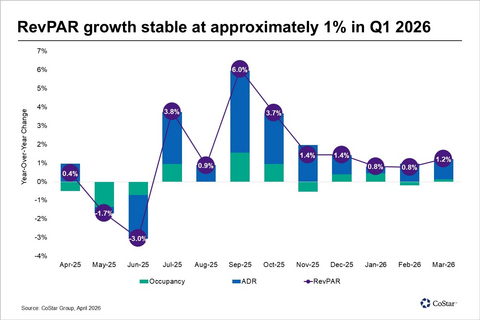
In the first quarter of 2026, the U.K. recorded a 1.2% increase in RevPAR, while occupancy remained flat, supported by events in regional markets including Glasgow, Manchester, Cardiff and Birmingham.
The Barclays UK Consumer Spend Report also showed travel spending fell in March for the first time in five years, with year‑on‑year declines across travel agents, airlines and public transport,” said Cristina Balekjian, principal market analyst at CoStar Europe. “Cancellations of overseas travel plans could boost demand for domestic staycations, as seen over the Easter weekend when demand spiked from Good Friday to Easter Sunday, although rate growth remained challenging.”
Looking ahead, stronger demand from British travellers staying closer to home is expected to support key U.K. tourist destinations, particularly over the summer, while London, which is more reliant on international and long‑haul demand, may face greater challenges than regions driven primarily by domestic travel.
The full analysis can be found here.
For more information about the company and its products and services, please visit www.costargroup.com.
About CoStar Group
CoStar Group (NASDAQ: CSGP) is a global leader in commercial real estate information, analytics, online marketplaces, and 3D digital twin technology. Founded in 1986, CoStar Group is dedicated to digitizing the world’s real estate, empowering all people to discover properties, insights, and connections that improve their businesses and lives.
CoStar Group’s major brands include CoStar, a leading global provider of commercial real estate data, analytics, and news; LoopNet, the most trafficked commercial real estate marketplace; Apartments.com, the leading platform for apartment rentals; Homes.com, the fastest-growing residential real estate marketplace; and Domain, one of Australia’s leading property marketplaces. CoStar Group’s industry-leading brands also include Matterport, a leading spatial data company whose platform turns buildings into data to make every space more valuable and accessible; STR, a global leader in hospitality data and benchmarking; Ten-X, an online platform for commercial real estate auctions and negotiated bids; and OnTheMarket, a leading residential property portal in the United Kingdom.
CoStar Group’s websites attracted over 131 million average monthly unique visitors in the first quarter of 2026, serving clients around the world. Headquartered in Arlington, Virginia, CoStar Group is committed to transforming the real estate industry through innovative technology and comprehensive market intelligence. From time to time, we plan to utilize our corporate website as a channel of distribution for material company information. For more information, visit CoStarGroup.com.
This news release includes “forward-looking statements” including, without limitation, statements regarding CoStar’s expectations or beliefs regarding the future. These statements are based upon current beliefs and are subject to many risks and uncertainties that could cause actual results to differ materially from these statements. The following factors, among others, could cause or contribute to such differences: the risk that London occupancy demand is not negatively impacted as increasing demand for short distance travel to other U.K. regions would suggest and the risk that higher demand in U.K. regions other than London due to domestic travel by British travelers does not continue as expected. More information about potential factors that could cause results to differ materially from those anticipated in the forward-looking statements include, but are not limited to, those stated in CoStar’s filings from time to time with the Securities and Exchange Commission, including in CoStar’s Annual Report on Form 10-K for the year ended December 31, 2022 and Forms 10-Q for the quarterly periods ended March 31, 2023, June 30, 2023, and September 30, 2023, each of which is filed with the SEC, including in the “Risk Factors” section of those filings, as well as CoStar’s other filings with the SEC available at the SEC’s website (www.sec.gov). All forward-looking statements are based on information available to CoStar on the date hereof, and CoStar assumes no obligation to update or revise any forward-looking statements, whether as a result of new information, future events or otherwise.
View source version on businesswire.com: https://www.businesswire.com/news/home/20260501942837/en/
Contact
Karolina Capova
Senior Media Relations Specialist
kcapova@costar.com

Lone Star Funds Announces Transformational Dual Acquisitions of RadiciGroup’s High Performance Polymers and Specialty Chemicals Businesses and DOMO Engineered Materials
Lone Star Funds (“Lone Star”) today announced that an affiliate of Lone Star Fund XII, L.P. has completed the acquisition of RadiciGroup, with its High Performance Polymers and Specialty Chemicals business areas, and has signed binding transaction agreements for the acquisition of DOMO Engineered Materials (“DOMO EM”), a business division of DOMO Group, with closing expected to occur imminently.
The simultaneous and highly complex acquisition of these businesses will bring together two established platforms to form a global, independent tier-1 compounder. The future combined business will benefit from a broad and complementary product portfolio, expanded geographic reach and enhanced capabilities to serve a diversified range of end markets, including automotive, construction, consumer and industrial applications.
By combining these businesses, Lone Star will create a stronger, more resilient platform with increased resources to accelerate innovation, enhance customer solutions and support long-term growth. The transaction also preserves critical industrial capabilities across several geographies where teams will benefit from operating as part of this stronger and more resilient platform.
Following completion, the combined platform will leverage well-established brands, including RadiciGroup, DOMO and TECHNYL®, while continuing to serve customers with a reinforced commitment to quality, reliability and technical innovation.
As part of the transaction, Jochen Fabritius has been appointed CEO of the combined organization. Mr. Fabritius brings over 25 years of industry and consulting experience and has been leading companies in the Lone Star portfolio for the last 10 years.
“This transformational and highly complex transaction underscores Lone Star’s ability to execute differentiated, value-driven investments,” said Donald Quintin, Chief Executive Officer of Lone Star. “Bringing together two leading and highly complementary businesses simultaneously creates a scaled platform with significant industrial and technological capabilities. We believe this combination will not only strengthen the competitive positioning of the business globally, but also provide the resources and stability needed to drive innovation, support customers and protect industrial know-how and employment.”
The completion of the RadiciGroup transaction marks the final step in the process announced in February 2025.
About Lone Star
Lone Star is a leading investment firm with its principal office in London, UK advising funds that invest globally in private equity, credit and real estate. The firm has been successfully navigating complex situations for over 30 years. The funds are experienced value investors that seek opportunities in situations that are in flux or complicated by specific structural or financial factors, regardless of the prevailing market environment. Our deep bench of senior leaders and expert deal professionals ensures a strong foundation for successful investments and strategic decision-making. Since the establishment of its first fund in 1995, Lone Star has organized 26 private equity funds with aggregate capital commitments totaling approximately $96 billion. For more information regarding Lone Star Funds, go to www.lonestarfunds.com. Follow us on LinkedIn.
About RadiciGroup
RadiciGroup is among the world leaders in the production of a wide range of chemical intermediates, polyamide polymers and high-performance engineering polymers, including recycled and bio-based solutions. RadiciGroup products are the result of outstanding chemical expertise and a vertically integrated polyamide production chain. RadiciGroup provides materials for a variety of industries, such as automotive, electrical and electronics, consumer and industrial goods, water management, transportation, household appliances and sports. At the core of the Group’s strategy is our strong focus on innovation, quality and customer satisfaction, all pursued in alignment with ESG principles.
About DOMO Engineered Materials
DOMO Engineered Materials, part of the DOMO Group, is a global leader in the development and production of polyamide-based engineered materials. With nearly 70 years of experience, the TECHNYL® brand supports a wide range of high-performance applications in the automotive, electrical and electronics, building and construction, consumer goods, and industrial sectors. DOMO Engineered Materials offers a comprehensive portfolio of specialized solutions designed to meet increasingly demanding performance requirements: STAR and MAX for lightweighting and metal replacement; ONE, RED, and PROTECT for heat and flame resistance; SAFE for water and food contact applications; PURE for electrical applications; and SHAPE for extrusion. The TECHNYL® 4EARTH range, which includes recycled and bio-based materials, further reinforces the company’s commitment to sustainable innovation, the circular economy, and reducing its environmental footprint. www.domochemicals.com
View source version on businesswire.com: https://www.businesswire.com/news/home/20260430069961/en/
Contact
Media Contacts
Andrew Johnson, Global Head of Communications and Public Affairs
Phone: 212-896-2251
Email: ajohnson@lonestarfunds.com
My Alps adventure holiday with endless high-octane thrills
Simon Miller on an Alps adventure holiday stuffed with high-octane adventuring
I’m never going to argue that a good book and a sun lounger isn’t a winning summer holiday formula, but go on enough of those trips and the novelty starts to wane. Seen one swim up bar, you’ve seen them all.
I wanted to do something different, something that would get the blood pumping. The Ötztal region in Austria seemed to fit the bill – a long, twisty Alpine valley that boasts an extraordinary range of activities to cater for all moods, tastes and abilities. Not only were there plenty of direct flights from the UK, but because it’s not a popular destination for the British, they are remarkably good value.
HIKING IN THE ALPS
No trip to the Alps is complete without a good hike, ideally one that culminates in a mountain summit. The summit in question for our family was the Similaun Spitze, at an altitude of 3606m. The climb wouldn’t be difficult, but long enough to require an overnight stay in a mountain hut. And, because the summit would involve walking across a glacier, we booked a guide.
We set off from the tiny village of Vent and after six hours of walking up a picturesque valley we arrived, exhausted and exhilarated in equal measure, at the Similaun Hut. Over dinner we were briefed on how to use crampons, metal spiked footwear that grips to ice and snow. And that’s when the fear set in. We weren’t climbers, we were a family of five who had innocently set off on a nice walk, not expecting to be told we would need to be roped together for our own safety or that we had to be up well before dawn in order to cross the glacier before the sun softened it. However, given we were all too terrified to sleep, getting up at an ungodly hour didn’t prove to be an issue.
In the pitch black of early morning we nervously set off, roped up and for the first time ever, wearing crampons. We made steady progress and after two hours we were sitting atop Austria’s sixth highest mountain. The sense of achievement was immense – our motely crew of five (youngest 8 years of age) had climbed a proper mountain and created a memory that I’m certain will last a lifetime.
BIKING IN THE ALPS

Mountain biking is a big thing in Ötztal, everything from extreme down hill tracks to gentle rides along the valley. We decided to give down-hilling a go so booked in for a beginner lesson. After practicing the basics it was time to head up the mountain proper on a telecabine to test our skills on a downhill descent. Or at least it should have been. One look up to where we were going and four of our party asserted what can only be described as an unequivocal refusal. So while the others explored the more leisurely cycling options of the valley floor, I was the only one of our group to take my bike up the mountain. Conclusion: not for the faint-hearted.
After a week in Ötztal, we felt renewed. The mountain air, the activity, the adrenaline and of course the noodle soup had all worked their magic. There is nothing better than the aches, pains and few bruises from unaccustomed activities to bolster holiday anecdotes and memories. Avoid the risk of your next beach holiday blurring into the last and give the Austrian alps a go.
OUTDOOR ADVENTURE
Having earnt some downtime, the next day we hit Area47, an outdoor adventure playground split into three zones – climbing, water and outdoor pursuits – it is a riot of activity. We spent our time white water rafting, canyoning, blobbing (being catapulted into the water from an inflatable bean bag) and being shot across a lake by something that has an alarming similarity to a canon.
Fact Box
Ötztal Tourist Office at oetztal.com; Simon stayed at the Habicher Hof Hotel habicherhof.at and visited Area47 area47.at
Read more: The Austrian ski resort offering great powder without the crowds