Women’s Super League chief paid £531,000 as it made £2.4m loss
The highest earner at the independent company set up to run the Women’s Super League, believed to be chief executive Nikki Doucet, was paid £531,000 as it made a £2.4m loss.
Accounts published by Companies House reveal the finances in the first year of Women’s Super League Football Limited, which took over management of the top two divisions in 2024.
WSLF recorded revenue of £17.4m for the year ending July 2025, made up mostly of £8.7m from media rights contracts with Sky and the BBC and £8.5m in sponsorship and licensing deals with partners including Barclays, Apple and Nike.
Expenses totalled £22.3m, among the largest of which were £9.4m in distributions to its member clubs and £4.3m in salaries and other staff costs, including £679,000 to its directors.
It resulted in an operating loss of £8.2m and a pre-tax loss of £3.1m which, after tax credits were applied, reduced to £2.4m.
The highest-paid director, which sources told City AM was CEO Doucet, received a package worth £531,000, including pension benefits.
That sum equates to three per cent of WSLF’s total revenue. The chief executive of the Premier League, Richard Masters, was paid £1.98m, or 0.05 per cent of its revenue in 2024, the most recent year for which accounts are publicly available.
It is also more than the £490,000 reported to be the salary of the WSL’s highest-paid player, Chelsea striker Sam Kerr.
WSL grapples with capitalising on Lionesses
WSLF drew down further on its £20m interest-free loan facility from the Premier League in 2024-25, taking its borrowing to £6.1m.
The Women’s Super League has established itself as the world’s highest-profile and most commercially successful in the game over the last decade.
Its uncoupling from the Football Association in 2024 coincided with a raising of minimum standards across the top two divisions, resulting from Karen Carney’s review.
That evolution has been overseen by former Citigroup investment banker and Nike executive Doucet, who was appointed the first CEO of WSLF Ltd in 2023.
The WSL faces a challenge to convert interest in England’s national team into regular engagement with domestic club football, however.
Despite the Lionesses defending their European Championship title last summer, TV viewing figures for the WSL have stagnated so far this season.
A spokesperson for WSLF said it did not comment on individual employees’ salaries.
Premier League clubs earn £250m in on-field Champions League prize money
Premier League clubs in the Champions League have banked over £250m in on-field prize money after all six teams qualified for the knockouts.
Arsenal, Liverpool, Tottenham Hotspur, Chelsea and Manchester City qualified straight for the round of 16 after successful campaigns in the 36-team, one-table group phase.
Newcastle United qualified too, but will need to win a play-off to reach the last 16.
But the six teams combined not only proved the strength of the Premier League in the pool stages of the Champions League, but managed to rake in a significant pay packet too.
Champions League prize money is split into two sections: performance-related bonuses and a value pillar, whereby media rights agreements in various territories contribute to a payment.
Premier League clubs rake it in
The six English clubs each netted over £16m for simply qualifying for the competition, while a group stage win was rewarded with nearly £2m and a draw £650,000. It means Arsenal, who won all eight of their matches, got £14.5m.
Come the end of the group stage, which saw 18 matches kick off at the same time on Wednesday, the teams are ranked in a single 36-team table.
Uefa then dishes out a lump sum based on a share price of £240,000. The 36th placed Champions League team gets a single £240,000 share, with each position above that receiving an extra share.
Arsenal, as top team, received £240,000 x 36 times, while Liverpool got the share 34 times, Tottenham 33 times, Chelsea 31 times and City 29 times. Newcastle United got £1.3m for finishing 12th.
The Magpies then received over £850,000 for reaching the play-offs, while the other five teams netted £9.5m apiece for reaching the round of 16.
In total, then, the six English Premier League teams have earned an on-field prize money total of £263.5m.
Episode 67: Dublin Racing Festival, Musselburgh and Sandown
Tom Marriott and Bill Esdaile are back to preview the Group 1 action from the Dublin Racing Festival at Leopardstown, with selections from Saturday’s cards at Musselburgh and Sandown and Wally Pyrah returns with his best bets on Wednesday’s Happy Valley card.
The Punter
‘The Punter’ has been City AM’s dedicated sports betting section for over a decade with a primary focus on horseracing.
Starmer: Businesses ‘cry out’ for more trade with China
Keir Starmer has said businesses are “crying out for ways” to export to Chinese markets as he struck a new deal for British travellers.
After meeting President Xi Jinping in China, Starmer defended his government’s ambitions to boost relations with the world’s second largest economy despite questions over security threats posed by state-backed spies and hackers.
The Prime Minister announced a string of deals with China, including getting Britons visa-free travel to China who visit for fewer than 30 days.
Business travellers will also benefit from the new perk.
Starmer said: “As one of the world’s economic powerhouses, businesses have been crying out for ways to grow their footprints in China.
“We’ll make it easier for them to do so, including via relaxed visa rules for short-term travel, supporting them to expand abroad, all while boosting growth and jobs at home.”
Trade between the UK and China is worth up to £103bn, with more imports flooding into Britain.
China’s relationship with the UK has come under question amid almost-unanimous criticism from opposition benches in the House of Commons due to security threats raised by its new mega embassy near the City of London, suggestions of phone-hacking and the collapsed case of two spies in parliament.
Economists including the Bank of England’s external member Alan Taylor said trade diversion from China would push down on inflation over the coming months.
Starmer praises Astrazeneca deal
Meanwhile, several business officials from the likes of HSBC, Standard Chartered and GSK joined Starmer on his trip to support his plans to boost trade relations.
Astrazeneca bosses announced they would invest nearly £11bn in China to expand medicines manufacturing.
Starmer praised the deal, stating it would help the pharmaceutical giant to grow, thereby “supporting thousands of UK jobs”.
Pascal Soriot, the chief executive officer of Astrazeneca, said: “By expanding our capabilities in breakthrough treatments like cell therapy and radioconjugates, we will strengthen our contribution to China’s high-quality development and, most importantly, bring next-generation modalities to patients.”
Earlier on Thursday, President Xi hailed Labour governments for supporting relations between the two countries.
In their meeting, the Chinese leader singled out Labour for its approach on relations with China.
“In the past, Labour governments made important contributions to the growth of China-UK relations,” Xi said.
“China stands ready to develop with the UK a long-term strategic partnership. It will benefit our two peoples.”
Starmer also faced calls to raise the jailing of British citizen Jimmy Lai for his pro-democracy campaign in Hong Kong.
Sir Keir has faced calls to raise the jailing of Hong Kong pro-democracy campaigner Jimmy Lai and the treatment of the Uighur minority with the Chinese leadership.
The Prime Minister said he had a “respectful discussion” with Xi on Lai and the treatment of the Uighur minority in Xinjiant, adding that this was “part and parcel of the reason to engage”.
The Prime Minister said: “We raised those issues, as you would expect.
Labour urged to rethink donor incentives for museums amid non-dom exodus
The exodus of non-doms from the UK is having a knock-on effect on philanthropy, with museums now urging the government to bring back generous donors.
Museums, such as the British Museum and Tate Modern, acquire expensive, world-class paintings primarily through a mix of public funding, major grants from organisations and private philanthropy.
However, with the exodus of non-doms from the UK following Labour’s rule changes, museums are increasingly facing fundraising challenges.
Sir Tristram Hunt, director of the V&A, told the FT that Rachel Reeve’s 2024 Autumn Budget was “definitely a challenge” for fundraising. Sir Hunt also called on the government to show gratitude to donors who make large gifts to arts institutions.
However, there are tweaks Labour can make to current gifting policies that will ease pressure on the City’s museums.
Clarissa Levi, art and heritage counsel at law firm Wedlake Bell, told City AM that the cultural gifts scheme (CGS) is a specific tax model introduced in 2012 to encourage philanthropy.
The CGS allows individuals to receive a 30 per cent reduction in their income and capital gains tax over a five-year period in exchange for their gifts to museums.
Tweaks needed to the CGS
However, as Levi pointed out, this scheme can only be used by individuals, so joint trustees or married couples are not eligible. If the government amends the scope, “it’ll make a big change for trusts”.
Another issue she pointed out was that if you get a tax reduction over the five-year period, you have to outline how you will use that discount from the outset.
“[So if you say], ‘I’m going to use one fifth of that tax reduction against my capital gains tax every single year for the next five years’, but, if you don’t end up having any capital gains, you don’t get to roll over the reduction to use double next year. You lose it,” she explained.
“It is quite difficult to know in advance what your tax income is going to be,” she added, noting the hopes for more flexibility on how people use this reduction in their tax affairs.
This comes as culture secretary Lisa Nandy announced last week a £1.5bn package to be invested to save more than 1000 arts venues, museums, libraries and heritage buildings across England from closure.
Museums are essential to London, with over 85 per cent of foreign visitors citing them as a key reason for visiting the capital.
How seriously should we take Anthropic founder’s ‘civilisational threat’ essay?
“Humanity is about to be handed almost unimaginable power, and it’s deeply unclear whether we can handle it” – that’s the warning from one of the most powerful men in artificial intelligence – so, is he right?
If you don’t have plans for the weekend you could do worse than to sit down and read the 20,000 word essay penned by the co-founder of the £350bn AI giant Anthropic, but take my advice and pour yourself a stiff drink to go with it.
I say that as a non-expert and one of the reasons why the essay is so good is because someone like me can just about keep up with it. I say someone like me because I don’t live at the cutting edge of AI; I’ve just started to use Gemini to help out with my inbox and I occasionally have an argument with Chat GPT about the economics of news media or whether the A303 is better than the M4.
The essay in question has sparked debate among experts and fear among the rest of us.
Dario Amodei co-founded Anthropic in 2021 and went on to launch Claude, one of the leading AI platforms. His warnings focus on the emergence of “powerful AI” – described as a model “smarter than a Nobel Prize winner across most relevant fields” able to perform multiple complex tasks with “a skill exceeding that of the most capable humans in the world.”
He predicts that “it cannot possibly be more than a few years before AI is better than humans at essentially everything.”has warned that “humanity is about to be handed almost unimaginable power” as the technology advances and warned that “it is deeply unclear whether our social, political, and technological systems possess the maturity to wield it.”
AI will ‘test who we are as a species’
In his essay, Amodei warns that the development of AI will “test who we are as a species” and described his article as “an attempt to jolt people awake.”
He says that while the potential for such AI to act autonomously, or be steered by malign state or corporate influence, is neither inevitable nor necessarily probable, society needs “to note that the combination of intelligence, agency, coherence, and poor controllability is both plausible and a recipe for existential danger.”
Engineers have already seen this. As Amodei admits, In a lab experiment where it was told it was going to be shut down, Claude sometimes blackmailed fictional employees who controlled its shutdown button. That does sound rather frightening, to me at least. We also learn that it’s getting increasingly hard to submit these models to tests because they’ve started to know when they’re being tested and so they’re on their best behaviour. I’m sure serious experts will argue or dismiss these points but again, to me, it sounds a little unsettling.
Bioweapons, hacking and suppression
Some of the specific risks identified in this essay sound like the plot of a Netflix drama; AI helping villains develop bioweapons, for example. On this specific point, Amodei says he is “concerned that LLMs are approaching (or may already have reached) the knowledge needed to create and release [bioweapons] and that their potential for destruction is very high.”
He says: “The general principle is that without countermeasures, AI is likely to continuously lower the barrier to destructive activity on a larger and larger scale, and humanity needs a serious response to this threat.”
Other grizzly risks include AI-powered mass suppression of societies, horrifying levels of state surveillance, autonomous weapons, catastrophic cyber war and unprecedented levels of economic concentration.
He spends a lot of time looking at who the bad actors behind these nightmare scenarios might be, and here he’s quite specific. He ranks them in order of severity. Top of the list is the Chinese Communist Party, he says China has “hands down the clearest path to the AI-enabled totalitarian nightmare.”
Next comes democracies competitive in AI, that means the US and perhaps the UK. He says “we should arm democracies with AI, but we should do so carefully and within limits.”
Blinded by the upsides?
Then he worries about non-democratic countries with large datacentres which could be used to develop frontier AI. And then, at the bottom of his list comes the AI companies themselves. He says AI companies “control large datacenters, train frontier models, have the greatest expertise on how to use those models, and in some cases have daily contact with and the possibility of influence over tens or hundreds of millions of users.”
He adds that “the governance of AI companies deserves a lot of scrutiny.” He’s not wrong, and some people might think AI companies should be at the top of his list rather than the bottom.
His essay looks at all kinds of risks and threats posed by AI either going rogue or being used by bad actors but he also notes that the consequences of huge, previously unimaginable economic disruption must be talked about and that because AI represents such a glittering prize – for investors, for businesses, for governments – we might be blinded to these risks, that because the potential gains are so immense “it is very difficult for human civilisation to impose any restraints on it at all.”
For context, Amodei’s previous essay was all about the upsides and you might want to read it just to cheer yourself up after this because undoubtedly the AI revolution will bring incredible benefits. But this long and detailed warning about the risks – ones we know of and ones we cannot yet foresee – has got people talking, and not everyone’s buying it.
Regulatory capture?
I spoke to one leading AI figure yesterday and I asked him as someone deeply immersed and experienced in this field, what he made of this essay – and he said “I’m so bored with it” – it is, he says, just another tedious “trust me, we know how to use AI and you must listen to us” puff piece. My friend said it’s all about regulatory capture, pure and simple: scare us then offer us the comfort blanket of “here’s how we should be regulated.”
My friend went further and said if Amodei really was worried about the social harms of his tech he wouldn’t be so busy sucking the life and intellectual property out of authors, artists and writers while developing products that flatten our knowledge, take away our sense of reality and undermine our democracy. In other words, all this talk of “AI could build a nuclear bomb” is just a distraction from the harm already being done.
I trust my friend, and I’ll talk to him more about all this, and whatever motivated Amodei to write his essay I’m glad he did because I think we should all talk about this more even if, like me, you currently scratch the surface of AI’s capabilities, because it is happening, it is coming, and the closer it gets the louder this conversation needs to be.
Mining M&A hits new highs after $93bn worth of deals in 2025
Global merger and acquisition activity in the mining sector hit a thirteen year high last year, as demand for critical minerals ramped up.
The aggregate value of global mining M&A activity hit $93.7bn (£67.9bn), the highest annual total since 2012 when $129.3bn of transactions were recorded, according to the latest survey from law firm White & Case.
It was a notable increase compared to the last two years, with total deal values rising by 27 per cent from 2023 where $73.6bn of deals were completed.
Transactions jumped 23 per cent compared to 2024, where deals totalled $76.5bn, as demand for critical minerals, including gold, lithium and cobalt, heated up amid the growth of the AI market and clean energy transition.
In particular, the clamour for gold within the tech sector held steady last year, with demand reaching 323t according to the latest report from the World Gold Council, in response to the AI boom and need for the metal in electronics.
Modest transaction activity
Despite the hike in value, transaction activity remained at similar levels to prior years, with 552 deals completed, a small jump from the 532 in 2024 and 502 in 2023.
This was credited to the constrained cost of capital and ongoing geopolitical uncertainty bringing accelerated deal-making to a halt for some companies, with growth instead pinned to partnerships within the private sector.
This included the merger between London-listed Anglo American and Canadian mining company Teck, while Glencore and Rio Tinto also revived merger discussions.
2026 outlook
Over 30 per cent of respondents expect strategic partnerships to be the most likely type of transactional activity this coming year.
Three in ten also predicted the gold market to experience the most M&A activity, expecting the asset to keep hitting highs off the back of geopolitical uncertainty, after it reached a staggering 53 new record breaking levels in 2025.
This was closely followed by the critical minerals market, with 27 per cent anticipating it to see the highest levels of M&A action.
Rebecca Campbell, global head of mining and metals at White & Case, said: “In 2026, strategic partnerships between governments, government agencies and the private sector are likely to be the backbone of growth M&A in the sector.
“Should the cost of capital pose a constraint, even as interest rates are expected to fall, miners can target assets eligible for policy support, such as preferential, state-backed lending or even the sale of equity to national governments.”
Campbell also noted that factors which used to hinder activity such as “volatile national policies, resource nationalism and the cost of capital” may also drive the market in 2026, as companies look to act before tensions and costs potentially rise.
Billion-dollar regulatory fines fail to dent Big Tech
For the world’s biggest tech firms, regulatory penalties are no longer a consequential financial event.
Alphabet, Apple, Meta and Amazon were fined a combined $7.8bn (£6.2bn) in 2025 for breaches of competition and privacy rules, according to a new Proton report.
And while that sounds like a hefty number, in practice, it would have taken the four companies just 28 days and 48 minutes to pay the entire sum using their free cash flow.
That calculation points to the enforcement problem facing regulators on both sides of the Atlantic. Fines are indeed rising, but they remain relatively small compared to the cash Big Tech throws off each month.
According to ths report, Alphabet topped the list.
Google racked up more than $4.2bn in penalties last year, including a $3.5bn EU fine for favouring its own ad services and a $381m sanction from France over Gmail advertising and cookie consent.
Even so, Proton has estimated it would have taken Alphabet just over three weeks to clear the bill.
Meanwhile, Amazon saw the sharpest increase. Its fines surged from $57m in 2024 to $2.5bn in 2025, largely driven by US action over deceptive Amazon Prime subscription practices.
Apple accumulated $851m across four separate rulings in Europe and South Korea, while Meta’s total reached $228m following an EU decision on its ad model.
Since Proton began tracking penalties in 2022, cumulative fines against Big Tech have now passed $21bn.
Fines barely register
The reason fines don’t have quite the impact they should for these tech titans, is simply cash flow.
Apple generated almost $99bn in free cash flow in the year to September 2025, equivalent to more than $11m an hour.
Meanwhile, Alphabet produced $73.6bn, or $8.4m an hour.
Amazon, on the other hand, despite thinner margins, still generated more than $10bn.
On those numbers, Apple could have paid all of its 2025 fines in just over three days. Meta’s would have taken less than two.
That scale gap raises questions about deterrence, seen when Apple was fined €500m in April for breaching Digital Markets Act rules around its App Store, yet continued similar conduct later on in the year.
Total fines across the sector actually fell slightly compared with 2024, even as investigations and enforcement actions kept coming.
“Clearly, fines are not working,” said Romain Digneaux, Proton’s public policy manager.
“After years of enforcement actions, we’d expect to see change. Instead, the penalties are being absorbed as routine costs.”
Media Release: Jannik Sinner and Allianz Announce Multi-Year Global Partnership
Tennis star Jannik Sinner and Allianz Group announced a multi-year global partnership today, with the leading insurer and asset manager becoming an official partner of the four-time Grand Slam champion. Boasting approximately 300 million fans worldwide and a billion-strong ATP global fan base, tennis is the second-most popular sport behind football across Allianz key markets. A cornerstone of the collaboration is empowering children and youth through education and sport, providing them with enhanced opportunities for growth, health, and future success. This partnership also expands Allianz’s involvement in sports, fostering awareness and emotional connections with people and customers in key Allianz markets.
This press release features multimedia. View the full release here: https://www.businesswire.com/news/home/20260129184263/en/
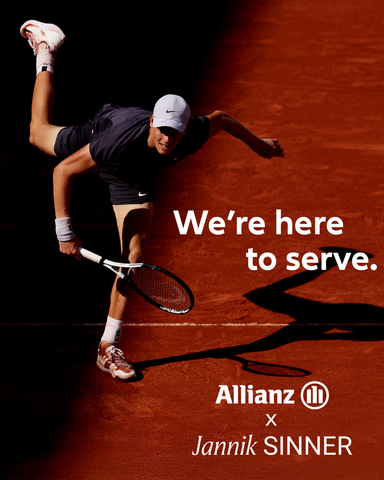
At the heart of the partnership between the world’s most valuable insurance brand and the current No. 2 ATP tennis player Sinner, are joint values and a mutual belief in resilience and excellence – the ability to perform consistently at the highest level through disciplined preparation, mental strength, and a strong team. These principles are central to Sinner’s sports mindset and align with Allianz’s dedication to supporting people and organizations through defining moments, securing their future and building confidence in tomorrow.
Jannik Sinner said: “I am delighted to announce this partnership with Allianz. Over the years I have learned that success in sport, as in life, is forged through resilience, preparation, and the willingness to push yourself beyond your comfort zone. A strong team drives every achievement – they push and support me, working hard day after day in order to improve both on and off the court. I know Allianz shares that vision, and I look forward to building a collaboration with them, especially through the partnership with my Foundation.”
Oliver Bäte, Chief Executive Officer of Allianz SE, said: “At Allianz, trust is at the heart of our mission to empower individuals and organizations for a brighter future. We’re thrilled to partner with Jannik, whose values of authenticity, resilience, and excellence mirror our own. This collaboration enhances our established sports partnerships and underscores our dedication to nurturing the potential of the next generation, empowering children and youth to face a changing world with confidence and optimism. Together, we build a future grounded in trust and shared success.”
Giacomo Campora, Allianz Italy’s CEO, commented: “Allianz Italy is proud to support an extraordinary Italian champion like Jannik Sinner. He is worldwide appreciated not only as an athlete, but as a role model of sportsmanship, simplicity, style, and determination to achieve his goals. The constant pursuit of excellence to which Jannik aspires is the same that drives the people at Allianz in their daily work. Today we begin this journey alongside him, aiming to grow together with him.”
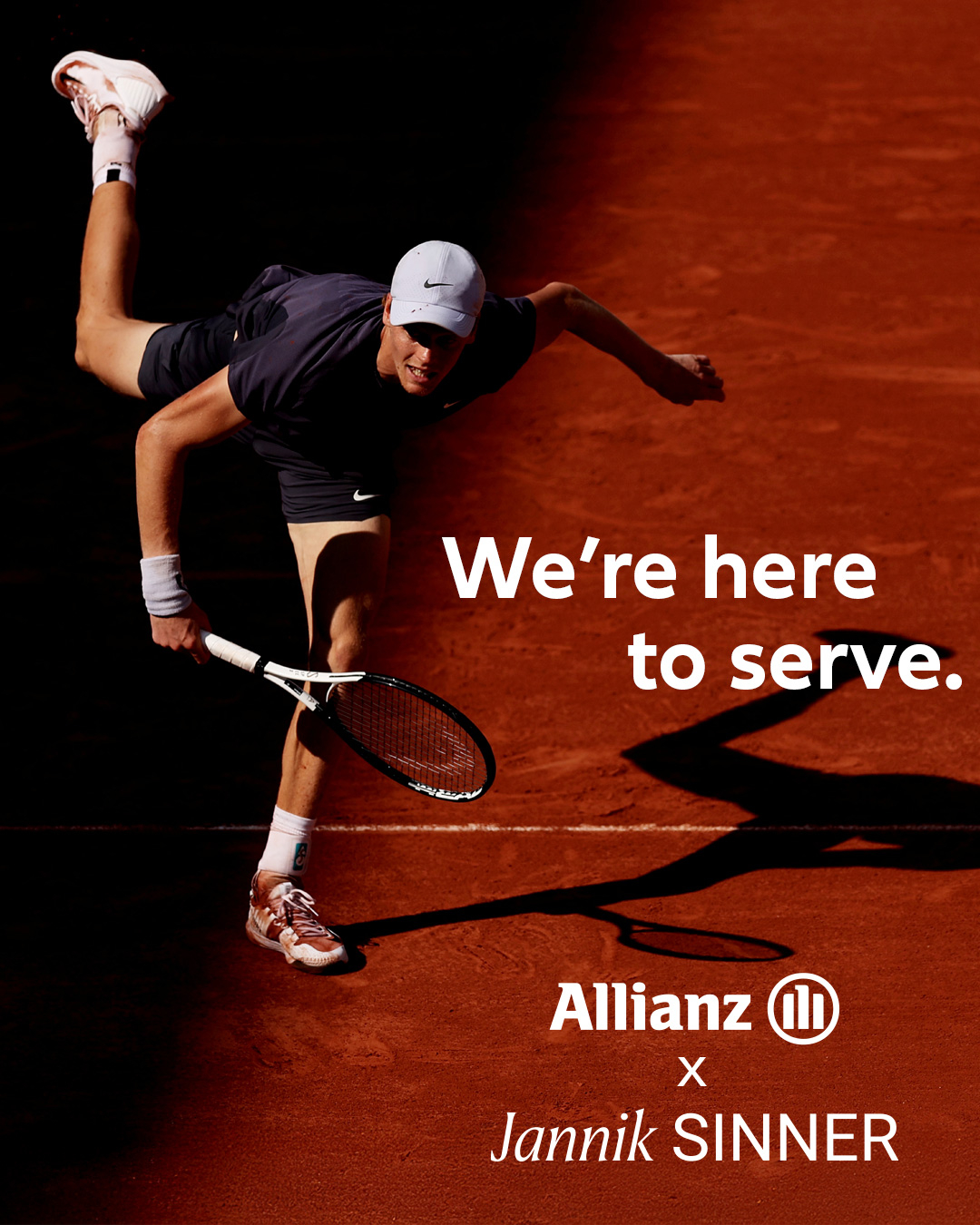
The tagline “We’re here to serve” encapsulates the unified spirit and values of Allianz and Jannik Sinner. This message will be prominently showcased in campaigns with Sinner as the Allianz Global Brand Ambassador, reaching customers, employees, distribution partners, and fans worldwide. The collaboration also extends to Allianz’s support for The Jannik Sinner Foundation, promoting programs that leverage education and sport to empower children to explore the world and their place within it.
Allianz boosts Sinner’s portfolio of global partners, which includes brands such as Rolex, Nike, Gucci, Lavazza, and Explora Journeys. Sinner enters 2026 on the back of a standout 2025 season in which he won six titles including the Australian Open, Wimbledon, and the ATP Finals, while reaching the finals of all four Grand Slam tournaments.
Allianz’s sport partnerships
Allianz has been a partner of the Olympic and Paralympic Movements since 2021 and will continue until 2032, playing a key role as the The Official Insurer for the upcoming Milano Cortina 2026 Olympic and Paralympic Winter Games. For more than 25 years, Allianz has partnered with FC Bayern München and also collaborates with hundreds of local sports clubs and associations in its national markets. As part of its Power of Unity positioning and program, Allianz believes in the power of sports to unite millions of athletes and fans in peaceful competitions and to transcend social and cultural barriers, which is ever more important in an increasingly divided and polarized world.
Further links |
About the Jannik Sinner Foundation
Founded in 2025, the Jannik Sinner Foundation believes that education and sport can transform a child’s life. Inspired by the people and opportunities that shaped Jannik Sinner’s own journey, the Foundation partners with trusted global and local organizations to remove barriers and provide children worldwide with access to education and sport.
It supports educational programs and sports initiatives that foster personal growth and empower children to thrive mentally and physically, helping them reach their full potential while embracing healthy, active lifestyles.
For more information, visit: www.janniksinnerfoundation.org.
About Allianz
The Allianz Group is one of the world’s leading insurers and asset managers serving private and corporate customers in nearly 70 countries. Allianz customers benefit from a broad range of personal and corporate insurance services, ranging from property, life and health insurance to assistance services to credit insurance and global business insurance. Allianz is one of the world’s largest investors, managing around 761 billion euros* on behalf of its insurance customers. Furthermore, our asset managers PIMCO and Allianz Global Investors manage about 1.9 trillion euros* of third-party assets. Thanks to our systematic integration of ecological and social criteria in our business processes and investment decisions, we are among the leaders in the insurance industry in the Dow Jones Sustainability Index. In 2024, over 156,000 employees achieved total business volume of 179.8 billion euros and an operating profit of 16.0 billion euros for the Group.
*As of September 30, 2025.
Mandatory corporate information: Corporate disclosures
These assessments are, as always, subject to the disclaimer provided below.
Cautionary note regarding forward-looking statements
This document includes forward-looking statements, such as prospects or expectations, that are based on management’s current views and assumptions and subject to known and unknown risks and uncertainties. Actual results, performance figures, or events may differ significantly from those expressed or implied in such forward-looking statements.
Deviations may arise due to changes in factors including, but not limited to, the following: (i) the general economic and competitive situation in the Allianz’s core business and core markets, (ii) the performance of financial markets (in particular market volatility, liquidity, and credit events), (iii) adverse publicity, regulatory actions or litigation with respect to the Allianz Group, other well-known companies and the financial services industry generally, (iv) the frequency and severity of insured loss events, including those resulting from natural catastrophes, and the development of loss expenses, (v) mortality and morbidity levels and trends, (vi) persistency levels, (vii) the extent of credit defaults, (viii) interest rate levels, (ix) currency exchange rates, most notably the EUR/USD exchange rate, (x) changes in laws and regulations, including tax regulations, (xi) the impact of acquisitions including related integration issues and reorganization measures, and (xii) the general competitive conditions that, in each individual case, apply at a local, regional, national, and/or global level. Many of these changes can be exacerbated by terrorist activities.
No duty to update
Allianz assumes no obligation to update any information or forward-looking statement contained herein, save for any information we are required to disclose by law.
Privacy Note
Allianz SE is committed to protecting your personal data. Find out more in our privacy statement.
View source version on businesswire.com: https://www.businesswire.com/news/home/20260129184263/en/
Contact
For further information about Allianz please contact:
Lauren Day
Tel. +49 89 3800 3345
E-Mail: lauren.day@allianz.com
Florian Amberg
Tel. +49 89 3800 15924
E-Mail: florian.amberg@allianz.com
Heidi Polke
Tel. +49 89 3800 90777
E-Mail: heidi.polke@allianz.com
For further information about Jannik Sinner please contact:
Fabienne Benoit
E-Mail: press@avima.com
Sam Postlethwaite
E-Mail: sam.postlethwaite@edelman.com
Ben Machon
E-Mail: ben.machon@assemblyinc.com

The Capitalist: Pub landlord swaps pints for paint in fight against Labour
A pub landlord gets creative, Linkedin tells us their secrets and a new sewer-side spot; catch up with the latest gossip in The Capitalist
‘SOUR TASTE NOT FROM MY BEER’
The hospitality backlash against last year’s Budget is far from reaching last orders as one artist and pub landlord converts his boozer into an art gallery in protest. Birmingham-based artist and landlord of the 19th-century pub The Gunmakers Arms, Mason Newman, has completed a series of satirical caricatures of Sir Keir Starmer.
Along with decorating his pub with the artistic critiques, Newman, who has already barred the Prime Minister and his Chancellor from the venue, is also introducing a new house beer named ‘Pinokeir’. The self-described “poor man’s Andy Warhol”, who’s previously worked with Ozzy Osbourne and Madonna, says publicans have been “pushed to breaking point”.
“A £1,600 saving spread over several years barely touches the sides… There’s been plenty of talk about support, but very little that actually makes a difference, and trust me, that sour taste isn’t coming from my beer.”
Political satire fans can find a wider news-agenda-focused exhibition series from Newman, launching at the Indelible Fine Art Gallery in Brighton.

HOW TO BECOME A LINKEDINFLUENCER
Linkedin popped over this week to give The Capitalist a lesson in etiquette. How to make a post go viral? Certainly not by sharing one of those notorious rags-to-riches tales popular on the platform, the website’s editors told us: instead, Linkedin favours detail-led posts that offer genuine insight rather than sensationalism. Oh, and you’re best to post yours on a Tuesday or a Thursday for maximum engagement.
Fascinatingly, editors from the platform also revealed that, unlike rival platform X, users tend to be well-behaved, rather than sharing dodgy conspiracy theories, because – shock, horror – their bosses are watching. While we’ve got you, did you know that 20 years ago we set up City AM on laptops based out of our living rooms, and now we’re a global brand? No? Well read on: here are our secrets to success…
A SIT BY A SEWER
If it ain’t broke, don’t fix it. That’s normally a good rule to go by, but nobody told the designer of the benches installed on a new public embankment near Blackfriars. The Bazalgette Embankment is not a cheery place, festooned as it is with drab installations and large black slabs, but the benches have got people talking. How to describe them? A few years ago when AI video was in its infancy, users were tickled by the results of requests to ‘show Will Smith eating pasta’ – and these benches look like that; benchy elements but totally distorted. Appropriately for a s**t bench, the site sits on top of a new sewage system. Don’t all rush there at once.
BROOKLYN TOASTS ESTRANGEMENT
Brooklyn Beckham and his wife Nicola Peltz are entitled to some R&R amid their brutal family feud, and it seems that they’re finding comfort in life’s finer things, specifically a £17,000 bottle of 1831 Château d’Yquem which the pair were papped swilling on a recent date night. Not that The Capitalist is jealous, but we do feel that this particular wine should be accompanied by something a little smarter than a t-shirt and baseball cap. Come on Brooklyn, dress for the occasion – and send us the receipt for Bill of the Week.