‘Terrifying’: Iran threatens $200 oil price if US-Israel strikes continue

A spokesman for the Iranian military has given a chilling warning that the cost of a barrel of oil could rocket to $200 if the war with Israel and the US continues.
The price of oil has continued to surge amid escalating tensions in the Middle East, which have triggered strikes on production sites and disrupted key shipping routes.
On Monday, a spokesman of Iran’s military’s joint command was quoted on the nation’s state broadcaster saying: “If you can tolerate oil prices above $200 per barrel, continue this game.”
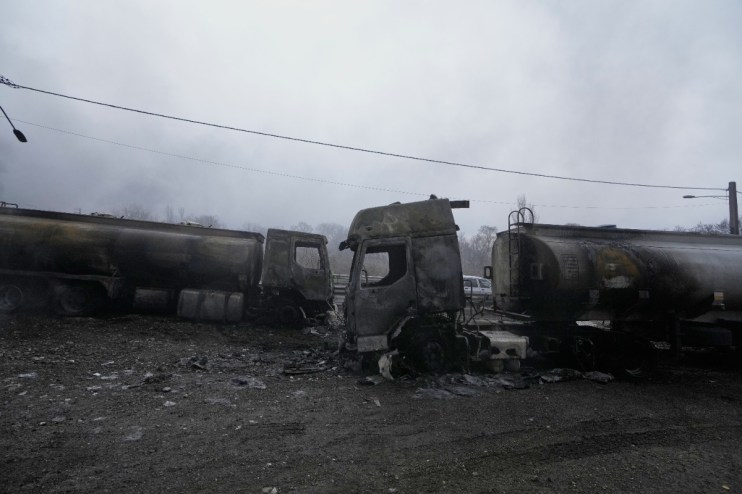
The remarks, as reported by the Wall Street Journal, comes after Israel launched strikes on a oil resources in Tehran, forcing the nation to slash its fuel allowance to motorists.
Oil has also been hit by the near closure of the Strait of Hormuz, through which a fifth of the world’s supply flows. Bloomberg reported on Monday a Greek ship carrying millions of barrels of crude had made it through the narrow waterway on Monday with its signal off, marking the first big tanker to leave the Persian Gulf since the disruption.
Domino effect
Brent crude, the international benchmark for oil, surged over 20 per cent to highs of $114 per barrel this morning – marking the commodity’s biggest one-day gain in six years. Prices have later given up some gains but held steady in triple digits.
The gains have fanned the flames of inflation fears, with markets tumbling and global economies bracing for interest rates to remain elevated.
Despite the market frenzy, President Donald Trump had doubled down on the war, this morning stating soaring prices were a “small price to pay for world safety and peace”.
Michael Every, an analyst at Rabobank, said: “The longer this goes on, the more exponential the damage becomes in a domino effect.
“If we are still in the same position this time next week, things could be quite terrifying.”
Oil could stay in triple digits ‘throughout 2026’
Analysts at Capital Economics have warned a longer conflict could have “lasting damage to Gulf energy structure”.
They said disruptions via the Strait of Hormuz along with more damaging attacks on the region’s energy infrastructure could result in the loss of around eight per cent of global annual exports of crude and liquified natural gas in 2026 and the impact “would probably continue into 2027 too”.
“Oil prices would probably stay in triple-digits throughout 2026” in the event of a prolonged conflict, analysts said. The analysts’ other scenarios include a relatively swift end to the conflict and a prolonged conflict that fails to inflict lasting damage on energy infrastructure.
On Friday, the White House sparked some hope of reprieve in the market by floating the idea of intervening in the market to cap rocketing prices but has yet to introduce any formal plan.
G7 finance ministers – including Chancellor Rachel Reeves – scrambled for an emergency meeting on Monday to discuss a possible joint release of petroleum from reserves coordinated by the International Energy Agency.
But France has poured cold water on the idea, with the nation’s finance minister Roland Lescure stating the G7 was “not there yet” on using reserves to ease the impact of the conflict, according to Bloomberg.
Paul Diggle, chief economist at Aberdeen, said: “Even after the further rise in oil prices today, we continue to warn that the oil price impact of the conflict is a non-linear function of its duration. So, there may potentially be further moves higher, before the eventual decline.
“We think $120 per barrel is easily in reach. If prices do then fall back, the global economic cycle would have a more stagflationary feel but wouldn’t be fundamentally derailed. “