Alex Dilling: Mastering the art of French cooking

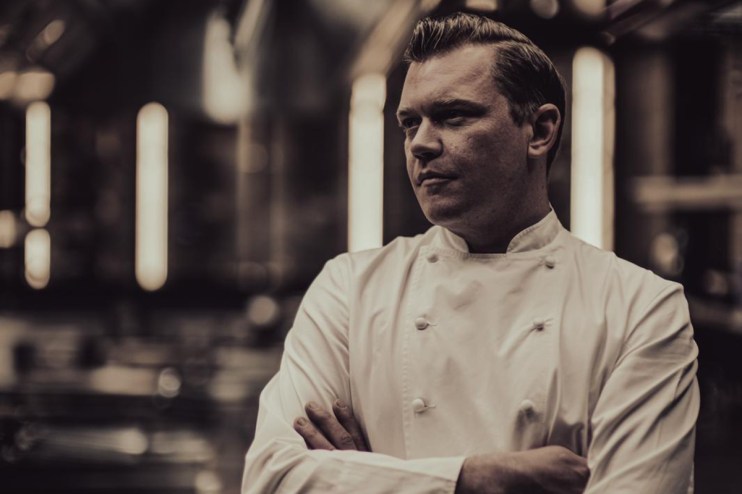
After honing his craft under two titans of French cooking, Alex Dilling now presides over one of London’s most refined dining rooms. His double Michelin-starred restaurant at Hotel Café Royal is a masterclass in modern haute cuisine, writes Carys Sharkey.
As a teenager in sunny, expansive California, Alex Dilling thought he’d be a punk rocker, or maybe a skateboarder. The American dream for a kid of 14. But decades later, the would-be rockstar is cooking some of the finest French food in the heart of well-heeled London. A lot then has changed.
Dilling may have a broad, west coast drawl and a sincere affability that feels profoundly American, but his career has a distinctly francophone sweep. The half-British half-American chef trained at Westminster College in London, but his career was moulded by two French titans. He started out under Alain Ducasse in New York before working with Hélène Darroze in London and Paris. In 2022, he struck out on his own with Alex Dilling at Hotel Café Royal on Regent Street. Within six months of opening, the restaurant was awarded two Michelin stars. Fast work for a lifetime mastering the art of French cooking.
“It’s a very modern and loose interpretation of French food,” Dilling tells me. Cooking with a “French accent”.
And nowhere is that accent more Gallic, more Gauloise-thickened than with his sauces, which are glossy and unctuous and lip-coating. It’s futile even trying to take decent photos of Dilling’s dishes. The sauces reflect too much light, rays bouncing off polished slicks.
Which is a shame, because Dilling’s food is some of the most aesthetically outrageous in the capital.
Dilling is understated when I ask him about his reputation for creating stunning, jewel-like dishes. “Every chef you know tries to make their food look nice”. After all, people like “pretty things”.
Caviar, cuttlefish and confetti
When I visit the 34-cover restaurant, which is swaddled in cream and beige plump curves and framed by a mirrored ceiling, one table has brought a ring light to better capture the food with. After all, the camera eats first. But beyond some very photogenic food is some very impressive cooking.
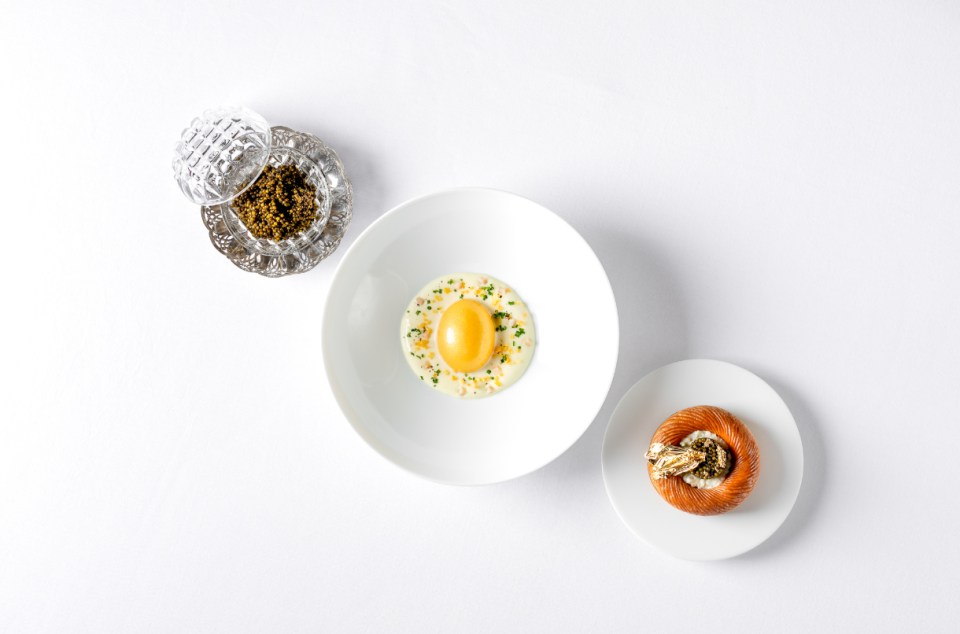
A dish of sweet crab is served in a caviar tin, topped with whipped cauliflower and confetti. Eaten with a little muffin and a little pearl spoon, it’s a playful delight. Another dish of brill comes draped in a lacy cuttlefish mourning shroud perched in a Basque-chorizo sauce. It’s an almost ridiculous display of technical skill. Even the humble bread course boasts a perfectly moulded block of butter. School-bus yellow on a silver dish on a thick tablecloth. It’s fine dining no doubt, but it never takes itself too seriously.
And when I meet the open and friendly Dilling, that makes total sense. After cooking at the highest echelons of haute-cuisine, it dawned on him that having a good time is actually pretty important.
“I think that more and more, and without pretension, it’s trying to get everyone to chill out a bit and realise everyone’s here to have fun. And the little cherry on top should be just absolutely delicious food that doesn’t challenge people too much, but stimulates them, excites them, and that they enjoy eating and looking at it”.
“When it all boils down to it, it shouldn’t be such a complex thing to run a great restaurant”, he adds – half-joking, half deadly-serious.
This ethos is wrung-out from years of experience. Before opening his eponymous restaurant, Dilling was head chef at the now-closed The Greenhouse in Mayfair. The vibe was not to everyone’s taste. In a review of the restaurant in 2018, Sunday Times food critic Marina O’Loughlin called The Greenhouse “cooking for dick swingers and strange, badgery awards people”, but conceded that most of what she disliked about the place wasn’t necessarily the “talented” Dilling’s fault. With his own venture, he seems less interested in ‘dick swinging’ flourishes.
The cooking is hours of meticulous technique disguised as merely “a sauce and a thing”. It’s maximalism masquerading as minimalism in the kitchen.
“It’s a direction I seem to be going in more and more over the years. I like it when you have a really complex plate of food, but you don’t have to confuse your palate or your mind with thinking about all the things on the plate. For me, it’s almost a no-brainer way to eat in a restaurant like this.”
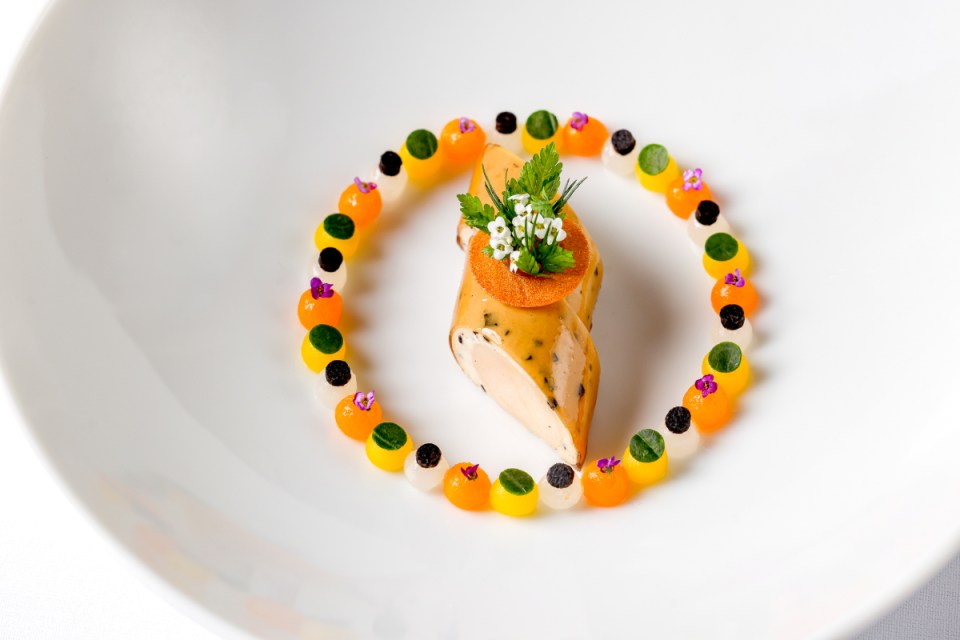
For Dilling, the exemplar dish of this philosophy is his hunter’s chicken.
A corn-fed chicken from south of France, wrapped in mushroom duxelle, chicken mousse with smoked Alsace bacon, caramelised and glazed in chicken jus with lemon thyme and bee pollen. Served with an albufera sauce enriched with foie gras.
Chicken, mushroom, bacon. Simple, elaborate, extraordinary.
It’s also a dish Dilling has a love-hate relationship with – he’s wary of monotony but unable to take it off the menu without backlash. Guests expect the greatest hits. He shrugs, “people dig it”.
The dish is also rooted in Dilling’s total infatuation with homely, French cooking. The sort of hearty poulet chasseur you’d find in bistros across France. If his love for cooking budded in San Francisco, cooking with his mum and grandfather, “spending hours labouring away making homemade pastas”, then it blossomed in Paris.
“I go to Paris all the time. I’m usually not seeking out three star Michelin places. I’m seeking out the restaurant that’s been there for hundreds of years, that serves the best blanquette de veau and just going to have a slice of foie gras with toast. And I adore that. I do think one day, that’s the kind of food I’ll probably end up cooking, because I love it so much, and I think there’s so much romance and history”.
Back in London, as waning spring bleeds into summer, he talks excitedly about how the menu will change with the seasons. How the best produce in the country will wind its way from every corner of the UK to Regent Street. For now, he’s got sweetbreads on his mind.
“I adore sweetbreads because they’re crispy, they’re soft, and they’re not funky, and anyway, they’re just a really beautiful thing.”
But until then, there is still work to be done, and Dilling has his sights set on those elusive three stars. So how do you join the exclusive club of six triple-starred London restaurants that counts his mentors Ducasse and Darroze among their ranks?
“I mean striving for excellence and just making small improvements every day. You know, we got two stars in four or five months or whatever. So we can’t be that far away.”