Forget France and Germany – why Spain is ideal for a river cruise

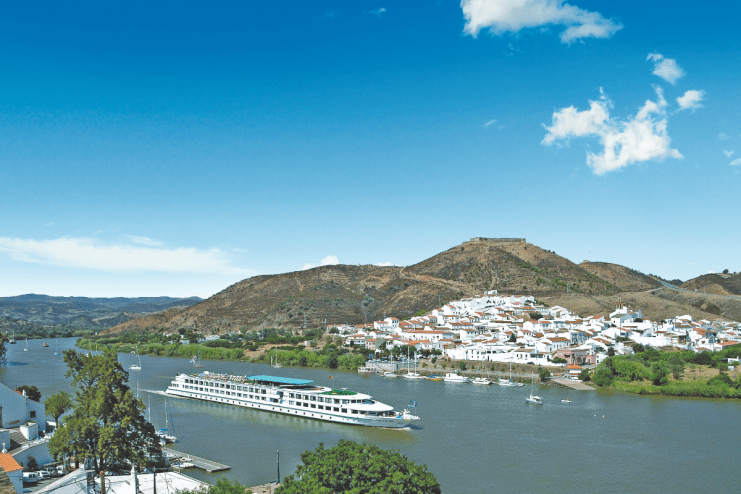
Elevate your European river cruise by taking the waterways to Spain
I must admit I hadn’t read through the full itinerary of the last day of our Croisi river cruise. So, it was a revelation coming face to face with three life size replicas of the ships that took Christopher Colombus to the New World.
We were at the Wharf of the Caravels (Muelle de las Carabelas), just over an hour’s drive south of Seville where we went aboard the Niña, the Pinta, and the Santa María. It seemed almost unimaginable how, in 1492 these small vessels left this tiny harbour, travelled to the Americas and returned with almost all the crew alive.
This was just one of many absorbing tours of our seven day cruise with Croisi, the largest river cruising company in France. As European river cruising is usually associated with France, the Rhine or the Danube, a visit to Andalusia seemed different, made possible because the Guadalquivir is one of the few navigable rivers in Spain. It was also good that it was not the height of summer, when it would have been just too hot.
So, we flew to Saville to board MS La Belle de Cadix (176 passengers; 39 crew) small, yet sturdy enough to navigate both a river and ocean. Unlike the typical Mediterranean cruises, this was quieter, more intimate and to my mind more in tune with how people want to travel now. The makeup of the passengers was mostly French speaking with just 30 English speakers. Enough so that we had our own guide and coach for our group tours.
A quieter way to see Spain
We traced a route that once carried explorers and traders between Spain and the wider world through regions famed for flamenco, fiestas, and grand Moorish architecture. The cabins may be small and the ship comfortable – rather than luxurious – but all the excursions, bar the one to Granada, were included in the competitive price, and each tasty French meal was served with top wine pairings, at no extra cost (all drinks except spirits) plus there is always a cocktail of the day.
There’s no need to plan, or queue on board, owing to an efficient waiter service in the dining room. Our original booking form asked for dietary requirements, and this is then adhered to, so there is no paper menu. This eliminates the food waste found in bigger boats. The French food was amazingly good both in taste and appearance, including the fabulous paella on our special Spanish evening. I also noticed an absence of plastics.
In our cabin there was a glass bottle which could be refilled in one of the ship’s water stations. I asked our Croation captain Timur Butkovic about his favourite aspect of the boat. “Croisi is a family owned company, and we are very much a crew family too. We all try to help each other. There is a comradeship on the La Belle de Cadix that I haven’t seen elsewhere. I know this personally, because previously I’ve worked for bigger cruising lines”.
Seville was both the beginning and the final destination, and the boat was small enough to dock just a short walk from the city centre. Our English speaking guide took us past the numerous tapas bars and coffee shops through to the old Jewish Quarter, where the whitewashed houses press close and the bougainvillea spills over iron balconies, making it possible to conjure images of the city’s interesting but chequered history. Then a visit to Seville’s cathedral where we were taken aback by its size and opulence.
A reminder of the country’s more ornate past
It is the third largest in the world, and is full of gold and silver ornaments and detailing. Situated close to the main door is the tomb of Christopher Columbus, featuring four statues representing the heads of the Spanish kingdoms of the time, Castile, León, Aragon, and Navarra. Two of them crestfallen and looking down, as they didn’t invest in the project. While showing us the tomb, Lola, our guide said “Columbus’ body has been moved so many times I think he has covered more miles after his death than when he was alive” From there, the scale shifted.
The Royal Alcázar — still in use by the Spanish royal family — is a reminder of Andalusia’s more ornate past. Its intricate tilework and carved stucco reflects centuries of Islamic and Christian influence. It’s also quite a business to get in. The showing of passports and tickets takes up quite a lot of time. Nearby is the huge tobacco factory, now part of Seville university, built in the 18th century because Spain held a monopoly on tobacco commerce with the Americas. It was the largest industrial building in Europe at the time and processed imported tobacco leaves into snuff and later, cigarettes, employing mainly women.
The most famous was Carmen, who had an opera named after her, and much celebrated by her contemporaries because she could roll the cigars between her thighs! My own favourite place was the iconic Plaza de España in the Parque de María Luisa built in 1928 for the Ibero-American Exposition of 1929. The layout is magnificent and the detail of the tiles just makes it a wonderful place to wander around and take in its vibrant atmosphere. We saw a bride and groom taking what has to be one of the smallest trips on water possible, on the tiny lake but it did look romantic and Instagram-able.
On another day we took a two hour coach journey from Seville to Córdoba. Its shaded courtyards, orange blossom and history layered over centuries endeared it to us immediately, but the standout, inevitably, is the Mezquita-Catedral de Córdoba. Here forest-like rows of red-and-white arches give way, almost improbably, to a Renaissance cathedral at its heart — a visual reminder of the city’s complex past. The journey down towards Jerez and then Cádiz introduces a different landscape altogether.
The Guadalquivir widens, the banks flatten, and the sense of being in ‘tourist Spain’ recedes, although we did of course have a wonderful and inevitable sherry tasting at the Osborne wine cellar. Cádiz itself, one of Europe’s oldest continuously inhabited cities, offers a contrast again. Sea air, and a slightly faded grandeur, much of it stemming from the fact it is the home of the Spanish navy and the port boomed in the 16th-century as a base for exploration and trade. Towards the end of my week, I tried to summarise the advantages of the boat.
Travel can feel logistically exhausting — flights delayed, cities overcrowded, tickets pre- booked weeks in advance, the simplicity of this cruise is the appeal. You unpack once, and the rest comes to you. It’s also about access. Andalusia’s great sights — Seville, Córdoba, Granada — are no secret, but by linking them via the river and coach, and pairing them with less obvious stops, the journey offers a broader and more authentic experience of southern Spain.
In a travel landscape that often prizes speed, there’s a lot to be said for slowing down — and for letting a place reveal itself gradually.
Book a river cruise in Spain
A six-day Andalusia cruise on the Guadalquivir costs from £1,139 per person. Next departure November 2026. Price includes all meals and drinks, excursions, Flamenco evening and port fees. Croisi also offers full ship charters.
Go to croisieurope.co.uk
Read more: Forget Seville, Cordoba is the real jewel of Southern Spain