End of Trump’s state visit is no time for Britain to relax

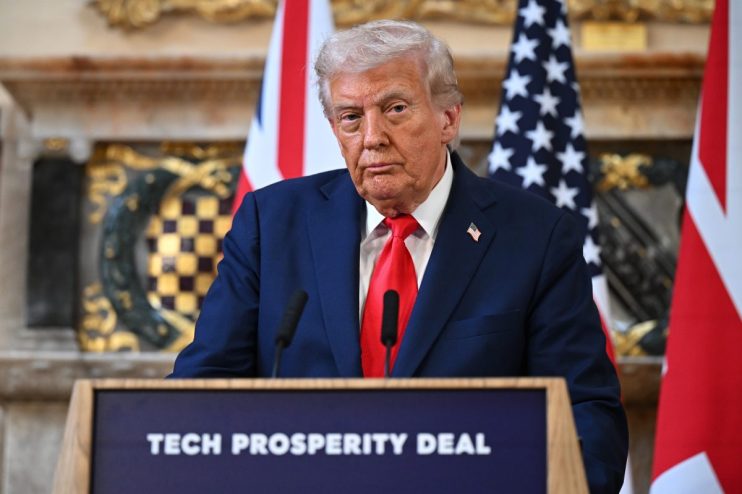
Donald Trump’s state seemed a success and brought inward investment with it, but steel tariffs are still on the table and political chaos reigns at home, says Eliot Wilson
The Eagle has flown. President Donald Trump undertook his unprecedented second state visit to the United Kingdom last week – unprecedented for a US president, anyway, though seven other heads of state have done the double. Now that the adrenaline rush has passed and the panstick has faded, we can look back at what happened.
There were no disasters. That may seem a low bar, but when dealing with an American administration as volatile and unpredictable as this, it cannot be taken for granted. As when Sir Keir Starmer visited the Oval Office in February, it is no small thing to have walked away without a profound clash of interests or a shouting match.
In economic and trade terms, where sentiment and ambition have to be translated into pounds and dollars, there was much positive news
In economic and trade terms, where sentiment and ambition have to be translated into pounds and dollars, there was much positive news. Alternative investment management heavyweight Blackstone Inc. will spend £100bn in the UK over the next decade, including building a £10bn data centre in Blyth in Northumberland, where the government has established an “AI Growth Zone”. Nvidia will roll out 120,000 processors, its largest commitment in Europe.
As part of the new “US-UK Tech Prosperity Deal”, which encompasses artificial intelligence, quantum computing and advanced nuclear energy, Microsoft will dedicate £22bn to AI infrastructure and build the UK’s biggest supercomputer; Google has pledged £5bn over two years on research and a new data centre in Hertfordshire; Salesforce will invest £1.4bn in a European AI hub; and there will be £1bn for computing capacity from AI Pathfinder.
Elsewhere, Peter Thiel’s Palantir Technologies will invest £1.5bn in return for a £750m software contract with the Ministry of Defence. San Francisco-based property firm Prologis is putting £3.9bn into life sciences and advanced manufacturing. There was no hiding ministers’ glee at the sheer weight of promised investment.
It is the kind of good news the government has so sorely lacked of late, and it should be welcomed. Jensen Huang, Nvidia’s president and CEO, was prevailed on to say that “the United Kingdom stands in a Goldilocks position, where world-class talent, research and industry converge”; Sam Altman, CEO of OpenAI, the developer of ChatGPT, praised “a government that quickly recognised the potential of this technology”.
Does US investment mean British jobs?
Cautionary notes have to be sounded. Most obviously, while this cascade of investment will support British jobs and is a positive step on that basis, it is overwhelmingly coming from US companies. Certainly, there will be a cumulative effect and the commitment by major American players should fuel the development of homegrown capabilities in areas like AI and quantum computing. But we also need to look ahead and try to discern the next step.
The UK has struggled to nurture homegrown companies. Recently strategist and Hampleton Partners MD Jonathan Simnett voiced concern at “the trend of tech firms going private due to AIM’s high costs, low liquidity and impaired ability to raise capital”. While an influx of transatlantic investment is undoubtedly beneficial, it is not clear whether it will do anything to address fundamental weaknesses in the UK economy.
There is also the unspoken element of trade, the dog that has not barked in the night. Although the US and the UK reached agreement on a range of tariffs in the summer, it was widely hoped that Trump’s state visit would see a deal to eliminate the 25 per cent tariff applied to British steel exports to the US. Although other countries face a 50 per cent rate, senior industry figures described the 25 per cent levy as “devastating” when it was imposed. But it seems that any further reduction or removal is not currently on the table. As the government wrestles with the future of Britain’s steel industry, this is undoubtedly a blow.
Where are we overall? By his own lights, President Trump seemed to enjoy his visit, and he remains dazzled by the panoply of royalty and ceremonial. Hefty inward investment has emerged from the event, though some of the timescales are long. The UK’s relationship with Washington remains better than those enjoyed by many other countries.
With Donald Trump, however, only a fool makes firm predictions. The Prime Minister will be turning his mind to his choice of ambassador after Lord Mandelson’s self-immolation, but for the government, and for British business, it will be a long and tense three-and-a-half years until the end of Trump’s term. No-one can relax. Every day brings new challenges.
Eliot Wilson is a writer