DakaDaka review: The comfort food we all need right now

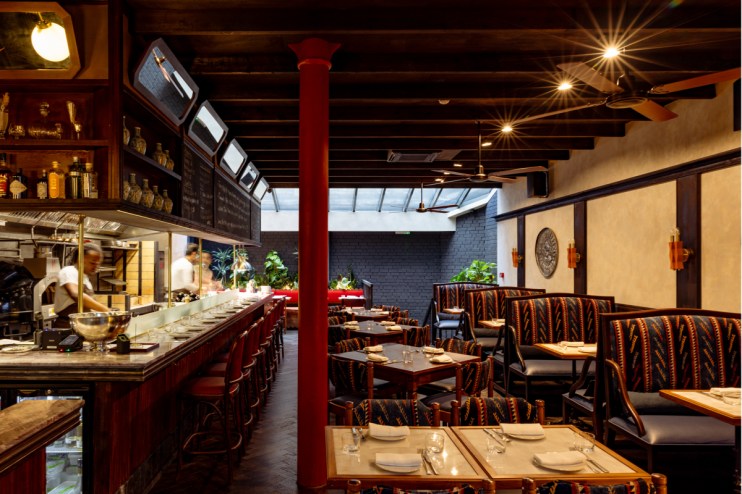
DakaDaka, 10 Heddon Street, W1B 4BX | Nearest Tube: Piccadilly Circus
Heddon Street has developed its own culinary microclimate. Whether by luck or design, it has become a place where you can almost guarantee a decent plate of food, with its current crop of restaurants including Sabor (superlative Spanish), Fonda (respectable Mexican) and Casa do Frango (very good Portuguese).
The new kid on this (literal) block is DakaDaka, which promises to address the relative paucity of Georgian restaurants in the capital. This is welcome news indeed. Every now and then, a nation’s cuisine threatens to have a break-out moment – a few years ago it was Peruvian – and in these times of global strife, perhaps the dumplings and cheesy bread of Georgia is the comfort food we need to take the edge off it all.
As I take a seat with a view of the open kitchen, I’m struck by a blurry sense of deja vu. I have, at some point, been quite drunk in this room. It takes me a moment to work out when: it was the first home of Fallow, which has since moved to its massive space on Haymarket, where it now serves some 5,000 covers a week. I once sat in this exact spot drinking bloody marys with founder and fellow Toast the City judge James Robson. Good times. Probably.
DakaDaka has picked up where Fallow left off (I’m sure something else has been here in-between but damned if I know what): on a Friday evening it’s packed with pretty people drinking pretty cocktails. The name DakaDaka apparently refers to the percussive rhythm of a leisurely supra, the word for a traditional Georgian feast, and that energy is certainty on display this evening.
The restaurant – relatively small at just north of 100 covers – already feels lived-in despite only opening at the end of last year. It’s decked out in dark wood and funky upholstery that I’m sure has some deep and meaningful connection to The Motherland (like many small nations with large, greedy neighbours, Georgia places a huge significance on things like fabrics).

The soundtrack of jazzy house music does not particularly evoke the dumpling emporiums of Tbilisi but I suppose it beats a soundtrack of traditional Georgian polyphonic singing (which may have Unesco Intangible Cultural Heritage status but is not really conducive to lively conversation).
The menu is like most menus in the second quarter of the first century of the second millennium: it’s essentially impossible to know how much to order from the various sections. I’m not sure how “snacks” differ from “small plates” or why bread features in three different sections or whether a skewer constitutes a main course or not. Never mind: the staff are brilliant and I end up only over-ordering by a dish or two, which is about as good an outcome as you can hope.
First up was soko: oyster mushrooms fried in a tempura-style batter, the initial crunch giving way to a deep, oily umami. Despite being a “snack” and only costing £6.50, it’s a massive portion. Top marks. Chvishtari is cornbread (two pieces about the size of croquetas) stuffed with cheese that hails not from the eastern extremities of Europe but the rolling countryside of Somerset. “This is my favourite thing on the menu,” gushes my waiter. I can see why.
Next was a bowl of Lobio, a Georgian take on hummus made with kidney beans, which I scooped up with kubdari (pork-stuffed flatbread) and honestly this is the good stuff, creamy and filling and indulgent but clearly made by someone who knows exactly what they’re doing.
And then there are the famous khinkali. I was forewarned that these dumplings are not an exact analogue of those you’ll find in Georgia, which are as big as your fist. At DakaDaka they’re scaled down to a little bigger than a Chinese har gow. They’re designed to be picked up by the twisted ‘nipple’ at the top and bitten in such a way as to catch the liquid contained within, although in a moment of madness I ordered the mushroom filling instead of pork, which means you miss out on that meaty broth. While the diminutive size is a little disappointing, the craftsmanship is not.

After all of this, ordering an entire plaice was probably overkill but it’s impressive nonetheless, perfectly cooked, the skin as salty as the sea from whence it was dragged, its eyeball glistening in the light, waiting to be plucked and sucked.
It’s virtually obligatory to wash everything down with a bottle or two of Georgian wine, which any bore will tell you is among the oldest wine traditions in the world, dating back some 8,000 years and using buried earthenware pots called qvevri. The wave of orange wine that took London by storm seems to have (thankfully) crested but at least the Georgians can say they were doing it eight millennia before it was cool. There’s a wide selection, running the gamut from pale, dry and refreshing to deep-amber and full-bodied.
I rounded things off with a ramekin of red wine ice cream – excellent, no notes – and a shot of chacha. The last time I drank this brandy-like spirit I ended up stumbling through the streets of Tbilisi in a merry fug, although this variety is marginally less caustic.
DakaDaka fits seamlessly into the Heddon Street ecosystem. It leaves you with the impression that it’s always been here, comfortably coexisting alongside the likes of Sabor and Fonda and perhaps even Fallow. And that is praise indeed.