Australian Open’s One Point Slam shows that merit still makes the best stories

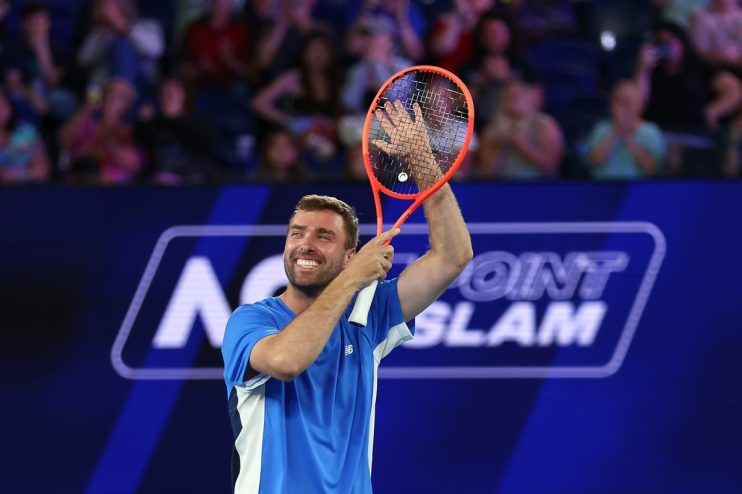
The Australian Open officially got under way this week, but the most talked-about moment of the year’s opening tennis slam may already be behind us.
Before a ball had been struck in the main draw, a little-known tennis coach from Sydney, Jordan Smith, walked away with A$1m after winning the One Point Slam — a made-for-entertainment tournament featuring a mix of professionals, celebrities and personalities.
Along the way, Smith beat some big names, including world No2 and defending Australian Open champion Jannik Sinner.
On the surface, it looked like another example of sport drifting further into spectacle. A punchy prize fund and a format that creates ready-to-post clips on socials.
But the success of the One Point Slam raises an interesting question at an interesting time. Where, exactly, is the line between sport and entertainment now? And does it even matter?
Over the past decade, the worlds of sporting competition, content creation and celebrity culture have steadily converged.
Athletes are influencers, influencers are athletes, and sporting stories are often consumed through documentaries, social feeds and Hollywood films rather than live broadcasts. In this landscape, performance is no longer the only currency that counts.
That shift puts pressure on one of sport’s oldest principles: merit. Traditional sporting competition is built on a simple Darwinian system. The fastest runner wins. The most skilful team lifts the trophy.
It doesn’t always work out like that of course. On any given day any result is possible, but over time the averages aggregate and the best rise to the top. These meritocratic pyramids give sport its credibility and, crucially, its plotlines.
Today, that model is being challenged. Like actors who are being cast because of their social following, athletes are building profiles on influence not competitive success.
One Point Slam produced a story the old way
Boxing offers the clearest example. Social media stars such as the Paul brothers have secured headline fights because of their views on YouTube, not points earned in the ring.
These bouts are often dismissed as novelty acts, closer to WWE than world title boxing — but the underlying logic is spreading.
Influencer-led football tournaments like Kings League and Baller League are built around personalities rather than qualification. In individual sports, content creators in golf, skiing and cycling have built careers without ever competing at the sport’s elite level.
Even more traditional pathways are loosening. LIV Golf operates as an invitational tour, while Formula 1 has long made room for drivers whose commercial value outweighs their results.
This reflects a broader reality that visibility, narrative and audience reach now sit alongside — and sometimes ahead of — competitive performance.
Which is why the One Point Slam is so interesting. Because despite being designed as a spectacle, its most compelling moment was not a celebrity cameo or a viral clip. It was Jordan Smith winning.
Smith wasn’t invited to the Australian Open because of a following. He wasn’t a known personality. He qualified. He earned his place by winning his state championship and, once on court, he simply won points.
His post-match interviews were nervy and unpolished — as you’d expect from someone not trained for television — but they were charming as a result. Over the course of an evening, sport did what it has always done best: it created a story rather than casting one.
In a matter of hours, Smith went from anonymous coach to global talking point. Not because he was entertaining off the court, but because he was effective on it. Competitive systems produce personalities organically, through pressure, performance and consequence.
As sport continues to experiment with new formats and hybrid models — and it should — events like the One Point Slam show that innovation and merit don’t have to be opposites. You can invite the world in, bend the rules and chase new audiences.
But the moment that truly cuts through is still the same one it has always been: someone earning their place and winning when it matters.
You can manufacture characters. Or you can let competition discover them for you.
Matt Readman is chief strategy officer at sports creative agency Dark Horses.