Arcadia at the Old Vic is a brilliant farewell to Tom Stoppard

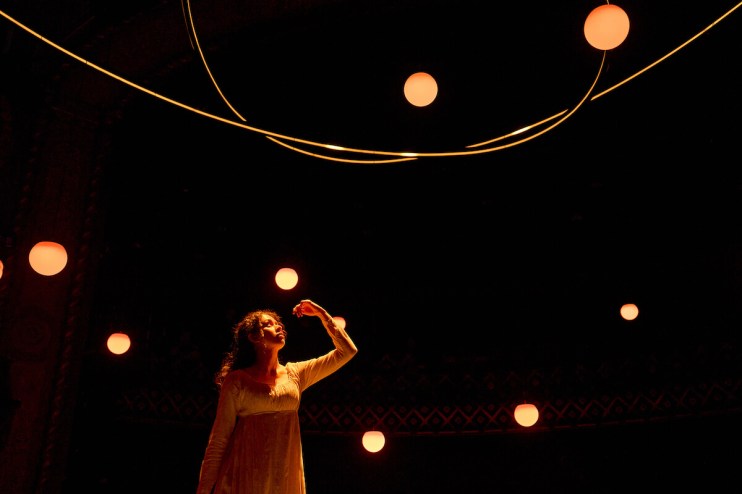
Arcadia | Old Vic | ★★★★☆
Arcadia is a dizzying piece of work, as broad as the universe and as self-contained as a jigsaw puzzle. Through it Tom Stoppard addresses some of humanity’s great questions: do we have free will? Is poetry more important than science? Is there anyone Lord Byron didn’t shag?
It opens in the Sidley Park country estate sometime in the early 19th century, with 13-year-old aristocrat Thomasina Coverly receiving a lecture from her dashing young tutor Septimus Hodge, a friend of Lord Byron, who in absentia casts a long shadow over Stoppard’s play. ‘Precocious’ doesn’t do Thomasina justice – she’s a maths protege who shows a grasp of concepts including the second law of thermodynamics, which hasn’t even been discovered yet.
The early scenes have an Oscar Wilde-ish flavour: “Do you think God was a Newtonian?” asks Thomasina. “An Etonian? Almost certainly I’m afraid,” replies Septimus.
The action then spins into the present day, where a gaggle of academics scour the estate for nuggets that might lead to their next big discovery. Hannah Jarvis is determined to find the identity of the “Sidley Park Hermit,” who she says symbolises the death of romanticism. The oily Bernard Nightingale wants to prove that Lord Byron fled the country after killing a man in a duel. Valentine Coverly thinks the key to his predictive algorithm lies somewhere in the estate’s old shooting journals.
And so we go back and forth through time, the stage spinning – the Old Vic is set up in the round – like the workings of a clock or the heavenly bodies above, neatly reflecting the play’s interest in time and space and everything within it.
Thomasina reasons that if we were able to produce an algorithm complex enough – perhaps as large as the universe itself – we would be able to predict everything that would ever happen, stumbling upon the theory of determinism, which has troubled philosophers since time immemorial (the subject of my undergrad thesis, incidentally). Perhaps it’s the idiosyncrasy and chaos of human desire that throws a spanner into this great, predictable machine, she muses.
If this all sounds a little dry and academic, it’s given life by a cast who really capture the sense of wide-eyed wonder at the heart of Stoppard’s masterpiece. Isis Hainsworth is especially good as Thomasina, whose impetuousness is always endearing and never grating, while Seamus Dillane brings a vulpine elegance to Septimus. The actors in the present-day sections of the play are given a rather harder task, lacking the best lines and often burdened with explaining the more complex concepts; Angus Cooper is worthy of particular praise for bringing a sense of contemplative melancholy to mathematician Valentine.
Arcadia is a play about what makes us human – about the desire to understand life’s great mysteries, desire among them. Whether approaching this through imperfect maths, history, art or emotion, it’s the striving that’s important, the passing of knowledge to the next generation, allowing them to run where you have walked. In light of Stoppard’s death last year, this message feels especially poignant.