20 years on from 7/7 London proves terrorists will never win

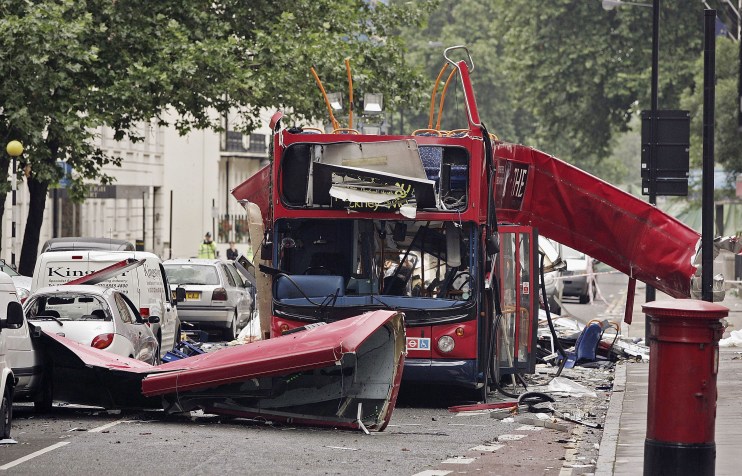
20 years ago today, 52 people died in a devastating series of bombings on London’s transport infrastructure. Throughout the following decades and subsequent attacks, London has remained undaunted, says Eliot Wilson
It was 8.49 am on Thursday 7 July 2005. The weather was unremarkable, edging towards 15℃, the skies partly cloudy. None of that was visible from the Tube, where, within 50 seconds, three suicide bombers detonated their devices: on the Circle Line, eastbound between Liverpool Street and Aldgate; on another Circle Line train which had just left Edgware Road for Paddington; and on the Piccadilly Line service southbound from King’s Cross St Pancras to Russell Square.
Just under an hour later, a number 30 double-decker bus, travelling from Marble Arch to Hackney Wick, exploded in Tavistock Square at 9.47am. If anyone had doubted it before – initially the explosions on the Underground were attributed to power surges – there was no longer any question: London was under attack.
The four suicide bombers, whose names I will not record here, had travelled to Luton by car that morning, catching a train to London and arriving at King’s Cross at around 8.30am. Three would be dead within half an hour, the fourth within 90 minutes. But 52 innocent civilians would also be killed, while nearly 800 others were injured. Some of the injuries were horrific, life-changing. There were 18 different nationalities numbered among the dead.
With the exception of the bombing of Pan Am Flight 103 over Lockerbie in December 1988, 7/7 – the numbers soon became an unmistakeable shorthand – was the deadliest terrorist atrocity the United Kingdom had ever seen. It remains so.
Britain’s first Islamic terror attack
It was also, though this is hard now to believe, the first instance of Islamist terrorism in Britain: two of the bombers made recordings before their deaths in which al-Qa’eda was praised as were Osama bin Laden, at that time still at large in Afghanistan or Pakistan, and his chief henchmen. The usual grievances were rolled out: support for the United States and Israel, the wars in Afghanistan and Iraq, a supposed crusade against Islam. All Britons were held responsible because we had voted for a government complicit in these actions (the general election had seen Labour win a third term just over two months previously).
It was a profoundly shocking day. It made everyone understand, even if they had already accepted this intellectually, that in the eyes of violent radical Islamism, there were no civilians, no innocent casualties, no “collateral damage”. The bombings were designed to kill as many people as possible and to fulfil the basic remit of terrorism: to spread terror. The identities of the dead, whether from Afghanistan, Grenada, Vietnam or Poland, were immaterial. For the bombers, they had meaning only in death.
That day made everyone understand that in the eyes of violent radical Islamism, there were no civilians, no innocent casualties, no “collateral damage”.
London was hardly a stranger to terrorism. The Provisional IRA had carried out its first attacks in the capital in March 1973, detonating two car bombs and injuring nearly 250 people. After that there were bombs at King’s Cross, Euston, Westminster, the Tower of London, the Hilton Hotel, Green Park Tube station, Cannon Street, West Ham station… Margaret Thatcher’s close ally Airey Neave had been assassinated by the INLA in the car park of the Palace of Westminster in March 1979, and three years later 11 soldiers were killed by explosions in Hyde Park and Regent’s Park. In 1992, the Baltic Exchange building in the City had been bombed, killing three people and causing £800m worth of damage.
Londoners remain undaunted
That London would be a target for Islamist terrorism was also no surprise. In a sense, it had been expected, inevitably and fatalistically, since 11 September 2001, when airliners in a cloudless New York sky had been weaponised, the Twin Towers had fallen and the world had changed.
It was shocking, partly because of the quotidian surroundings in which such a violent death had come to so many: we have all been on crowded Tube trains, crammed into buses, felt the press of fellow passengers. For a while that was overlaid by fear: was that rucksack too large, too prominent, was its bearer nervous or agitated? Perhaps there is a spirit of light-heartedness that has gone, or is now more fragile.
In truth, though, Londoners are resilient. They have had to be. We have taken the blows, and every blow since, on Westminster Bridge in 2017, on London Bridge in 2019, and elsewhere, and we have kept going. The threat of terrorism, not from a political group with specific demands, like the IRA, but from theocratic murderers for whom our existence is grievance enough, is now part of our world.
Twenty years on from the London bombings, we owe thanks to the security services for the hundreds of lives which have been saved in nameless foiled terror plots, and we pay tribute to those who lost their lives or paid a terrible price on 7/7. But terrorism cannot win unless we allow it to. We carry on, cautious, wary but undaunted in our everyday lives: it is what the bombers would hate most. Any other response is unthinkable.
Eliot Wilson is a writer and contributing editor at Defence on the Brink