Tracey Emin at the Tate Modern review – raw, real and radical

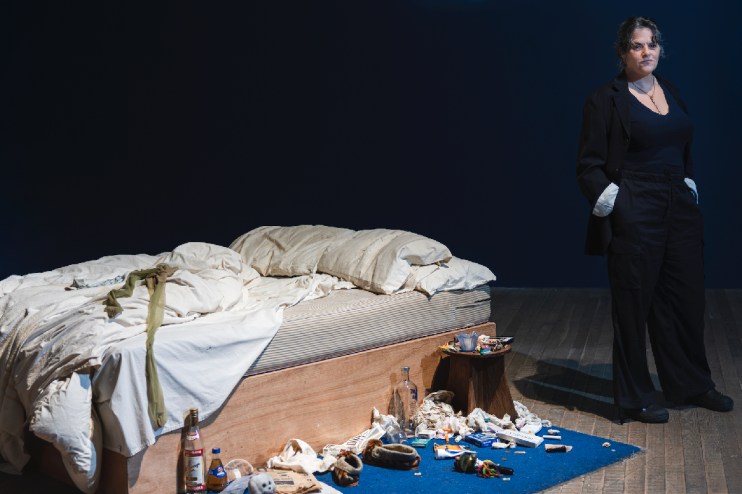
Tracey Emin: A Second Life | Tate Modern | ★★★★☆
When Damien Hirst’s major retrospective rolled into the Tate Modern all the way back in 2012, it came with a sense of celebration. The multi-millionnaire artist who put British art back on the map had returned with a willy-waving exhibition of his greatest hits. The Shark! The polka dots! And the piece-de-resistance, his famous diamond-encrusted skull – entitled For the Love of God – which took pride of place in the centre of the Turbine Hall.
Fellow Young British Artist Tracey Emin’s retrospective is a very different beast: quieter and more reverential, her tapestries and paintings and bronzes spotlighted against deep blue walls. I wonder if there were any discussions about putting Emin’s My Bed – a piece of work every bit as iconic as Hirst’s skull – in the Turbine Hall?
Emin’s body of work – much of it concerned with her body – is so raw and personal that Second Life feels less a retrospective of the art than it is a retrospective of the artist. Displayed in roughly chronological order, it begins with her short film Why I Never Became a Dancer (1995), which recalls her ditching school at 13-years-old, spending her days drinking cider on Margate beach, and having sex with men more than a decade her senior.
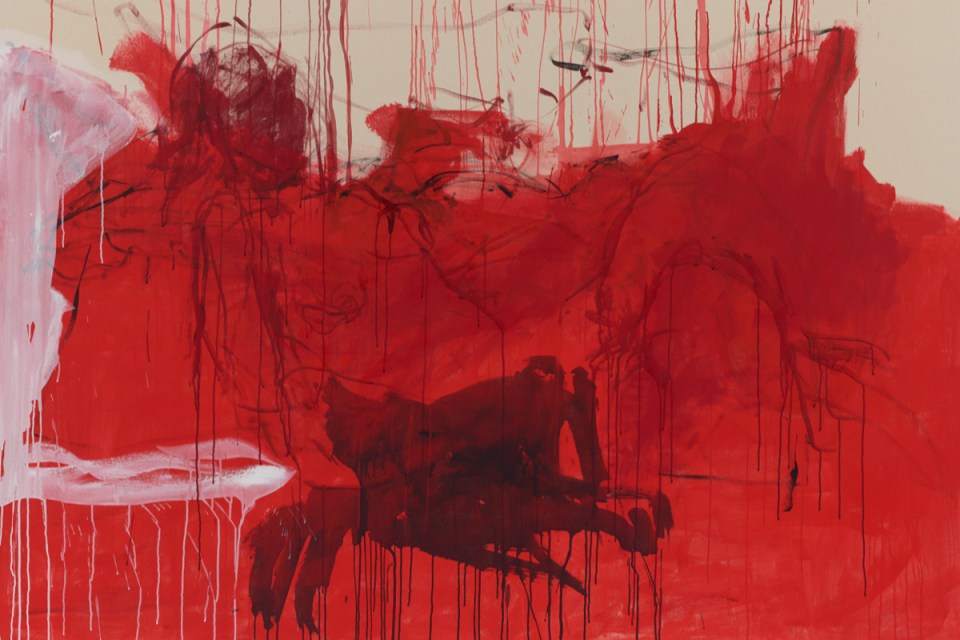
We read framed, diary-esque notes about her mother’s sexually inappropriate boyfriend, her desire to escape the confines – and the traumas – of Margate, her eventual escape to London. Then we arrive at what one curator referred to as the “abortion rooms”, filled with the art Emin made in the wake of a pregnancy termination whose complications were almost fatal (she notes that she had two abortions, one that almost killed her and one that saved her life).
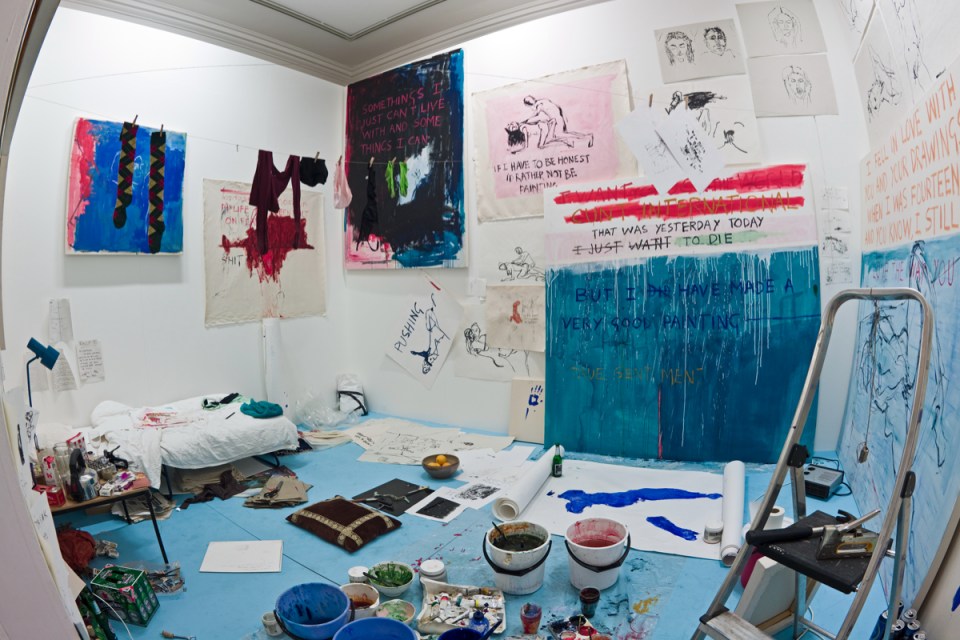
In this section there’s a giant tapestry filled with advice about unwanted pregnancies, including the best ways to find a 24-hour chemist; there are sketches of Emin spreadeagled on a hospital bed; there is a painstaking recreation of the box-room in which she locked herself while she attempted to overcome the post-pregnancy nausea brought on by the smell of turps and oil paints (she stayed in this room for three weeks, working naked and sleeping on a camp bed, creating some of the most striking paintings of her career).
Tracey Emin: A Second Life
Next comes what you could call her illness years – hence the title Second Life – when Emin underwent a cystectomy and hysterectomy following bladder cancer. There is a corridor filled with extremely graphic photographs of her recovery: blood dripping from the open wound in her abdomen, balls of bloodied tissues, insides on the outside. Opposite are a row of never-before-seen polaroids of the artist as a younger woman, sexy selfies with flashes of hips and breasts. Life comes at you fast.
Her most famous, infamous work, My Bed, feels a little adrift after all this, wrenched from the chronology of her life (perhaps a logistical rather than artistic decision). It’s an installation that’s been discussed, parodied and aped so many times for so many years that it’s been stripped of much of its power. That stained mattress and half-drunk bottle of Stoli and the discarded condoms have become a kind of shorthand for Tracey Emin’s work, lauded or derided depending on your point of view.
More interesting is what follows, a room in which Emin directly confronts death. There are a series of large-scale paintings, the most technically accomplished of her career, in which she grapples with mortality. In one piece a black figure stands over a prone, nude woman. In another Emin carries her mother’s ashes. In the centre of the room is a “death mask” of her face cast in bronze, on loan from the National Portrait Gallery, her face tiny and vulnerable in the vastness of the gallery. It gives the impression this is all taking place after Emin’s death, a complete oeuvre of interlinked work about what it means to pilot a human body, a thing that desires and is desired, and which is slowly, inexorably dying.
Any exhibition of Emin’s work comes with an inevitable wave of misogyny-flecked feedback from armchair critics. My teenage son could have made that! My toddler could have done this! My cat could do better! But your son/toddler/cat didn’t make some of the most recognisable, confrontational, important work of the last 40 years. Tracey Emin did.
This exhibition may have the reverential trappings of gallery curation but beneath the surface is the snarling tenacity of a woman who refuses to be shamed for the trauma she bears and refuses to apologise for being human.