The £1bn company with no staff? Why AI is a gift to Britain’s small businesses

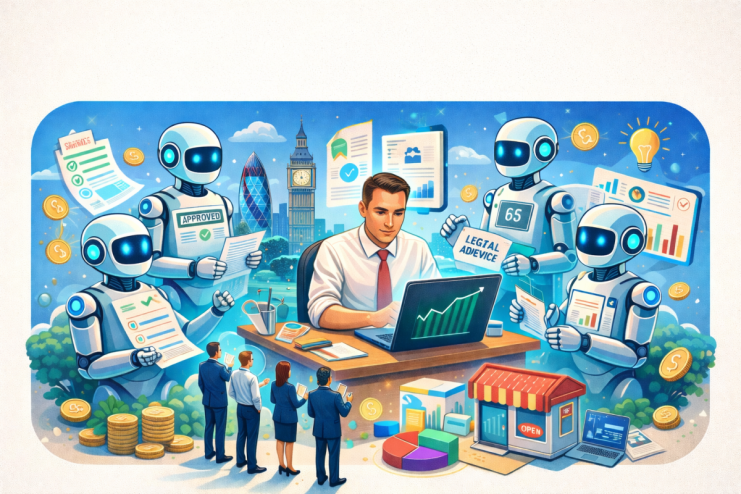
With branding built on Canva, market research synthesised in seconds or client decks as slick as McKinsey’s, could we say now that for the first time, a five-person firm can present like a 50-person one, and potentially undercut and outmanoeuvre larger rivals? Asks Eliza Filby
In Silicon Valley, investors are salivating at the thought of the first billion-dollar company with no employees. No HR department. No middle management. No office politics. Just a founder, a laptop and an army of AI agents.
For years we’ve measured a firm’s health by headcount or revenue per employee. No more. It sounds dystopian and not without consequences, as recent unemployment figures suggest. And yet for the UK’s small businesses, which employ more than 60 per cent of the workforce, AI integration could be the productivity boost the economy needs.
For decades Britain has had low productivity but high employment. As economist Gerard Lyons puts it, when faced with a choice between investing in productivity or hiring more labour, Britain’s business owners have always chosen cheap labour. That calculus is now shifting because of two factors: the government has made hiring more expensive and AI has become cheap, accessible and exponentially better.
I’m not naive about its limits, both ethically and creatively. I’ve seen AI used badly. And, it has to be said, mostly in large corporations which are grappling with regulation, security and shadow use by juniors and recalcitrance by elders; integration feels like turning round an oil tanker. Meanwhile, I’m seeing small firms using it impressively; building second brains, bespoke GPTs and agentic tools. In co-working spaces filled with micro-businesses (firms with fewer than ten staff) I see seamless adoption and workers rewarded for deploying it well. This is where some of the best young talent is learning. They have a natural advantage; they are agile, have fewer legacy systems and can experiment without layers of approval.
This matters uniquely to Britain (unlike the US) because we are a land of small businesses. We are not short of entrepreneurs, but we are short of capital to scale. Britain too has long had a thriving consultant class, but many independent contractors have felt squeezed in recent years with tighter compliance and shrinking corporate budgets. On the upside, done the right way and in the right hands, AI can enhance the type of expertise and micro-businesses Britain is good at building: small, personality-led firms combining deep human experience with AI-powered adoption.
Disruptors are already here
We are already seeing the disruptors. In law, Garfield AI – founded by a City lawyer and a quantum physicist – is delivering legal services at scale through software. In consultancy and accountancy, former PwC and EY leaders have launched Unity Advisory, an AI-led alternative to legacy firms with lower overheads but similar professional reach. In advertising, former WPP-star, Ajaz Ahmed has launched his independent Studio.One to challenge the traditional agency model.
Disruption is nothing new; there’s always been breakaways from big business. But what is striking is both the change in tech and structure. These are lean organisations designed to stay lean, and potentially not with the same need or desire to scale employees or even to be bought by bloated conglomerates that can’t keep up with the pace of change.
But the real gain may be with Britain’s micro-businesses. Firms with fewer than ten employees which account for roughly a quarter of private sector employment in the UK. There are also 4.4m self-employed people – ‘solopreneurs’ – who have the capacity to take advantage. For decades these businesses or individuals relied on agencies, consultants and outsourced services to access capabilities they could not afford in-house. Overheads were often swallowed by outsourcing or hiring. Limited polish restricted their capacity to win big contracts.
With branding built on Canva, market research synthesised in seconds or client decks as slick as McKinsey’s, could we say now that for the first time, a five-person firm can present like a 50-person one, and potentially undercut and outmanoeuvre larger rivals?
And yes, of course, it is important to admit that this advantage mostly favours those who already possess expertise in something people will buy. But knowledge work is fragmenting and what people and companies will buy is changing. Instead of vast pyramids of associates billing by the hour, we are seeing clusters of specialists; hyper-networked, digitally amplified, operating with minimal fixed costs but also in a range of different things. Who could have predicted that a menopause spokesperson or a podcast expert had a viable business model five years ago? And who’s to say they will in five years’ time?But people buy people and, as Daniel Priestley argues, social media is amplifying this shift. Personality-led businesses travel further. Clients increasingly buy trust, insight and narrative rather than faceless institutions. The broader point is simple: headcount is no longer destiny. The billion-dollar company with no employees may or may not materialise. But the five-person firm competing with the Big Four? That is already here. For Britain’s small businesses, this may be the most exciting moment in a generation. Small could potentially be beautiful in the age of AI.
Dr Eliza Filby is a historian of generations and author of the Sunday Times bestseller Inheritocracy