Thailand sets sights on £2.3bn exhibition growth with design-led economic pivot

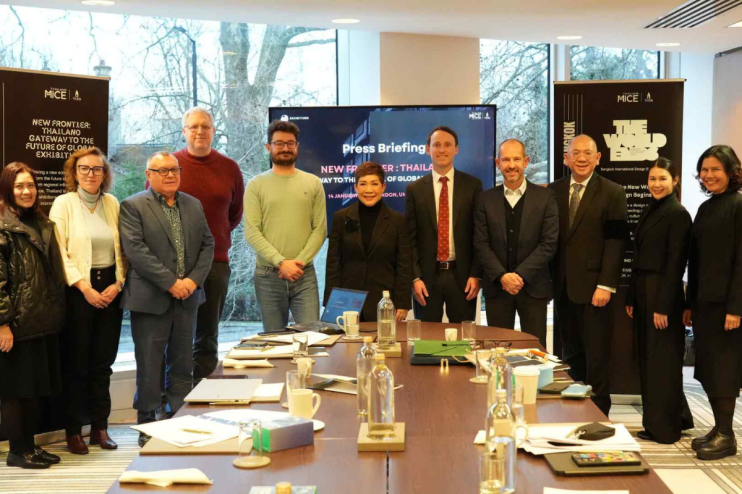
Thailand’s business events strategy targets higher-value trade, FDI and global capital flows
Thailand is repositioning itself as a serious player in the global exhibition economy, having unveiled a strategy in London that seeks to move the country beyond traditional trade events and into higher-value, design-led international platforms.
At a briefing hosted by the Thailand Convention and Exhibition Bureau (TCEB) on 14 January, officials outlined a plan to elevate Bangkok from regional host to global exhibition hub – integrating infrastructure, industrial policy and creative economy growth.
Thailand already ranks among Asia’s leading exhibition destinations, hosting 509 domestic and international exhibitions in 2025, attracting 23.6 million participants and generating approximately $2.9bn (£2.3bn) in exhibition-related revenue. With the largest exhibition venue capacity in ASEAN and the fourth largest in Asia, the country is now shifting its focus from scale to value.
“We are evolving from transactions to value creation,” said Dr Supawan Teerarat, President of TCEB. “Creativity allows industries to move up the value chain.”
From tourism to “Return on Experience”

Central to the strategy is what TCEB describes as a pivot from mass tourism towards high-value business travel – and from simple return on investment (ROI) to “Return on Experience” (ROE).
Business visitors already outspend leisure tourists significantly. According to figures shared at the London briefing, conference visitors can spend up to fourteen times more when long-term commercial relationships are factored in. The argument is straightforward: exhibitions do not simply drive hotel occupancy, they catalyse supply-chain partnerships, foreign direct investment and manufacturing expansion.
Thailand is also targeting growth in “bleisure” – the extension of business trips into longer stays – which increases per-visitor spend across hospitality, retail and wellness sectors. For a country where tourism accounts for a significant share of GDP, this diversification into higher-margin business travel is positioned as a strategic hedge against cyclical leisure demand.
Design as industrial strategy

At the centre of the new push is The World Ends, a Bangkok International Design Expo scheduled for November 2026. Far from a conventional trade fair, the event is designed as a cross-sector platform linking design with manufacturing, energy, mobility and medical innovation.
Thailand’s creative economy is already valued at $44.5bn, contributing more than eight per cent of national GDP. The bureau’s thesis is that embedding design into established industrial sectors – from electric vehicles to medical technologies – will “premiumise” exports and increase global competitiveness.
The model mirrors strategies seen in Northern Italy and parts of South Korea, where design capability has been systematically integrated into advanced manufacturing. For Thailand, it signals an ambition to move beyond contract production towards higher-margin, IP-driven growth.
Energy, geopolitics and national capability
The London delegation also highlighted Thailand’s role as host of Gastech 2026, positioning the country as a strategic platform for global energy dialogue. Described by organisers as the “Davos of the energy sector,” the expo is expected to attract 50,000 attendees and 30 government energy ministers.
The event will occupy 75,000 square metres at the Bangkok International Trade & Exhibition Centre (BITEC), underscoring the country’s logistical capacity to host large-scale industrial summits . According to organisers, proactive involvement from Thailand’s Ministry of Energy – including direct ministerial engagement – has set a new benchmark for host government cooperation.
In a fragmented geopolitical climate, Thailand is also positioning itself as a neutral gateway. The country maintains visa-free entry for 93 countries and visa-on-arrival access for more than 30 others. For global organisers navigating increasingly restrictive visa regimes elsewhere, accessibility has become a competitive advantage.
Sustainability tied to financial support
Environmental performance is being integrated into the commercial framework. TCEB has set a target to reduce carbon emissions from the events industry by 20,000 tonnes of CO₂ equivalent by 2030.
Financial and logistical support will increasingly be linked to carbon measurement and reduction requirements. Organisers will be encouraged – and in some cases required – to track emissions through a dedicated “Zero Carbon” application and footprint calculator.
For institutional investors and multinational exhibitors facing ESG scrutiny, the move signals that sustainability in Thailand’s exhibition sector is shifting from voluntary initiative to structured governance.
A 2026 inflection point
The message delivered in London was clear: Thailand does not see exhibitions as peripheral to economic strategy. Instead, they are being framed as instruments of industrial policy – platforms that attract capital, accelerate supply-chain integration and reposition national branding.
Bangkok’s inclusion in UNESCO’s Creative Cities Network as a City of Design provides cultural capital. Large-scale energy summits demonstrate industrial credibility. The new design expo aims to bridge the two.
For UK investors, organisers and corporates assessing Asian market exposure, Thailand is positioning itself not simply as a destination, but as a platform – one designed to capture higher-value trade in a more fragmented global economy.
As 2026 approaches, Thailand is betting that the future of exhibitions lies not in footfall alone, but in influence, capital flow and intellectual property.
For more information visit www.businesseventsthailand.com