Rugby resists modern marketing but Les Bleus have created a blueprint

The sport of rugby union can be confusing. I don’t mean the rules – although they are part of the problem – but more how a sport can both thrive and struggle to survive almost simultaneously.
Nowhere has this been more evident than in the 2026 men’s Six Nations. It was a tournament many claim to be the greatest ever, with record scorelines and viewing figures.
Yet in between matches we saw documentaries about player welfare and stories about the commercial struggles of the domestic game.
In this cloud of uncertainty, rugby’s bright future can be found under the light shows of the Stade de France.
French rugby has known its own crises, but right now it looks in a completely different league, on the pitch and off it. In France, rugby does not feel like a sport in retreat. It feels like a sport discovering itself.
Marketing sport in the modern world is not complicated. I’m not saying it’s easy; but it is simple.
Make stars. Not just excellent players, but figures who command attention beyond the pitch. Build spectacle – give people a reason to watch that extends beyond the scoreboard.
Prioritise skill, creativity and flair on the field. Let athletes express themselves. Tell stories that invite supporters closer. And cross borders into music, entertainment and fashion.
Yet rugby has been slow to become the showman it needs to be. There is something in the sport’s DNA that resists these marketing codes.
Rugby has always preferred the collective to the individual, the system to the flourish. It distrusts the raised arm, the knowing grin, the hint of theatre.
Personality, in this ecosystem, can feel like a transgression. Just look at the polarisation caused by rising England star Henry Pollock to see how the sport is torn on what it wants to be.
Even its attempts at modernisation have carried a certain reluctance. The Netflix series Six Nations: Full Contact was meant to be rugby’s Drive To Survive moment.
Instead, it often felt like knocking on a door that was only ever half-open. Access was limited, candour rationed. The stories never quite felt real.
Dupont and Bielle-Biarrey give France X factor
Which is what makes France so compelling – because French rugby feels free to take the best of modern sport and apply it to the game with the same improvisation and creative disorder you see on the pitch.
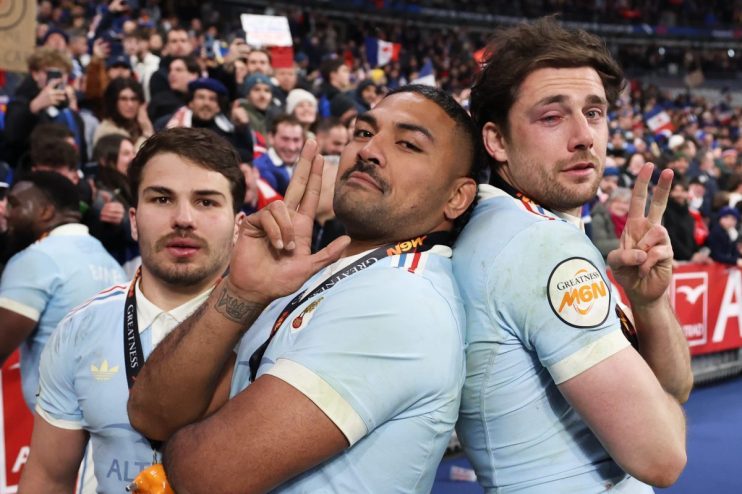
Yes, they are naturally blessed with superstars like Antoine Dupont and Louis Bielle-Biarrey who genuinely have the gravitational pull to bring in wider sports fans, but they set them up and set them free to be the individual icons the sport needs.
Matchday in Paris has become an almost comical act of theatrical staging, with literal galloping horses in the build-up rivalling the great American football stadium shows of the US.
But their latest foray, into the world of fashion, is the most encouraging of all. Their 120th anniversary ‘Le Crunch’ limited edition kit sold out in hours, not just among French rugby supporters but sports fans around the world. It’s a tactic taken straight from the playbook of Paris Saint-Germain and other major European football clubs.
And the response has been emphatic. Television audiences for the national side increasingly rival those of football in France, a notion that would have felt implausible not long ago.
Beneath that, the domestic structure easily supports two professional leagues whereas many nations can produce just two professional clubs.
Former Scotland player Jim Hamilton this week once again iterated his frustration that rugby has fallen so far behind other sports in how it promotes itself.
Well, Les Bleus have created the blueprint, tested in Paris and visible to anyone willing to look: celebrate your stars, invest in the spectacle, tell better stories and meet audiences where they already are.
Matt Readman is chief strategy officer at sports creative agency Dark Horses.