Hong Kong Racing Chief warns of industry at a crossroads

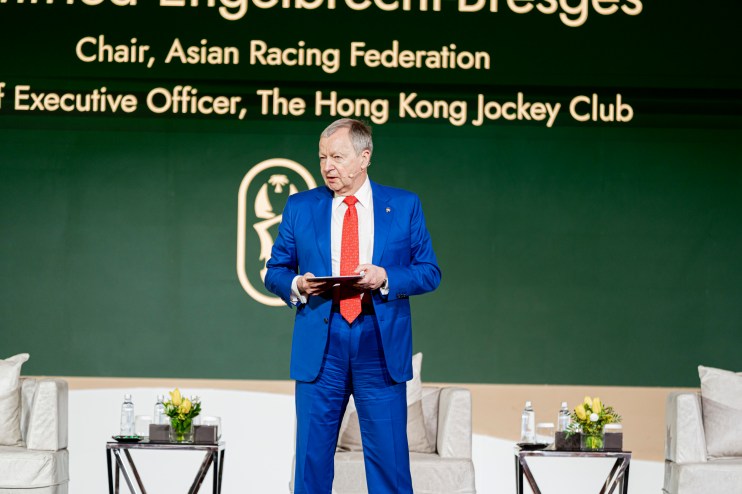
MAJOR challenges for the racing industry and betting companies were highlighted as global leaders gathered at the 41st Asian Racing Conference (ARC) in Riyadh this week.
Front and centre was Winfried Engelbrecht-Bresges, Chief Executive of the Hong Kong Jockey Club (HKJC) and Chair of the Asian Racing Federation (ARF).
In his opening address as ARF Chair, a position he has held since 2014, Engelbrecht-Bresges outlined several key threats facing the racing industry, including the growth of illegal gambling, increased competition from sports betting, iGaming and prediction markets, and an ageing fan base.
“I firmly believe that we stand at a crossroads,” he said. “A crossroads for growth, and one where we may struggle to shape our future in the way the sport requires.”
As head of the HKJC, an organisation generating approximately £13 billion in annual betting turnover and home to two of the world’s top 10 ranked racehorses, Engelbrecht-Bresges oversees one of the most influential and respected racing and betting bodies globally.
However, he warned that racing’s market share is declining.
“Wagering trends, especially since 2023, show racing’s share continues to shrink,” he said.
“In 2020, racing had a market share of 22 per cent. We are now down to 13 per cent.”
Engelbrecht-Bresges pointed to World Pool as an example of how racing can evolve both as a sport and a betting product.
Created by the Hong Kong Jockey Club and first launched at Royal Ascot in 2019, World Pool was designed to create a global, consolidated pari-mutuel market.
The system allows bettors from multiple countries to wager into one shared pool on elite international races, offering improved odds stability and potentially higher returns.
Now entering its seventh year, the initiative includes more than 27 jurisdictions offering access to pools across major racedays in 11 countries.
“We expect turnover for World Pool to reach around HK$12 billion in 2025/26,” Engelbrecht-Bresges said.
“This initiative demonstrates what can be achieved through collaboration. When we showcase the best racing in the world, we generate growth. We have expanded coverage to include 54 per cent of the world’s top Group One races across 380 events.”
Echoing themes raised at the ARF’s previous conference in Sapporo in 2024, Engelbrecht-Bresges emphasised the need for stronger global cooperation within the industry.
“We want to promote our sport globally. We create heroes, competitions and platforms that allow us to broaden our reach and connect with new customer segments,” he said.
“We must collaborate internationally if we want to turn the tide. One of our biggest problems is fragmentation. We need to change our mindset and work together globally to move the sport forward.”
Looking ahead, Engelbrecht-Bresges identified illegal gambling, particularly that facilitated by cryptocurrency, and emerging betting formats appealing to younger audiences as significant threats.
“We face a massive challenge from illegal operators,” he said.
“Their growth, particularly when enabled by crypto, is exponential. The global cost of illegal gambling is estimated at $3.7 trillion. In Hong Kong alone, we have seen a 29 per cent increase in illegal operators targeting our customers. They often offer better prices, extend credit, and crypto makes their activities extremely difficult to track.”
Although the conference primarily focused on Hong Kong and the wider Asia-Pacific region, Engelbrecht-Bresges also warned that regulatory developments elsewhere could accelerate offshore betting activity.
“Affordability checks in the UK have created a significant incentive for some punters to move offshore,” he said, a trend he inferred should serve as a warning to other jurisdictions.
Another major concern raised in his address was racing’s struggle to attract younger audiences.
Engelbrecht-Bresges highlighted the rapid rise of prediction markets, such as Kalshi, as evidence of shifting consumer behaviour.
He suggested racing is failing to engage younger bettors who expect fast, mobile-driven and highly interactive experiences.
“Younger customers are used to having everything on their phones,” he said.
“They want gamification and instant gratification.”
Kalshi, a platform that allows users to trade probabilities on real-world outcomes, reportedly generates weekly turnover of around $2 billion, yet offers minimal engagement with horse racing markets.
“Why?” Engelbrecht-Bresges asked. “Because racing is not currently interesting enough for younger customers. This is where we must revitalise our customer base.”