US Supreme Court rules Trump’s ‘Liberation Day’ tariffs were illegal

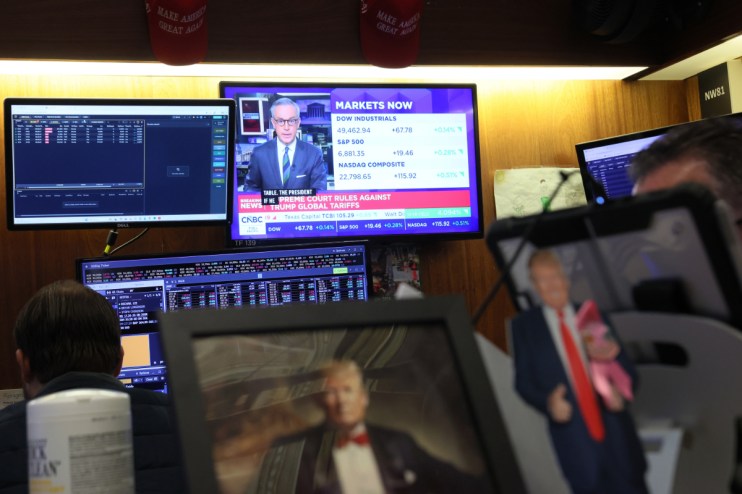
The US Supreme Court has handed down a landmark ruling that the sweeping tariffs President Donald Trump imposed on trading partners last year were illegal.
Justices were weighing up a case centred around the Emergency Economic Powers Act that allows a President to regulate imports during a national emergency.
The White House had argued the act authorised Trump to impose his ‘Liberation Day‘ levies without any clear limits on the scope of duration.
But on Friday the Supreme Court – which has a 6-3 Conservative majority- struck down the tariffs which could pose major financial consequences for the Trump administration. All three liberal justices – Ketanji Brown Jackson, Elena Kagan and Sonia Sotomayor – voted against the tariffs and they were joined by Amy Coney Barrett, Neil Gorsuch and John Roberts.
Justices Brett Kavanaugh, Samuel Alito and Clarence Thomas dissented.
The President had previously warned of a “complete mess” should he lose the case and warned the US would be forced to “unwind” trade deals.
Trump responded to the news saying: “The Democrats on the court are thrilled.
“They’re against anything that makes America strong, healthy and great again. They also are a frankly, disgrace to our nation, those justices.”
In his response he warned of a 10 per cent tariff across the board for 150 days to replace the ones struck down by the Supreme Court.
He also took a jab at “certain” members of court – in a reference to Gorsuch and Barrett, who Trump nominated to the court – adding it was “unpatriotic and disloyal to our constitution”.
A UK government spokesperson has said: “The UK enjoys the lowest reciprocal tariffs globally, and under any scenario we expect our privileged trading position with the US to continue.
“We will work with the Administration to understand how the ruling will affect tariffs for the UK and the rest of the world.”
The FTSE 100 enjoyed a bump on the news with Diageo and Burberry each extending the day’s gains to near four per cent.
The pound also rallied over 0.3 per cent to over $1.35 against the dollar clawing back some losses after a weak few days for sterling.
Trump’s emergency authority ‘falls short’
Chief Justice John Roberts, who wrote the decision, said: “The President asserts the extraordinary power to unilaterally impose tariffs of unlimited amount, duration, and scope.”
“In light of the breadth, history, and constitutional context of that asserted authority, he must identify clear congressional authorisation to use it.”
The court said the emergency authority the President had intended to rely on “falls short”.
The historic ruling will raise questions of the economic implications for the Trump administration as it opens the door to refunds for affected importers through the US Customs and Border Protection Agency, who have been paying the duties over the last year.
Tariffs covered in Friday’s ruling from the US top Court include Trump’s first trade offensive in February 2025 to tax goods from China, Mexico and Canada as he argued the drug trafficking from the countries constituted an emergency.
He renewed this line of reasoning in April, where he launched his ‘Liberation Day’ tariffs, which ranged from 10 to 50 per cent levies on goods across the globe. The move came as Trump branded the US trade deficit – where the country imports more than it exports – as an “extraordinary and unusual threat”.
A number of tariffs are not included in the ruling, however, including those on industry-specific steel, aluminium, lumber and automotive tariffs, which were implemented under Section 232 of the Trade Expansion Act of 1962, with the White House arguing national-security concerns.
A potential $120bn hit: What happens next?
Economists are making broad estimates for the range of the hit for the White House.
The US Treasury has pocketed around $240bn in customs duties in the last year, around $180bn more than the same period in 2024.
“Assuming the Treasury is now forced to issue refunds, we’d expect the bill to run to about $120bn, or 0.5 per cent of GDP,” Paul Ashworth, chief North America economist at Capital Economics said.
However, the ruling did not provide guidance on whether the government should or how it would go about returning the billions that has been collected.
Michael Pearce, Chief US Economist at Oxford Economics suggested the US could look to reciprocate the levies through alternative legislation.
“Even if the administration is able to replicate the overall level of tariffs using other means, the by-sector and by-country implications could end up looking very different, which will create another bout of trade policy uncertainty for business, investors, and households,” Pearce said.
“This uncertainty is a key downside risk that could ding, rather than derail, growth this year.”