Fix Hammersmith Bridge to jolt Britain out of degrowth daydream

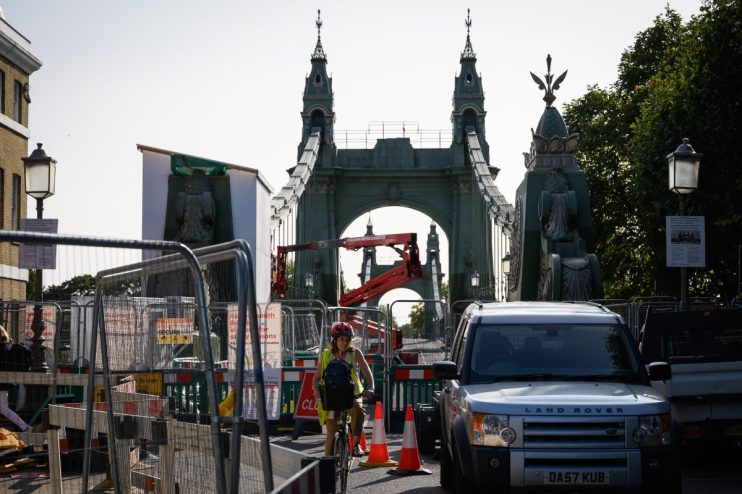
The seven-year closure of Hammersmith Bridge is emblematic of British decline. The government must now take responsibility, says Neil Garratt
“When you have eliminated the impossible, whatever remains, however improbable, must be the truth.” We might picture a bewhiskered Victorian Londoner contemplating those words in Arthur Conan Doyle’s latest novel, The Sign of the Four, as he gazed across the Thames from Bazalgette’s grand new Hammersmith Bridge, then just three years old. Now, dilapidation has seen it closed to motor traffic for seven years. Sherlock Holmes’s famous maxim would lead him straight to the only answer to our present problem: the government must pay for Hammersmith Bridge.
The closure is a national embarrassment and a local nightmare. People who once quickly nipped across the river are now stuck in transport purgatory, cut off from places that were once an easy daily trip. A child that used to see her grandparents across the river every week becomes an occasional visitor. Communities severed, friendships stretched apart. It’s a symbol of a nation going backwards. While the Victorians quickly replaced the damaged 1824 bridge, today no one wants to pay because no one can afford to pay.
It is this logic that leads us to the government’s door. Let’s start with Hammersmith and Fulham council. They are legally the owner, but they are as likely to put a man on the moon as they are to find £250m to replace the bridge, legal duty or not. We can rule it out.
Moving up a layer, we reach the Greater London Authority. From 1889 the London County Council and then the Greater London Council owned Hammersmith bridge. Upon the GLC’s abolition in 1986 it was given to H&F council. In 2000 the Greater London Authority was created, reinstating London’s top tier of local government, so that may seem its rightful home today. Or at least, the rightful writer of the cheque.
The GLA does have more financial muscle than a borough. Thus, in 2015 it completed major repairs to the Hammersmith Flyover. Unfortunately, it has its own backlog of overdue capital renewals stretching to billions of pounds across many aging assets. For example, the Westway has had its speed limit cut from 50mph to 30mph following safety concerns with the bridge structure.
Worse, TfL’s backlog is growing each year to the tune of £400m as annual investment falls short of the £1.2bn required to maintain its network’s current state of repair. Far from the bridge’s saviour, TfL is more a watchlist of potential future embarrassing closures.
Troubled bridge over water
The GLA is also keenly aware that Hammersmith isn’t the only troubled bridge owned by a London council. If you were wondering which bridge would be next to close, we already know the answer: Broadmead Road bridge in Redbridge closed indefinitely to motor vehicles in July 2023. Structural failures again. This is a wide, modern road bridge spanning the Central Line by Woodford station which, like Hammersmith, the council cannot afford to rebuild.
Before we get to the government, let’s quickly consider one other possible funder of failing bridges: the City Bridge Foundation. For almost 900 years it has defied the nursery rhyme, ensuring London Bridge does not fall down. It now looks after four further bridges using a large capital fund originally built up from long-abolished tolls and rents from buildings on the ancient London Bridge. It’s an amazing thought that mediaeval rents paid for the Millennium Bridge.
They are entirely independent and receive no tax income, so must steward their funds to maintain, repair, and ultimately replace those five bridges. Demanding they take on the burden of Hammersmith Bridge has two major problems. First, it punishes the prudent. In a nation with many failings, why drag down one institution that’s doing its job? Second, it’s sticking plaster thinking. We simply must kick our addiction to running down our assets, yet this plan gets our hooks into yet another asset.
And so to the government. Like its predecessor, this government hesitates to set an expensive precedent that it will take on everyone’s crumbling assets. The classic moral hazard. This isn’t unreasonable, but as we have seen: there is no one else. No other body can take on Hammersmith Bridge, Broadmead Road bridge, and whichever bridge, road or tunnel goes pop next. If the government does not fix it, it will stay broken then eventually collapse. Improbable though it might seem, that is the truth.
The sight of our rundown Victorian infrastructure should jolt us out of our degrowth day dream, galvanise us afresh to restore not just our bridges and our pride but also our commitment to growth and productivity
It may be that the government itself is also incapable of solving this. Perhaps, as a nation, we are no longer rich enough to build and maintain bridges across our rivers and railways. As an incurable optimist, I do not think we have slipped so far, but with every passing year of inaction, the government is signalling that the idea has merit. This must be a sharp wake-up call, not that we are incompetent but that we are deliberately making ourselves poorer and we must stop.
I remain an optimist both for Britain and for London. I believe the sight of our rundown Victorian infrastructure should jolt us out of our degrowth day dream, galvanise us afresh to restore not just our bridges and our pride but also our commitment to growth and productivity. That won’t solve everything but, in the end, it will solve almost everything. If nothing else, it will pay for a new bridge.
Neil Garratt was elected to represent Croydon and Sutton on the London Assembly in May 2021