City AM Football Power List shows that systems, not individuals, control sport

Ed Warner, one of the judges for the City AM Football Power List, gives his take on what the rankings reveal about the game.
Here’s your gentle starter for 10: who’s the most powerful man in world football? Easy, right? Gianni Infantino. But who are the 24 people you’d rank immediately behind Fifa’s president?
I’ve been wrestling with that challenge alongside 15 other panellists to compile the inaugural City AM Football Power List. The result is dispiritingly light on footballing artistes, reflecting money’s iron grip on the world’s most popular sport.
The curious thing about this power‑list judging process is that it forced us to apply subjectivity to an industry that is essentially objective. Football’s arithmetic is clear. It divides into winners and losers as determined by results on the pitch. But power is not measurable.
It is even more ephemeral than the bogus yardstick of relative on-field superiority that is xG. And that made our exercise both fascinating and faintly absurd. Still, the list we’ve produced tells a story, not just about individuals, but about the forces shaping modern football.
So without further ado, here are the 25. Prepare to disagree, as disagree you inevitably will. After all, the list isn’t the one I’d have produced if acting alone, and I’m sure each of my compatriots feels the same way.
Fifa, Uefa and Middle Eastern might
Infantino’s ascendancy isn’t a function of charisma or public affection. It is about jurisdiction. His organisation controls football’s calendar, its pinnacle global competitions and, crucially, the flow of monies into national federations.
Aleksander Ceferin ranks highly for similar reasons, presiding as he does over the sport’s commercially dominant continent. Uefa has seen off the threatened breakaway Super League and is bloating its competitions to appease Europe’s wealthiest clubs at the expense of its constituent nations’ domestic competitions.
Infantino and Ceferin are powerful because they control access to the greatest prizes and their accompanying riches. Of those working beneath them to shape the game’s future, Arsene Wenger – 19th on the list – is quietly but profoundly influential. Youth development, talent pathways, the laws of the game: all fall under Wenger’s wide Fifa remit.
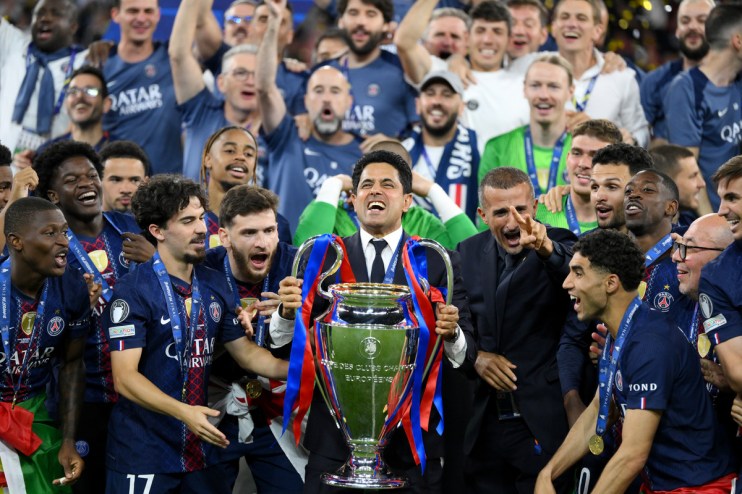
The global federations may own football’s structure, but it bends under the pressure exerted by geopolitics. Nasser Al‑Khelaifi, Sheikh Mansour and Mohammed bin Salman occupy the other three of the top five places in the Power List.
Acting on behalf of their Middle Eastern states, their aims are strategic, from nation-building to economic diversification, reputation management, global trade and tourism. Football as a gateway to reshaped nationhood.
Ferran Soriano, CEO of City Football Group, should be viewed in part through this lens. He sits atop the most sophisticated multi‑club model in the sport, bankrolled by the UAE. This venture has ushered in an era of systems to replace the century old one of individuals, forcing clubs of all sizes to think in terms of networks.
Club and player power
Traditional club power still matters, though, and Florentino Perez and Joan Laporta are its most potent symbols. Their influence extends far beyond Real Madrid and Barcelona, and even Perez’s driving of the failed Super League venture has not diminished his reputation as a fearsome political operator within European football. Both men have the benefit of club platforms with extensive brand heritage and commercial reach.
The Premier League remains the world’s most powerful domestic competition, but it’s not entirely clear who embodies that power. CEO Richard Masters comes in at No10, although he doesn’t command the EPL’s clubs in the same way as his predecessor Richard Scudamore. There is a sense that it is the clubs who effectively call the tune. Note too: no-one from the FA makes the cut.
John Henry, dominant force at Liverpool FC, stands as the lone representative of the many consortia now invested in English football. That no others feature says much about their failure to date (with Chelsea as principal case in point, although “failure” is obviously a relative term).
And while on the subject of the Premier League, Dana Strong, CEO of Sky, is a crucial inclusion. Global broadcast revenue is central to the EPL’s economic model, and Sky’s domestic contract remains its key component.
Footballers (and an agent) do appear, but their rankings reflect a truth the sport rarely articulates. Players shape the culture of the game, but they tend to influence rather than exert power. Cristiano Ronaldo and Lionel Messi, global icons both, are obvious choices.
So too the retired David Beckham, in spite of a smaller haul of honours than the other two. Beckham’s commercial potency and cultural magnetism show few signs of waning over time. No room yet for new stars such as Lamine Yamal though. That sole agent? Jorge Mendes. And not a manager in sight, not even Pep.
Women’s football, legal eagles… and Trump
Whether our panel has fairly assessed those behind the growth of women’s football remains, to me, an open question. In absolute terms, it could be argued that the women’s game has some way to go before it can lay claim to top 25 power positions. However, there are figures with such positions of influence within women’s football that they can be said to have the duty to transform its perceptions and economics.
Power is as much about having such opportunity as it is about the status quo. Hence the inclusion in the Power List of Michele Kang, women’s football’s most ambitious multi‑club owner; Jessica Berman, commissioner at the NWSL in the United States; and Dawn Airey, chair of the WSL board in England. Crossover figures – those shaping all of football, men’s and women’s; whether male or female themselves – remain rare, however.
Two names represent the service providers embedded in the contractual web that enmeshes the game. Jean‑Louis Dupont, the lawyer behind the seminal Bosman ruling, can be said to be one of the most influential legal minds in the game. Maheta Molango, CEO of the PFA, is an assertive advocate for player rights. Their inclusion is a recognition that power is not only exerted politically or financially. It also operates contractually.
African football’s increasing influence is captured through Patrice Motsepe, president of CAF. Africa is the sport’s largest talent engine, and CAF’s political weight is growing. Motsepe’s dual role as both football leader and billionaire industrialist gives him leverage other confederation presidents don’t possess.
And then there is Donald Trump, perhaps the list’s most left-field (if not left-wing) inclusion. The American president’s relevance is obviously tied to this summer’s World Cup.
He may be the recipient of Fifa’s first peace prize, but his direct influence on football is clearly limited. I confess though that his name was one of the very first I thought of after Infantino’s when I started to compile my own list submission. Can’t see him making the 2027 City AM Football Power List, though.
The bigger truth is that, with very few exceptions, power in football is no longer about personality. It is about systems. Governing federations, nation states, investment funds, legal frameworks and media networks shape the sport far more than any individual.
The whole is very much greater than the sum of its parts, and will remain so for as long as the world’s greatest power players continue to be dazzled by the myriad opportunities that it presents.
Ed Warner is chair of GB Wheelchair Rugby and writes his sport column at sportinc.substack.com