‘Bold’ new plans for Barbican area submitted

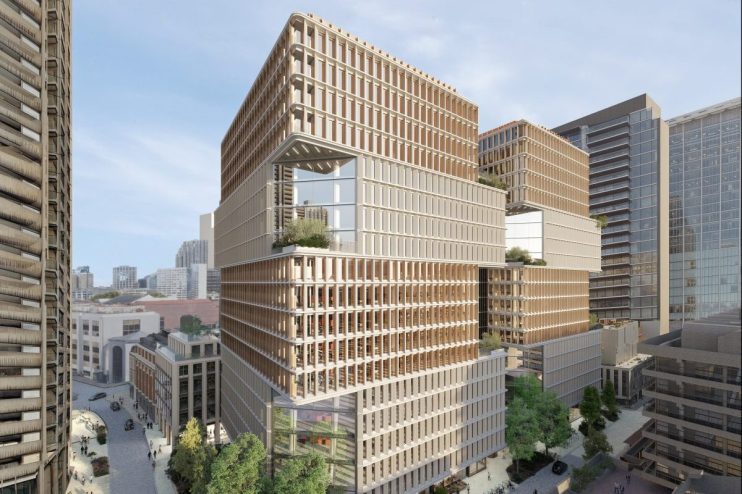
Plans have been submitted to redevelop 1 Silk Street, featuring a public plaza at the Barbican Centre’s main entrance and a retail arcade.
The proposal seeks to turn the existing building, which is currently occupied by Linklaters but set to become unlettable due to tightening energy efficiency standards, into a “long-term, sustainable” site.
“We’re pleased to present designs that will improve the surrounding public realm and environment through a combination of cultural, amenity, and sustainable uses,” European accounts manager at investor La Salle, Gary Moore, said.
“We look forward to contributing towards a significantly improved offering in a growing cultural destination in the City.”
The building, which sits opposite the Barbican Arts Centre, would provide 91,100 sqm of commercial space and 2,189 sqm of retail and community space, as well as a new public area.
The Barbican itself is set to undergo a serious redevelopment, with construction starting in 2027.

The plans for 1 Silk Street include new facilities for the Guildhall School of Music and Drama, a public art programme and a shared-use community hall.
A retail arcade would also introduce a new pedestrian route through the site, connecting Moorgate and Liverpool Street stations to the Barbican Arts Centre.
“The planning application marks a bold step in redefining workspace and cultural integration in the heart of the City of London,” Sir Stuart Lipton, founding Partner at developer Lipton Rogers, said.
“With a strong commitment of environmental responsibility and community engagement, we aim to deliver a new thriving destination that meets the evolving needs of businesses, visitors, and local institutions.”

Around 40 per cent of the current building’s structure would be retained, while developers have targeted a minimum BREEAM Excellent and NABERS 5* certification and a 352 per cent uptick in biodiversity units per hectare.
“Our vision is to deliver a new landmark for this part of London – one that introduces dynamic retail and cultural spaces, creates new public realm, and strengthens important pedestrian connections,” Kent Jackson, Partner at architects SOM, said.
“Expanding upon the area’s existing cultural legacy, these elements will help to reimagine this corner of the city as a vibrant destination whilst creating a bold new architecture that has a positive contribution to the City of London’s Destination City strategy.”