Bournemouth: Vitality Stadium expansion setback hits European plans

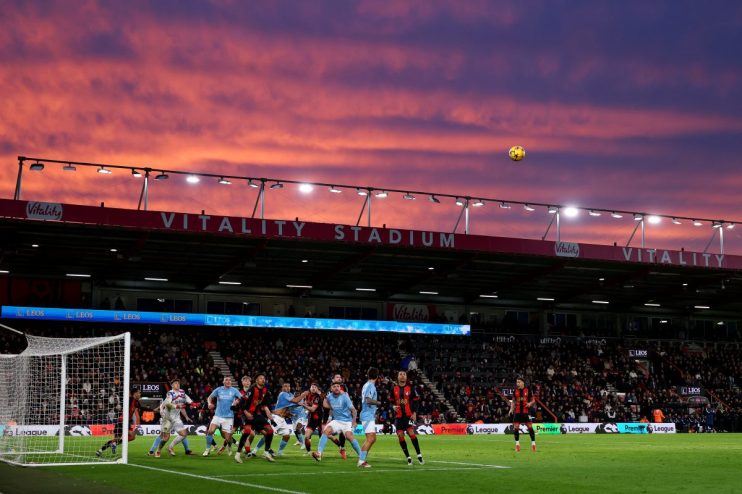
Bournemouth’s plans to redevelop the Vitality Stadium ahead of a potential first season in Europe have been hit by delays.
In what has been a remarkable season, it is still on the cards for the south coast club to qualify for the Champions League. They sit sixth in the Premier League, which will earn a spot in Uefa’s top competition if Aston Villa finish in the top five, as expected, and win the Europa League.
Bournemouth are also well placed to finish in the top seven and secure Europa Conference League football. But hopes of capitalising on that momentum have hit a snag after a council planning meeting to discuss redevelopment of the South Stand, scheduled for next Monday, was cancelled. Although the club submitted the required documentation, planners requested more information.
City AM has been told the meeting will take place later in May, but the delay has forced Bournemouth to push back major South Stand works until later in the season and into next summer, shifting immediate focus to corner infills and improvements to the stadium perimeter and hospitality areas.
Residents on nearby streets have lodged objections, citing loss of daylight and privacy, and concerns over how doubling the stadium’s capacity will impact transportation in the area on match days.
Bournemouth had hoped to release an additional 1,500 seats for next season but have revised the figure down to 800. With financial regulations limiting spending on wages and transfers to a percentage of revenues, expanding the stadium has become essential. Once complete, capacity will rise from 11,286 to around 20,200.
Burnley’s owner interest bites
Burnley’s latest accounts show a 32.6 per cent increase in interest payments as the cost of ALK Capital’s leveraged buyout continues to weigh on the club.
When ALK Capital acquired an 84 per cent controlling stake in the club – through subsidiary Velocity Sports Partners – in December 2020, around £55m of the purchase was funded via a loan to Burnley. The structure mirrored the Glazer family’s takeover of Manchester United in 2005. Manchester United have since paid over £1bn in interest to the family.
Burnley’s interest payments totalled £10.5m in 2024 and had risen to £13.9m by July 2025. Cumulatively, interest payments are thought to have exceeded £40m since the takeover.
The financial strain of playing in the Championship was laid bare in the accounts. The club made a pre-tax loss of £28.5m, despite making a £59m profit on player sales and winning the league, which does not bode well for next season after relegation was confirmed following defeat to Manchester City a few weeks ago.
“The Directors would once again like to thank all Clarets fans for their continued support,” the club posted on their website when publishing the latest accounts.
Fifa close Taliban loophole
It is not often that Fifa receives praise these days, but players from the Afghanistan women’s team have hailed the closure of a “Taliban loophole”.
Under previous rules, national teams required approval from their Football Association to compete in official competitions. Since the Taliban seized power in 2021, women and girls have been banned from sport, forcing Afghanistan’s female players to flee abroad and play friendlies as Afghan Women United.
Amendments to regulations now allow Fifa to ratify teams without approval from their national association, ending a five-year exile for the Afghanistan women’s side.
“Today, the Taliban’s power no longer extends to the world of international football,” said Maryam Karimyar, who moved to Portugal.
Sevin Azimi, who lives in the UK, said: “Many of us have made enormous sacrifices, losing our homes, our country, our careers, and precious years of our footballing lives in the struggle for dignity and freedom.”
Saudi hunting for young audiences
Global sport has been reeling from recent cuts by Saudi Arabia’s Public Investment Fund to golf, snooker and tennis. In a troubling economic climate, the Kingdom is refocusing on more sustainable investments. City AM understands future funding for sport will prioritise those with a strong youth appeal – including Newcastle United.
Many warn football risks turning off young fans by persisting with 90-minute matches in an era of shrinking attention spans. The exorbitant cost of attending games or watching on TV is also at odds with teenagers accustomed to watching free video game streams on Twitch.
Nonetheless, children remain obsessed with playing football and the sport is still viewed by PIF as a powerful draw for future generations. With youth in mind, the Kingdom is also doubling down on investment in esports.
Indeed, even Crown Prince Mohammed bin Salman is said to unwind by playing Call of Duty.
PE lessons put mid-lifers off sport
Were you ever picked last for teams at school? Or did you hate getting changed for PE?
According to new research by Age UK, you are not alone – and those experiences have put millions of those aged 50 to 65 off exercise and sport. Forty per cent – around 4m people – say bad experiences in PE and school sports put them off for life.
The charity’s campaign urging mid-lifers to put those bad memories behind them and get fit is supported by a raft of sporting figures, including Dame Kelly Holmes, Sally Gunnell and Dame Denise Lewis.
Gabby Logan, another supporter, said: “I exercise because I love it, it gives me a great feeling when I do it, I like being able to play lots of different sports and move well, but I’m also doing it to futureproof myself so that, when I’m in my 70s and 80s, I’m still as active as I can be. My motivation is to be able to play tennis with the grandchildren I haven’t got yet.”