On this day: Thomas J Watson, father of IBM, was born

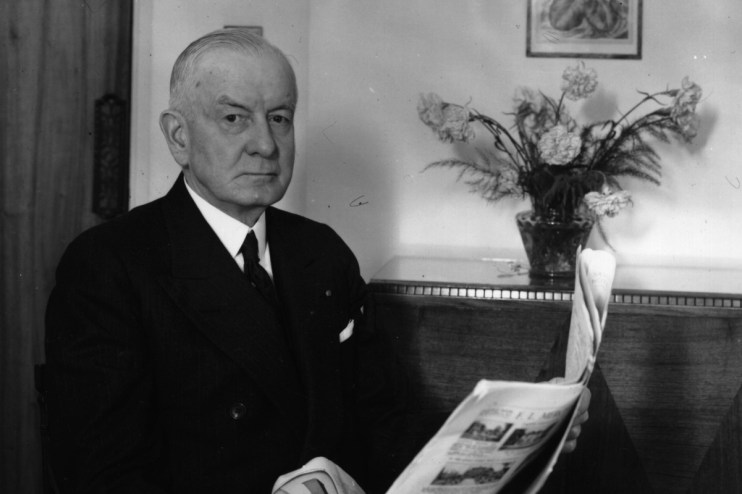
On 17 February 1874, the man who would go on to found the largest industrial research organisation on the planet was born in the tiny town of Campbell, writes Eliot Wilson
The town of Campbell, New York, in the Appalachian Mountains had a population of less than 2,000 in 1874. Thomas John Watson, born this day, was the fifth child and only son of a farmer and lumberman; by the time he was attending the one-room school, he was already working on the family farm, aged five.
When Watson died in 1956, he was one of the richest men of his era, leaving an estate worth more than $3.5m. He was not an inventor and no corporate giant bears his name, but it was a rebranding which symbolised his path to success: in 1924, he renamed the manufacturer of record-keeping and measuring systems of which he was president as International Business Machines: IBM.
Thomas Watson’s parents wanted their son to be a lawyer, but it held little appeal. He first tried teaching, but a single day in the classroom changed his mind. He then studied accounting and business at the Miller School of Commerce in Elmira, New York, leaving to become a book-keeper on $6 a week at Clarence Risley’s Market, a butcher’s in Painted Post.
Painted Post, where his father farmed, was a village of just under 700 souls, and $6 a week was what schoolteachers, unskilled labourers or farmhands earned. After a year, he joined a friend, George Cornwell, a travelling salesman who sold pianos, organs, sewing machines and caskets around southern Steuben County, and studied his techniques avidly. He now earned $10 a week but realised that on commission he would be earning $70.
That realisation was an epiphany. Watson moved to Buffalo, a booming city of a quarter of a million, and went through a number of sales jobs before opening a butcher’s of his own. But these were exceptionally difficult times, and the Depression of 1893-97 was the worst in America’s history. Watson’s business failed, but left one door open for him: he had a mechanical till from Ohio’s National Cash Register Company. While arranging for instalment payments to be taken from the new owner of his shop, Watson pestered the Buffalo branch manager, John J Range, until in 1896 he was hired as a sales assistant.
Everything changed
It changed everything. Watson became NCR’s most successful salesman in the Eastern US, honed a ruthless sales strategy and in 1907 was promoted to head office in Dayton, Ohio. In 1912, NCR was found in violation of the Sherman Antitrust Act and Watson was one of 28 senior figures convicted of illegal anti-competitive sales practices. He was sentenced to a year’s imprisonment, but the convictions were overturned three years later on evidential grounds.
Fired by NCR and with a prison sentence hanging over him, Watson had been hired as general manager of the Computing-Tabulating-Recording Company in 1914 and was promoted to president after his legal case was resolved. CTR was a holding company overseeing four other manufacturers of record-keeping and measuring systems and a chastened Watson set himself a clear goal: the best machines on the market sold by a motivated and disciplined sales team, acting in an “honest, fair and square way”.
It worked. CTR’s revenue when Watson took over had been $4.2m; by 1920 it was $16m. Costs were rigorously controlled, long-term customer relationships were nurtured and research and development were prioritised. In 1924, CTR was renamed the International Business Machines Corporation, or IBM. Watson, celebrating his 50th birthday three days after the name change, had truly arrived.
Watson may not have been the founder of what became IBM, but he shaped its image, practices and culture just as significantly as if he had been its progenitor. A major opportunity lay ahead of IBM or one of its competitors: it was obvious to Watson that accounting machines would transform the conduct of economic enterprise, yet by 1929 only two per cent of tasks had been widely automated.
The year before, Watson had granted an hour-long meeting at the Century, his club in midtown Manhattan, to Professor Benjamin Wood, a young psychologist at Columbia with an expansive vision of how IBM’s machines could change the world. The encounter lasted five hours and proved a meeting of minds.
IBM funded and equipped the new Columbia Statistical Bureau under Wood in exchange for his ideas and testing of equipment as the market developed. The collaboration between Watson and Wood laid the foundations for modern computer science, and in 1933 Wood became the first PhD to join IBM’s payroll.
Building the bomb
There seemed almost no limit to what machines were becoming able to do: complex scientific calculations, scoring of test papers, compilation of census data. In 1941, that potential exploded as the United States entered the Second World War. IBM was subcontracted by the War Relocation Authority to manage the data for the internment of 120,000 Japanese-Americans, and supplied equipment to US cryptography efforts. Most significantly, it developed and built the Automatic Sequence Controlled Calculator, an early electromechanical computer which performed calculations for the Manhattan Project. IBM was helping to build the Bomb.
Watson maintained the pace in peacetime. 1952 saw the launch of the IBM 701 Electronic Data Processing Machine, the company’s first commercial scientific device, and in 1956 it launched the IBM 305 RAMAC, the first commercial computer to use a moving-head hard disk drive for secondary storage. Watson missed the launch of the RAMAC by three months: on 19 June, five weeks after retiring as CEO at the age of 82, he died of a heart attack in the Roosevelt Hospital in Manhattan. His son Thomas J. Watson Jr had succeeded him as CEO.
He was lionised as “the world’s greatest salesman” after his death, but his success stemmed from more than that. He believed in education and intellectual curiosity, and developed what The New York Times called “the IBM way of life”. This came from his concept of an industrial “family”: customers, employees and owners, each of whom deserved to benefit from the overall enterprise; but he was also close to Presidents Roosevelt, Truman and Eisenhower.
His most enduring legacy is a single word he adopted as a slogan while still at the National Cash Register Company: THINK. Exasperated at a sales meeting, he exclaimed:
“The trouble with every one of us is that we don’t think enough. We don’t get paid for working with our feet – we get paid for working with our heads. Knowledge is the result of thought, and thought is the keynote of success in this business or any business.”
THINK summed up Watson’s approach and remains IBM’s motto; it was also its first US trademark, registered in 1935, 14 years before “IBM” was registered. Today IBM has a presence in 177 of the world’s 195 countries, is the largest industrial research organisation on the planet and has an annual revenue of $63bn and 270,000 employees. It makes you THINK.
Eliot Wilson is an author and historian