What is the long-term plan for the Strait of Hormuz?

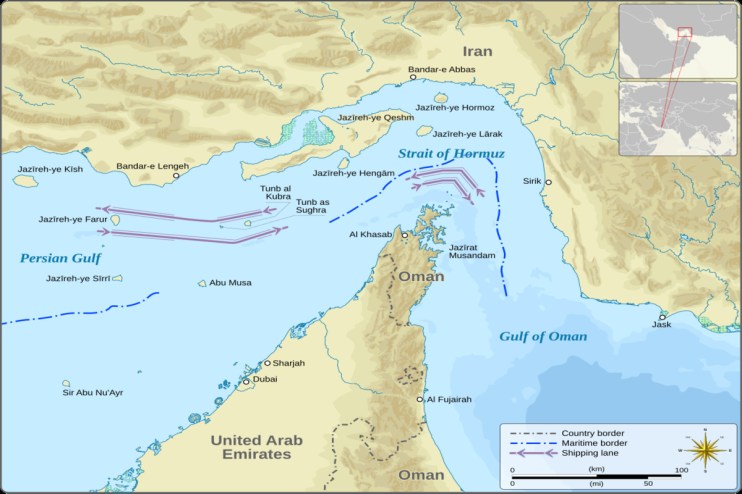
The disruption of the critical Strait of Hormuz by Iran has created a major global energy crisis that requires a high-risk military solution – but the West currently lacks both the determination and a coherent long-term plan. says Eliot Wilson
Today is a red-letter day for Middle East navigational hazard enthusiasts: five years ago, at 7.40 am, the 224,000-ton container ship Even Given was caught in a sandstorm travelling north in the Suez Canal. She was just over six miles into the waterway and was blown aground diagonally across the entire canal, blocking it entirely; it took six days to free the Ever Given, during which time a queue of nearly 370 ships built, the value of their goods estimated at $9.6bn per day.
The Strait of Hormuz, which links the Persian Gulf and the Indian Ocean, is, like the Suez Canal, one of the world’s most important maritime chokepoints. There are reckoned to be five such chokepoints dominating commercial shipping routes, including the Strait of Hormuz and the Suez Canal: the others are the Bab-el-Mandeb, between the Red Sea and the Gulf of Aden; the Panama Canal; and the Strait of Malacca between Sumatra and the Malay Peninsula, connecting the Andaman Sea and the South China Sea.
Iran announced the closure of the Strait of Hormuz on 2 March, the third day of the US and Israeli military operation. It has since refined this to a ban only on shipping from the United States, Israel and their Western allies, and Chinese, Turkish and Indian vessels have safely navigated the waterway; but others from Malta, Thailand, Liberia and elsewhere have been attacked. Iran’s word has not been enough for the maritime insurance industry and premiums have soared or coverage simply been refused, causing traffic to dwindle more or less to nothing.
The Strait of Hormuz usually carries around 20 per cent of the world’s seaborne trade in oil and liquefied natural gas (LNG). Michael Froman, President of the Council on Foreign Relations, has called this “what could be an unprecedented and escalating global energy crisis”, with the price of oil soaring since President Trump authorised Operation Epic Fury on 28 February.
Reopen the Strait by force?
Trump has indicated that he will reopen the Strait of Hormuz by force, initially appealing to allies for assistance, then, when little was forthcoming, angrily denying that America needed anyone’s help. This adolescent moodiness is typical of the President, but allies of the United States cannot afford to sit back and shrug. However we got here, we face the possibility of a serious economic crisis prompted by an energy shortage far worse than the oil shocks of 1973 and 1979.
No-one in Washington nor the chancelleries of Europe should be surprised. Iran has never fully closed the Strait of Hormuz for any sustained period before, though Saddam Hussein’s attack on Iranian tankers at Kharg Island in 1984 was intended to provoke such a move and sparked the destructive four-year Tanker War. But the ability to disrupt the strait, 104 miles long but only 24 miles across at its narrowest, has always been the dagger Iran holds at the throat of the oil-hungry West.
Our desperate hope must be that Washington has already undertaken a great deal of planning, examining options for exactly this scenario. It has wargamed conflict over the Strait of Hormuz extensively in the past and trained alongside British forces. But one major exercise, Millennium Challenge 2002, was halted and amended when the opposing “Red” forces inflicted huge losses on the “Blue” American side.
Whether or not Millennium Challenge was, as alleged, rigged, it indicates the enormous military commitment and hazards of forcing the strait. Iran has begun laying some mines in water but it is not clear in what quantity. Nevertheless, Dr Emma Salisbury of the Foreign Policy Research Institute described recently how much the US Navy’s mine countermeasures capability have diminished.
Placing naval vessels in such a narrow strip of water to escort commercial shipping would expose them to drones, missiles and swarm attacks by speedboats. UK defence chiefs have reportedly refused to deploy Royal Navy warships because the situation is simply too dangerous. Advance air strikes against potential launch sites and command and control centres can only reduce rather than eliminate the risks: if Iran chooses to fight back, it can.
Former Royal Navy officer Tom Sharpe has warned that “if you consider… three threat environments [air, surface and subsurface], and the fact that you need to escort 100 ships a day to restore shipping to normal levels, you’ve got a resource problem”, notwithstanding the armada Trump has moved to the region.
This is the great conundrum. The West cannot allow the Strait of Hormuz to be closed. Article 37 of the UN Convention on the Laws of the Sea protects against maritime traffic being “impeded”, while the 1907 Hague Convention VIII forbids the laying of mines “with the sole object of intercepting commercial shipping”. But the disruption of energy supplies would make reopening the strait essential anyway – yet some Western nations seem to be ignoring this.
At the same time, a military solution is only achievable at enormous risk, with huge resources, meticulous planning and determination. Even now, Iran holds many of the cards, and while America should not be left to carry the burden of this task alone, potential contributing nations are entitled to ask: what is going to be done, how, when and what is the anticipated end–state? It seems that few are persuaded so far.
Unless Iran capitulates – unlikely given its staggering loss of senior political and military leaders and Trump’s demand for “unconditional surrender” – there seems no alternative. But a lot of work remains.
Eliot Wilson is a writer and historian; senior fellow for national security, Coalition for Global Prosperity; contributing editor, Defence on the Brink