What an AI bubble could mean for Reeves

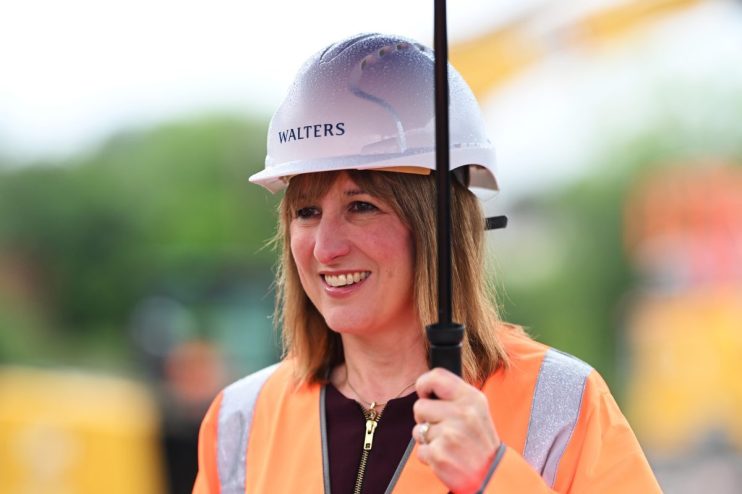
The traditional ministerial photo-op of walking around a construction site clad in a high-vis jacket and a hard hat usually takes place at a factory or housing site. But last month, chancellor Rachel Reeves donned fluorescent yellow for a different facility – a huge data centre built to power the UK’s digital economy through AI.
Alongside Labour’s new tech secretary Liz Kendall, Reeves toured Google’s shiny new $1bn (£735m) Hertfordshire data centre, part of a wider £5bn investment pledge from the Silicon Valley heavyweight.
The visit was used to symbolise a new economic era – one built not on cranes and concrete, but on code and compute power.
Reeves dubbed the project as a “powerful vote of confidence in the UK economy”, and Labour is betting big on that sentiment.
Britain’s growth strategy, at least for now, depends heavily on the fortunes of AI and the tech behemoths pouring billions into it.
Yet with warnings of an AI bubble simmering to the surface on both sides of the pond, Reeves’ bet looks potentially risky.
If – and it’s a big if – the bubble bursts, it would do more than puncture Silicon Valley’s dominance, it would harm the chancellor’s economic plan.
Riding the AI wave
Big Tech’s arms race to build the chips and data centres that power the rise of large language models (LLMs) has unleashed an investment boom of historic proportions.
In the US, Harvard economist Jason Furman estimates that IT equipment and software accounted for 92 per cent of GDP growth in the first half of this year.
Deutsche Bank economists say that without this tech surge, “the US would be close to, or in, recession this year”.
This boom is being principally driven by a handful of names: Nvidia, Meta, Microsoft, OpenAI and Oracle.
Between them, these companies are spending hundreds of billions of dollars to build the infrastructure of AI.
Sam Altman’s ‘stargate’ project – a $500bn plan set to construct the next generation of compute power – is emblematic of that mania.
‘Losing $200bn better than losing the race’
Meta boss Mark Zuckerberg said his firm alone will invest $600bn by 2028. “Even if we lose a couple hundred billion”, he said, “it would suck, but it’s better than being behind the race for super intelligence”.
In the UK, ministers are trying to capture some of that flood. Data centres have been called national infrastructure, AI ‘growth zones’ have been fast tracked, and the government has taken a somewhat relaxed approach to Big Tech regulation.
During Trump’s visit last month, tech firms pledged £31bn of investment into the UK, with Microsoft alone injecting £11.6bn in Britain for AI infrastructure, and OpenAI opening a British counterpart to its stargate venture.
Google’s Ruth Plat told the BBC there were “profound opportunities” in this country for advanced AI search, pointing to a “special tech relationship” between the US and the UK.
So far, the numbers look positive, with our data centre capacity jumping 54 per cent in five years, according to DC Byte.
But the sheer mega scale of the investment spree is starting to unnerve central bankers and market watchers alike.
Alarms sounding
On Wednesday, the Bank of England’s Financial Policy Committee warned that “the risk of a sharp market correction has increased”.
The central bank’s committee singled out the tech sector, arguing that “equity market valuations appear stretched”, especially for companies tied to AI.
It also warned that a “sudden correction could occur”, if expectations around AI “become less optimistic” with “material spillovers to the UK financial system”.
Governor Andrew Bailey remains bullish on the long-term tech promise, but anxious about over-exuberance.
He said: “Should we be optimistic today? Yes, but only if we make the necessary investment”.
The problem, he added, is that so much of that investment is speculative, and often circular.
Bubbles start with a story people want to believe
When OpenAI struck a deal with AMD earlier this month to buy chips in exchange for the right to purchase shares, analysts saw an echo of late-1990s ’round-trip’ deals that inflated the dot-com bubble.
Meanwhile, cloud provider Oracle is borrowing tens of billions to build data centres that may never generate meaningful profit margins.
What’s more, its AI server rentals currently make just 14 cents for every dollar of sales.
Tech now makes up around 40 per cent of the S&P 500, which is the same concentration it reached before the dot-com crash.
“Every bubble starts with a story people want to believe”, Dat Ngo of trading guide Vetted Prop Firms argues. “In the late 90s, it was the internet. Today, it’s AI. The parallels are hard to ignore: skyrocketing stock prices, endless hype and companies investing billions before fully proving their business models”.
MIT’s recent research has poured cold water on the hype, revealing that 95 per cent of firms are currently receiving zero return from their AI investments.
Similarly, Qlik found that one in ten firms say their AI initiatives are seeing sizeable returns.
A political problem
For Reeves, an AI bubble problem could become an economic and political one. Tech has become the UK’s fastest growing source of investment.
The communications and information sector is now investing over £10bn a quarter, up 43 per cent since before the pandemic and double that of a decade ago.
The danger is that if the sector stalls, so too could Britain’s already anaemic growth.
Economists expect GDP to expand by just 1.2 per cent this year, and 1.1 per cent the next. Any dip could blow a hole in Reeves’ fiscal rules, forcing her into more tax rises.
“When you are an economy struggling to grow more than one per cent a year anyway, you really don’t need a huge amount to tip the balance and swing you back towards recession”, says Oxford professor Andrew Goodwin.
What’s more, Oxford Economics estimates that a major AI downturn could knock 1.2 per cent off global GDP by 2027, including a hit of nearly one per cent to the UK.
A slowdown in the US- where the AI bubble is most inflated – would quickly ripple across the Atlantic.
As an “open economy with a global financial centre”, the FPC argued on Wednesday, “the risk of spillovers to the UK financial system from such global shocks is material”.
For Reeves, who has staked her credibility on restoring stability after years of volatility, an AI bust could be disastrous, leaving her growth plan in tatters and test Labour’s claims to economic competence.
Some remain positive. As Filip Bialy, professor at the Open Institute of Technology, said: “The hype may end not with the burst of the bubble but rather with a more mature understanding of the technology”.
Reeves, for her part, will be hoping that the UK’s AI drive will continue to be a huge opportunity for economic growth. And if the AI bubble pops, the chancellor’s hard hat may as well be a helmet.