‘We have been ignored for most of our life,’ says FTSE 100’s newest bank

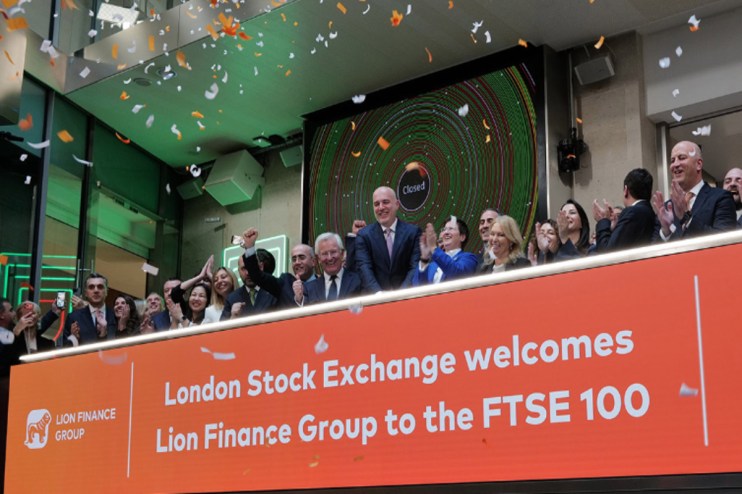
Lion Finance thought of itself as the London Stock Exchange’s wallflower. But after its promotion the the market’s blue-chip index earlier this year, the bank is finally getting noticed.
Shares in the group formerly known as Bank of Georgia have enjoyed a quiet ascent since the beginning of 2022.
In that four-year window the stock has climbed over 500 per cent to the 13,348.13p it trades at today.
But before this, the bank spent years glued to the wall after first floating in 2012 at 666p and fluctuating around the 1,000p mark until 2021.
“We have been ignored for most of our life,” Archil Gachechiladze, the group’s chief executive, tells City AM.
That changed in March when the bank secured blue-chip status with a promotion to the FTSE 100 following its quiet, multi-year surge.
The promotion made Gachechiladze one of the longest-serving blue-chip bank bosses – second only to Standard Chartered’s Bill Winters. It also made him the youngest chief executive of a FTSE 100 company.
He describes the entrance as having led to “sudden increased” interest. More than 200 investors are said to have expressed interest in attending the group’s capital markets event in June within a day of the invite being sent.
Just last week, Lion Finance gave its backers another reason to cheer after earnings breezed past market estimates. The post-results rally lifted the stock to gain of over 40 per cent for the year-to-date, making it one of the top performing blue-chips this year.
Investors do their homework
“More people and more funds have decided that it’s worth it for them to do the homework in terms of studying the macro,” Gachechiladze says.
The macro he references rests in Armenia and Georgia, the two dominant markets for Lion Finance and the latter of which Gachechiladze was born and raised.
“In a nutshell, it’s two economies that are growing very strongly… both are showing fantastic results,” he says.
The group’s profit hit GEL618.8m (£175m) for the second quarter, a 21 per cent rise year-on-year and five per cent ahead of market expectations.
That came after a combination of high net interest income, an expanding loan book and better-than-expected fee income helped more-than offset some higher cost-of-risk and operating expenses.
But the extra assignment for investors goes beyond the balance sheet. Georgia is currently facing a political crisis over its democratic future, following the Georgian Dream party claiming victory in disputed parliamentary elections and passing controversial foreign influence laws.

The saga has stalled Georgia’s ambitions for European integration and has led to closer ties with Moscow. It has ignited waves of major on-going pro-Western street protests, which have been met with police crackdowns.
“It doesn’t affect our business directly,” Gachechiladze says, instead suggesting that “if anything, the economy has been doing very well.”
Asked on risk positioning in regards to the domestic turmoil, he says the group has not “felt any economic headwinds”.
One of the financial sectors ‘most attractive’ stocks
Analysts too are remaining unphased by the developments and have bet heavily on the firm.
Jens Ehrenberg, who heads up financials research at Cavendish, said he was “encouraged by persistently strong growth across the group’s markets”.
“We believe Lion Finance Group remains one of the most attractive stocks in our sector,” he bullishly added and labelled the stock a ‘Buy.’
Ben Maher, market analyst at KBW, said the bank “continues to deliver in the right areas”.
Both set a target price for the group at around 13,500p.
The growing momentum comes against a far drop-off in tone for the broader London bourse, which is watching its prized assets slowly get picked off by overseas buyers.
For Gachechiladze, remaining in London is not a question – even as he points out the bank is still trading at a 30 per cent discount to its Eastern European peers.
“We have discussed different things,” he says, “but we’ve always come to a conclusion that London is the right place for us.”
He describes the City market as holding “more understanding” of Lion Finance’s market and also points to the presence of “more region-focused investors”.
Those investors are now reaping the rewards of their work as the bank targets distributing 30 to 50 per cent of its annual profits through quarterly dividends and share buybacks.
In the first half of 2026, it boosted its cumulative dividend by 15.7 per cent year-on-year to GEL5.90 per share (167p) and completed a buyback worth £15.6m.
Gachechiladze may need to keep the cash flowing and then some as he looks to tempt more investors into doing their homework to help reach his next ambition.
“I cannot call it a target,” he says, throwing up his hands in a knowing grin, “but we would not mind being in FTSE 50 – I understand that’s a more prestigious club.”