The London Stock Exchange is shrinking – but Julia Hoggett is still an optimist


The London Stock Exchange’s two flagship indexes are trading near all-time highs. But beneath the surface, it has been another testing year for the capital’s bourse. Boss Dame Julia Hoggett tells Ali Lyon what she is doing to disprove the doomsters.
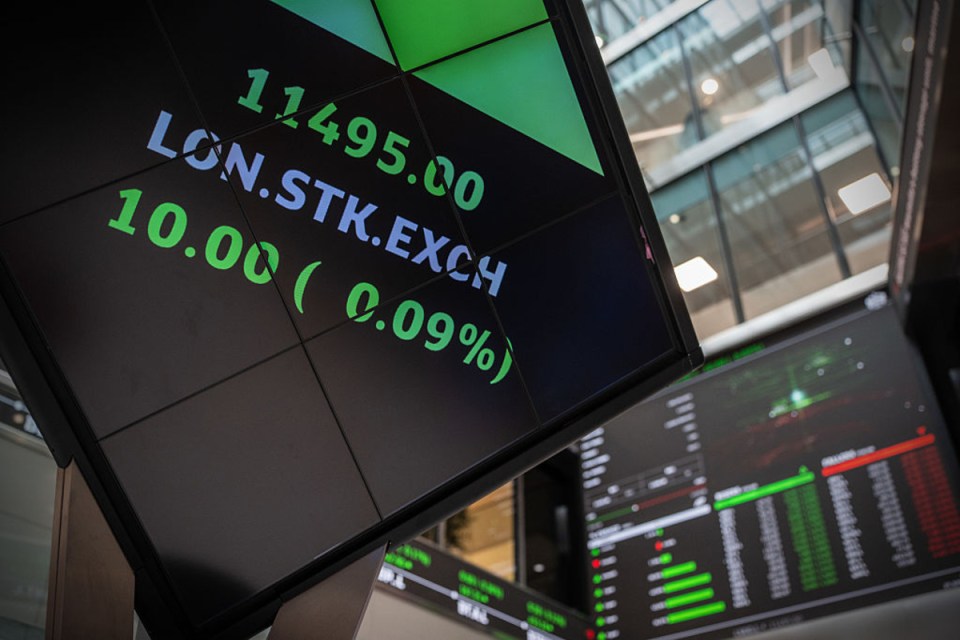
In the cavernous foyer of London’s historic stock exchange, a giant cube is flashing green.
The FTSE 100, it reveals, is on the cusp of surpassing the record it struck back in February, before Donald Trump’s war in Iran sent oil prices skyward and stocks in the opposite direction. The FTSE 250, for years the unloved sibling of its shiny big brother, is also sitting pretty on a fresh high. Even the ever-embattled junior market, Aim, is six per cent higher over the first week of August.
But as Dame Julia Hoggett decelerates into her sixth August running the bourse – a crucial month for reflection and contemplation, she says – the City grandee knows that those ostensibly healthy signs are a mere subplot of the London Stock Exchange’s story in 2026.
This year, the protracted flow of companies leaving the exchange has swollen into a flood, and the trickle of companies replacing them – as if in response to the uncompromising heat pounding Paternoster Square outside – has dried up almost entirely.
The London Stock Exchange’s testing 2026
More than 30 companies have already left or are poised to leave London’s main market so far this year. Factor in Aim, and the number is even higher. Some departing firms are pursuing a listing elsewhere, while a handful of smaller firms just want to rid themselves of the hassle of public market life.
But – overwhelmingly – they are being plucked off by foreign rivals or investors. Notable departures include investment giant Schroders, bought by its bigger US rival Nuveen; insurance darling Beazley, which is heading to Switzerland’s Zurich; and FTSE mainstay Intertek, which was was snapped up by Swedish buyout giant EQT in June. The feeding frenzy has led grandees across the City to warn the capital’s bourse is “on life support”, being “gutted” and proving a “fertile ground for bargain hunters”.
Animal spirits are in short supply and, as is always the case when things go awry, a blame game is afoot. Some hold successive governments responsible. Others say it is the fault of the City’s regulators and pensions industry. But an increasingly hard to ignore minority are also turning their fire at the LSE and Hoggett herself in their search for a fall guy. The main charge is that amid the wave of de-listings, the guardian of London’s bourse has failed to show the urgency or – to quote Octopus founder Greg Jackson – the “hustle” the situation requires.
But as she sits down for what is her first set-piece interview in over six months, that narrative of managed decline is one that the stock market’s bespectacled, softly spoken boss is, unsurprisingly, hellbent on correcting. Reports of the London Stock Exchange’s death are, in Hoggett’s eyes, greatly exaggerated.
“We are third in the world at creating companies, third in the world at scaling companies,” she tells City AM. “We have the second, third, or fourth largest volume of institutional capital in the world, depending on how you count it. [And we] create more consequential research per capita than anywhere else.”
To Hoggett, the dour mood plaguing the Square Mile is not so much a symptom of the ill-health of Britain’s capital markets but one of its root causes.
“We need to stop throwing shade at ourselves as a nation and then being surprised if it’s a bit chilly and a bit dark and a bit damp,” she says. “Most countries in the world want exactly what we’ve got.”
But for all the executive’s talk of cynical attempts “to fit a set of facts into a narrative”, the data paint a picture that even the staunchest advocate for the stock market would find it hard to question.

IPO drought stretches into fifth year
As if to prove the point, in the days following our interview, yet another flurry of takeover interest and delisting momentum dominated financial news. Easyjet flew off into the arms of American private markets behemoth Apollo. And on Wednesday, Bodycote – an industrials stalwart listed on the London Stock Exchange for over 50 years – disclosed two near-identical takeover bids from buyout giants CVC and Veritas.
For those raising the alarm, the situation wouldn’t be as stark were there a reliable line of fresh listings coming to take the departees’ place. But since a blockbuster 2021 in which some 50 companies chose London to make their public market debut, the scale and frequency of initial public offerings (IPOs) has ground to a halt as well.
So far this year, there has been just one capital-raising IPO of note: that of Uzbekistan’s national investment fund (dual-listed with Tashkent). Meanwhile, amid a barrage of international and domestic uncertainty, key candidates like Waterstones, Visma and payments firm Sumup are all said to have pushed their London debuts into 2027.
On this front, Hoggett is notably sanguine. The exchange, she says, has “the biggest pipeline we’ve had in 20 years”. And rather than spending her time convincing them to commit, it is her job to be ready for them when they do.
“I can tell you that we have the highest number of companies by the greatest value in our pipeline preparing to execute than has been the case since I’ve been here,” she says. “When they choose to come? That’s their choice.”
The drop-off in IPOs comes despite a five-year push from Hoggett – a self-professed workaholic who is rarely “not thinking about work” – to get the bourse ship shape in a capital markets ecosystem unrecognisable from just a couple of decades ago. Companies are increasingly happy to stay private for longer. And European founders – like their US counterparts – want evermore control over their brainchild, even after they go public.
In one of her first major moves in the role, Hoggett set about trying to fix those “problem statements”, overseeing what was held up as the largest listing rules overhaul of a generation. The shake-up, carried out hand in glove with the Financial Conduct Authority (FCA), drew widespread praise, and she has since followed it up with a subsequent effort to revive the ever-beleaguered Aim.

London Stock Exchange’s Pisces showing signs of Life
Alongside that, the LSE has also launched a new private market under the FCA’s PISCES regime, where companies can trade shares in pre-determined windows. It is a market that has divided the City. Its proponents hail it as an innovative, important way of matching buyers and sellers in companies not quite ready for an IPO. Critics, though, say it a solution in search of a problem.
But the London Stock Exchange’s Private Securities Market is showing signs of life. Autonomous driving darling Wayve and fintech Moneybox have both launched transactions on the platform in the past two months. And the pipeline of interest from others is also “building”, Hoggett insists.
But if the capital markets infrastructure has improved to such a striking degree over her tenure, what – beyond mere ‘bad vibes’ – explains the state of Britain’s stock market? To Hoggett, the answer lies in the “perverse” incentives that dissuade people from investing in the UK.
“We have structurally, over the course of the last 25 years, changed the nature of our capital from risk capital to defensive capital, and removed almost all of the incentives to invest in the UK,” she says. “We charge UK investors to buy UK assets in a way we don’t charge them to buy non-domestic assets.”
The main perversion in Hoggett’s sights is stamp duty on shares, the 0.5 per cent tax the government applies on every London-listed stock as it changes hands. The levy means that where investors can trade and invest in Tesla, Nvidia or Apple as much as they like free of charge, equivalent investments in Astrazeneca, HSBC and Rolls-Royce will be taxed.
Unlocking pensions and Isa pots
In Hoggett’s eyes, the transaction duty partly explains why the two largest pools of cash in Britain – Britain’s vast pension funds and Isa pots – have swerved their domestic market in favour of American and Asian counterparts. That retail investors and annuity fund managers still enjoy other fiscal subsidies while doing so should be up for “genuine public debate”, Hoggett adds.
“Most nations we compare to ourselves have a greater bias, both culturally and institutionally, in their domestic investment,” she says. “And I think most pensioners in this country think their pension fund is actually being invested in the economy that will be the future of their kids. I think quite a lot would be shocked to know how little of them actually are.”
To fix this, the bourse boss urges Britain’s pension sector to double down on the commitments made at last year’s Mansion House Accord. The pledge, in which some of the UK’s largest providers agreed to devote at least five per cent of their portfolios into UK private assets, has come under fire for its slow and non-committal enactment. And while she is somewhat sympathetic to the argument that several pension funds don’t yet have the resource to launch private equity and venture capital arms, she shakes her head dismissively at any suggestion there are not enough high-quality assets to back in Britain.
“We need more transparency for pensioners and for those investing in the UK as to where their money actually is invested,” she says. “Arguably I think one of the most valuable things for the UK would be for that transparency to be there sooner and more visible soon. I think it would lead to an ability to measure the tangible change that these initiatives have fostered.”
But any tailwind from these gargantuan, multilateral shifts feel a long way off for a bourse bleeding constituents at a rate of knots and which needs results now. Indeed, as if to press home the scale of the challenge, less than two days on from our interview and Glencore, the Anglo-Swiss commodities giant, announced its plans to add a secondary listing in Sydney amid frustrations at years of stubbornly low valuations despite a run of stellar trading.
But whether through her various overhauls, assiduous campaigning, or even trivial measures like introducing “confetti on the balcony” at big LSE events, the restless Hoggett is adamant that the bourse is course correcting.
“I am an optimist,” she reflects. “But I don’t think it’s false optimism.”