UK needs a minister for drones to prepare for modern warfare

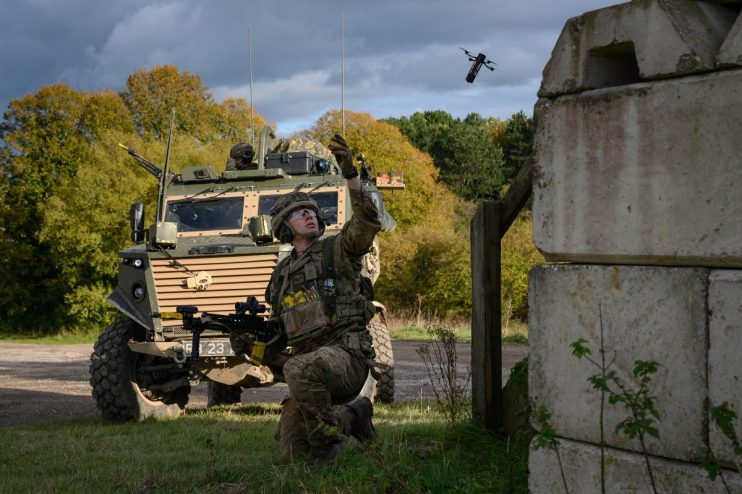
As autonomous warfare spending edges towards a quarter of the MoD’s budget, it makes sense to appoint a dedicated minister for drones, writes Michael Martins in today’s Notebook
A minister for drones is essential for modern warfare
It takes little time in defence circles to see that autonomous warfare is where the growth and investment is. The logic is simple: when machines can assume the risks once borne by soldiers, few politicians or generals will choose to risk human lives.
Public spending has already followed suit. Since Russia’s invasion of Ukraine, the UK has committed nearly £10bn, roughly one-fifth of the Ministry of Defence’s (MoD) annual budget, to drone and counter-drone capabilities. With Russian drones now routinely testing NATO’s sea and airspace, spending will inevitably rise in both offensive systems and in the layered defences needed to stop them.
As autonomous warfare spending edges towards a quarter, or even a third, of the MoD’s budget, it makes little sense for responsibility to remain scattered across ministerial portfolios. The Prime Minister should therefore appoint a dedicated minister for autonomous warfare. Such a post would recognise both the strategic importance and the industrial scale of this new domain, while bringing coherence, accountability and ministerial advocacy to a sector that many politicians still do not treat seriously. It would also create a ministerial champion to defend long-term, domestic investment from the Treasury reflex to raid capital budgets for short-term savings.
Instead, however, this summer’s reshuffle created an MoD minister for people, an odd move in a period defined by autonomy and artificial intelligence. Allies like Poland, Finland and Denmark are already moving toward dedicated ministers for autonomous systems. The UK, with its much more dynamic and developed AI and defence-tech ecosystem, risks falling behind.
A minister responsible for autonomous systems would not only consolidate procurement, doctrine and fiscal backing, but also act as a conduit for investors and manufacturers. Most major and high-growth defence companies are placing billion-pound bets around autonomy but struggle to find the right minister to speak to for a steer, often getting passed around between multiple departments before giving up. In an era of war and stretched budgets, that could have costly consequences.
‘Making Tax Digital’ will bring pain to small businesses
A friend recently told me they must file nine (nine!) tax returns next year. Corporation tax and four VAT returns for their limited company and four returns for the new Making Tax Digital (MTD). This is absurd. By the government’s own calculations, the only beneficiary of MTD will be HMRC, while the House of Commons’ Public Accounts Committee’s 2023 and 2025 inquiries show that MTD creates huge costs for small businesses. And yet this ostensibly “pro-growth” government will press ahead – likely to the benefit of Reform, the only party committed to cutting business taxes.
Striking statistics
Like most Londoners during last month’s Tube strikes, I spent a lot of that week walking long distances between meetings. On one such journey, I watched an ambulance spend seven minutes stuck in strike-induced traffic without moving. Who knows how long it took the person inside to receive proper medical care, and I can only hope they survived. Unsurprisingly, statistics show that death rates in September rose on both the previous month (13 per cent) and year (three per cent).
No 10’s favourite think tank misunderstands entrepreneurialism
The Resolution Foundation, where a disproportionate number of government ministers used to work, recently released a report that Chancellor Reeves will use to justify higher taxes on dividends, the way entrepreneurs pay themselves. The Foundation recommends “levelling the playing field” on tax between dividends and salaries, which makes me think pressing publish was the biggest commercial risk these think tankers have ever taken and belies how deeply they misunderstand entrepreneurialism. If the playing field was level, everyone would work for the civil service instead of taking risks to grow the economy.
Hooray for Instagram vigilantes
Like most Londoners, I try to avoid staring at my phone while walking, wary of scooter-riding thieves snatching it. And yet the Met Police tell me petty crime isn’t worth their time, a mindset echoed by the British Transport Police’s recent decision to stop investigating bike thefts at Tube stations.
With low-level crime now effectively outsourced to the public, one man has stepped in: Diego, the creator of Pickpocketlondon, an Instagram account that films and exposes thieves in real time. He patrols crime hotspots, brings media on ride-alongs and even tags repeat offenders with paint to warn locals. He’s become so effective that the Met have asked for his help solving cases.
I’d still prefer a functioning justice system, but in its absence, transparent, non-violent vigilance will have to do.
Michael Martins is founder of Overton Advisory