On this day 1571: The Royal Exchange is opened

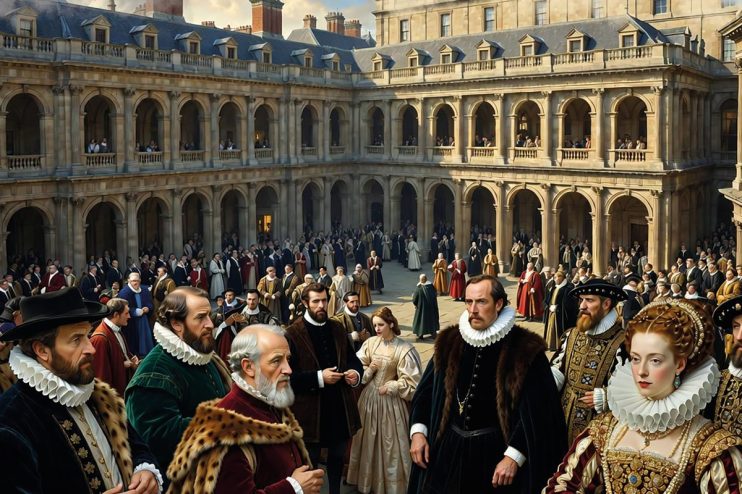
The Royal Exchange was opened by Elizabeth I 455 years ago on this day. Eliot Wilson traces the origins of its success
Tudor England saw massive changes in the economy and how it was understood and approached by the institutions of the state. A population of perhaps 2.1m when Henry VII seized the throne in 1485 doubled to 4m by the death of Elizabeth I in 1603, powering not just economic growth but transformation. Agriculture remained central to England’s wealth but it was the expansion of trade which allowed the country to begin muscling towards the front rank of economies.
Trade meant raw wool and finished cloth: the Lord Chancellor had sat on a Woolsack in the House of Lords since the 14th century as a constant reminder of its importance. And England’s most important trading partners were in the Low Countries, just across the Channel. This vibrant and expanding commercial relationship is where a man called Thomas Gresham enters the scene.
Gresham was the son of Sir Richard Gresham, Lord Mayor of London (1537-38), one of the four members of Parliament for the City in 1539 and 1545 and a rich and successful cloth merchant. He was three times Master of the Worshipful Company of Mercers and a senior figure in the Company of Merchant Adventurers. Thomas Gresham was admitted as a liveryman of the Mercers’ Company in 1543, aged 24, and shortly afterwards left for the Low Countries where he worked as a merchant either on his own account or for his father or uncle, Sir John Gresham, another Master of the Mercers’ Company.
The young Thomas Gresham lived principally in Antwerp at this point and quickly gained a reputation as a skilful and shrewd financier. The city was, in Fernand Braudel’s words, “the centre of the entire international economy”, not only a thriving port but a cosmopolitan hub of rich and ambitious merchants and bankers. It was Europe’s second-largest city north of the Alps after Paris and growing rapidly, and in 1531 it had seen the opening of the late-Gothic Handelsbeurs, the world’s first purpose-built commodity exchange.
In 1552, Gresham, by now a familiar figure among the many foreign merchants in Antwerp, was appointed as the King’s Merchant, the Crown’s agent in the city and responsible for managing the royal finances. He corresponded regularly with the secretary of state, William Cecil (later Lord Burghley) and became invaluable for his ability to raise substantial loans on reasonable terms on the financial markets; he helped Edward VI pay off almost all his debts and after a short period out of favour under Mary I was recalled because no one else could fulfil his role.
Gresham returned to London in 1567 as tensions between the increasingly Protestant population of the Low Countries and their Spanish Catholic Habsburg ruler Philip II grew into the full-scale violence of the Dutch Revolt.
The London stock exchange is born
His father Sir Richard had long harboured a desire to construct a London stock exchange, or bourse, modelled on the Antwerp exchange but had died with the ambition unfulfilled. Sir Thomas Gresham – he had been knighted by Elizabeth I in 1559 – made an offer to the City of London: if the Corporation provided a suitable plot for such an institution, he would pay for the building himself.
This was not unadulterated altruism. The London exchange, like the Handelsbeurs in Antwerp on which it would be modelled, would include shops on its first floor, and the annual £700 rental Gresham could realise from these commercial premises would in time more than pay for his initial outlay. The site chosen was on Cornhill, at the intersection with Threadneedle Street, and a lofty four-storey building with a central courtyard was constructed, using timber from Gresham’s estate at Ringshall, slate from Dordrecht and glass and woodwork from Amsterdam.
On 23rd January 1571, the Royal Exchange was formally opened by Queen Elizabeth I, its title reflecting her patronage. She and the court dined with Gresham at his mansion on Bishopsgate before proceeding to the newly completed bourse. It was open six days a week and there were two hour-long trading sessions every day, marked by the ringing of the bell in the Exchange’s tower.
For the first time, there was a dedicated meeting place for London’s wealthy merchant class, which displayed daily stock and commodity prices, the arrival and departure of ships and news of recent bankruptcies. For its first centuries, though, the Royal Exchange was open only to merchants trading in goods; stockbrokers were banned from the premises because of their “bad manners” and rowdy behaviour, and were forced to conduct their business in the inns and coffee shops which sprang up around the Exchange.
The Royal Exchange would have to be rebuilt twice. Gresham’s tall Flemish-inspired edifice was destroyed in the Great Fire of London in 1666 and replaced by a more classical design by Edward Jarman; this too burned down in 1838 after a stove overheated and caused a blaze which could be seen from Windsor, 24 miles away. The current neoclassical building, the work of Sir William Tite, was opened by Queen Victoria in 1844.
England was not the birthplace of modern commerce, but its merchants and financiers learned quickly. The establishment of the Royal Exchange attracted traders from across Europe and opened the door for the creation of chartered companies to exploit new overseas markets. The founding of the Bank of England in 1694 allowed the Crown to raise finance far beyond the abilities of rivals, and from the coffee houses which had been the home of the exiled stockbrokers sprang insurers Lloyd’s of London in 1689 and the London Stock Exchange in 1801.
These were the powerful sinews of the Commercial Revolution and the driving force behind the British Empire, and in a sense it started on Cornhill this week in 1571, under the watchful eye of Elizabeth I, Gloriana, and the man who financed that glory, Sir Thomas Gresham.
Eliot Wilson is a writer, historian and contributing editor at Defence On The Brink