My favourite Nasdaq-listed, Chinese-owned, Cayman-incorporated Scottish castle

A question: what’s the fastest-growing hotel group in Britain?
You might opt for Premier Inn, the Whitbred-owned budget chain that’s set to open more than 1,000 new rooms this year.
A wildcard choice might be Yotel, the group set up by Yo! Sushi man Simon Woodroffe that’s ballooned from a single site in 2007 to two dozen today.
But this kind of growth is paltry compared to the company I have in mind.
Per its latest trading update, this Nasdaq-listed business has seen a “301 per cent increase” in full-year bookings “as of June 20, 2025.”
The increase is in fact an understatement – because it compares the first five-and-a-bit months of this year with the whole of 2024. Pro-rated, we’re actually looking at a 749 per cent year-on-year increase.
This is, quite possibly, the fastest growth any hotel chain has ever seen, in all of human history. So, the stock must be popping, right? Sadly not.
In fact, it’s down about 98 per cent from its 2021 peak. The shares have become so worthless, earlier this year the firm faced a warning from Nasdaq that it risked being ejected from the exchange.
So what’s going on? The company’s headquarters help tell the story.
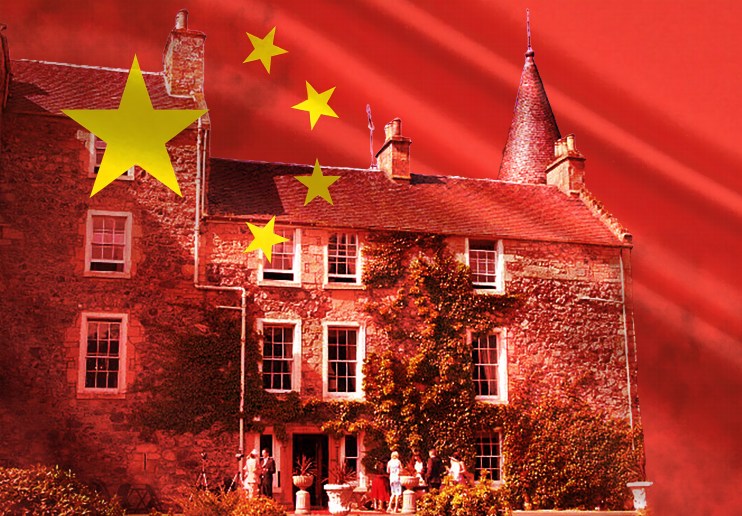
The firm’s registered head office is Fernie Castle, a remote 16th century tower house about an hour’s drive from Edinburgh. To my knowledge it is the only Nasdaq-listed company run out of a castle – quite the feat.
The site is thought to have been acquired in 1605 by Sir Michael Balfour, 1st Lord Balfour of Burleigh, who was appointed James VI and I’s Ambassador to the Duke of Tuscany and Lorraine in 1606. It was passed down over several generations.
The 6th Lord Balfour of Burleigh was the UK government’s Scotland Secretary between 1895 and 1903, while the 7th, George, was Chairman of Lloyds Bank from 1946-54.
Another family member, Francis, sold the castle to an hotel chain in 1960. And it was this chain that sold the site in 2022 to a mysterious China-based, Cayman Island-incorporated investor called MD Local Global in a £1.6m deal.
This post has been republished from my new Substack with City AM, which will peer into the zany, curious corners of the financial world in search of intriguing tales.
If you’re enjoying it — please do consider subscribing to the weekly newsletter. It’s free.
MD began life in the early noughties as an estate agent based in Tianjin in the east of the country. A string of major contract wins led the firm to expand across China in 2014, including into Chengdu, Suzhou, and Yangzhou.
Before the pandemic, the business became the primary estate agent contractor to a host of big developments, including by TEDA, the state-owned investment firm, and by insurance firm Ping An, China’s sixth largest company and a major HSBC shareholder.
MD was collecting millions of dollars each year in commission from new build apartment sales, until the firm suddenly plunged to a loss in 2021. MD’s MD, Siping Xu, decided it was time for something a little different.
“The cooling down of new construction in the residential housing market in China had a negative impact on our operation results,” Xu told shareholders.
“However, we are glad to see our establishment of a new joint venture company in the United Kingdom in August 2021 for asset management business, which was a significant step for our global expansion strategy.”
Change of plan
So out went the Chinese estate agency, in came the new UK plan: to “seek to acquire, transform and preserve high-quality historical and cultural assets while providing exceptional experiences and integrating values of faith and morality into the respect for architecture, conveying its operational philosophy to the public.”
18 months later, in early 2023 MD confirmed it had acquired the cultural assets it was looking for: Fernie Castle, and a B&B in Torquay. By May it said both had been renovated and reopened.
And it was this Torquay B&B, The Robin Hill, that produced the phenomenal growth I mentioned earlier. Except, it’s not quite as phenomenal as might appear. Because the number of nights booked there last year, which has since grown eight-fold, was just 227.
Its 20-odd rooms were booked an average of just over a week year: an occupancy rate of about 3 per cent. Indeed the firm reported revenues of only $48k for 2024.
Unfazed by this performance, MD has vowed to go further and faster. In April last year, the firm said it was gearing up to renovate (again?) and expand Fernie Castle, plans which “have passed initial review by the Fife Council in Scotland”. In February this year, MD said it had integrated the use of ChatGPT to help design a new Chinese-themed 10,000sqm garden outside the castle; in March it launched a new “cultural” e-commerce platform, and in May it hired a new French cuisine-trained “culinary chef” to open a new high-end restaurant at the B&B.
Except: To date there has been no planning application with the council; the e-commerce platform doesn’t exist; and the star chef is the guy who used to run the canteen at Devon police station, whose signature dishes (which the hotel has expertly filmed) are mushroom soup and rice pudding.
As for the castle, it’s been hard to find evidence anyone has stepped foot in it for the past two years. The website accepts no online bookings, and since the takeover, there’s only been a single, anonymous Google review: “I was disappointed to turn up at Fernie Castle to find it run-down and dilapidated. It looks like the Chinese company that bought this property is letting this castle fall to ruins. What a shame.”
So quite what this Nasdaq-listed firm is really doing is unclear – they did not respond to my questions or a request for comment. The rice pudding looks decent, mind you.