Gorton and Denton proves messy, multi-party politics is here to stay

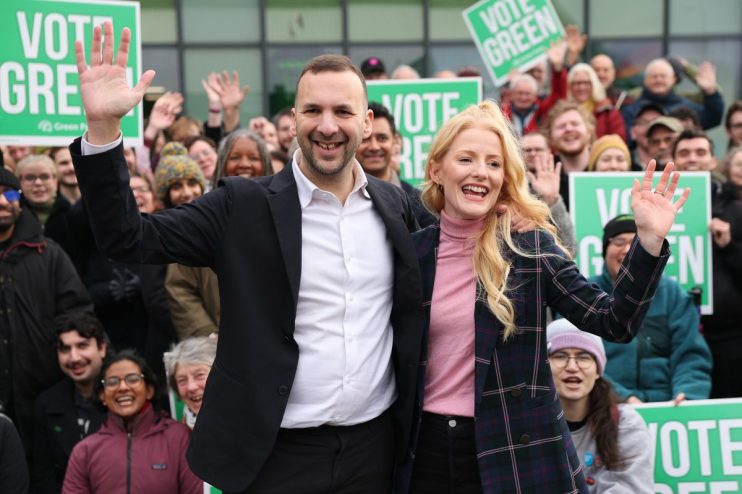
A resounding win for the Greens in the Gorton and Denton by-election reveals just how fractured and angry voters are becoming, writes Scarlett Maguire
In what we may now distantly remember as ‘ordinary times’ Labour should never have lost Gorton and Denton, even on a bad day, let alone finished third on less than 10,000 votes. Yes, governing parties (nearly) always get a bit of a kicking in by-elections, yes the circumstances for this by-election were particularly unfavourable for Labour, yes the best candidate was blocked from standing. But even so, not just a Green win, but a resounding one on 40.6 per cent of the vote, should have been out of the question.
The final count confirmed what anyone looking at the polls over the last 12 months could already tell you: we are now living in a time of messy, multi-party politics. But, they also revealed interesting dynamics, especially when it comes to tactical voting, that will really matter when it comes to 2029.
Keir Starmer outlined his strategy for the next general election at the Labour party conference back in September, painting the next few years as a direct fight between him and Nigel Farage for the soul and future of the country. This was an odd thing to do so far out from 2029 when the next election is currently due to take place, but the premise was also potentially flawed in other more fundamental ways too.
Firstly, there is clearly a strong desire amongst parts of the electorate to ‘stop Farage’, and in principle greater support for a Labour/Liberal Democrat coalition than Reform/Conservative one. But the realities of a fractured politics under our first-past-the-post system means that it will be difficult to say on a constituency by constituency basis who is best placed to block Reform.
Gorton and Denton provided a curtain raiser on just how toxic and confusing the battle to be the challenger party will be in hundreds of constituencies
Gorton and Denton provided a curtain raiser on just how toxic and confusing the battle to be the challenger party will be in hundreds of constituencies if a) the Greens remain hostile to the Labour leadership and b) the parties on the left remain as clustered as they are in current opinion polls (the latest Yougov poll has Labour on 18 per cent, Greens on 17 per cent and the Liberal Democrats on 14 per cent). It seems unlikely that Zack Polanski’s Greens will reconcile themselves with Labour as long as Starmer remains in place, and Gorton and Denton will likely fuel the Greens’ rise further. Approximately half of current Labour voters are currently considering the Green party, and their biggest barrier has not been ideological, but a belief it would be a wasted vote. This equation will start to change in the Greens favour, especially after their first ever by-election win.
Secondly, we still do not know whether progressive voters and those on the centre-left are prepared to rally behind such an unpopular Prime Minister and government. Labour, having won more than 50 per cent of the vote in Gorton and Denton in 2024, should have been the obvious choice to stop Reform. We often talk about how voters tempted by Reform want change, however what we can see from these results is that sentiment is shared by voters on the left and the right of British politics. Indeed, it is Green voters and Reform voters that are most likely to think that ‘Britain is Broken’. Talk of how the Greens are extremist is unlikely to persuade voters to whom the current status quo is not just unfortunate but unforgivable. That message is unlikely to work in a world in which the two main parties could go from 86.1 per cent of the vote in Gorton and Denton in 2019 to just 27.3 per cent in 2024.
Thirdly, the potential for a tactical vote on the right is largely ignored in these conversations. More Conservative voters would rather see a Conservative/Reform coalition than a Labour/Lib Dem one. In Gorton and Denton, Conservative voters who prioritised stopping Labour/Greens self-sorted remarkably into the Reform camp, with the Conservatives recording just 1.9 per cent of the vote, losing their deposit for the first time in a by-election in decades. This wasn’t enough for Reform to win, and they still finished a distant second behind the Greens, despite a very bullish start to their campaign. The better the Greens do nationally, the more likely wavering Conservative voters back Reform in seats where they look likely to win, just as Corbyn was arguably as much of a factor in Boris Johnson’s 2019 landslide as Brexit.
A setback for Reform?
In some senses, this won’t be too troubling for Reform HQ. The seat was 413th on their target list, and they managed to outperform the combined Conservative and Brexit party in 2019 (28.7 per cent to 23.8 per cent). However, the result does leave some strategic questions potentially unresolved, most fundamentally how to rally their base at the same time as not driving support against them. The party performs better in low turn-out environments, however we have seen in Caerphilly and in Gorton and Denton what a powerful motivator stopping the party can be to voters who may otherwise have stayed at home.
Much of this is not set in stone. By-elections shape as well as reflect current public sentiment. Starmer has been weakened by this result, and a change of Labour leadership, or to a lesser extent direction, could change much of the electoral calculus. Likewise, Reform’s polling success is to a significant extent determined by their ability to remain dominant in polls and elections, and if the party under-performs in May or loses ground in the polls we could see things shift more substantially on the right as well.
However the maths shakes out, one thing that is less easy to change is the fundamental truth behind last week’s shock result: voters across the spectrum are unhappy with the state of the country and angry at the political class’s perceived inability to fix it.
Scarlett Maguire is founder and director of Merlin Strategy