City of London gives green light to controversial Liverpool Street plans

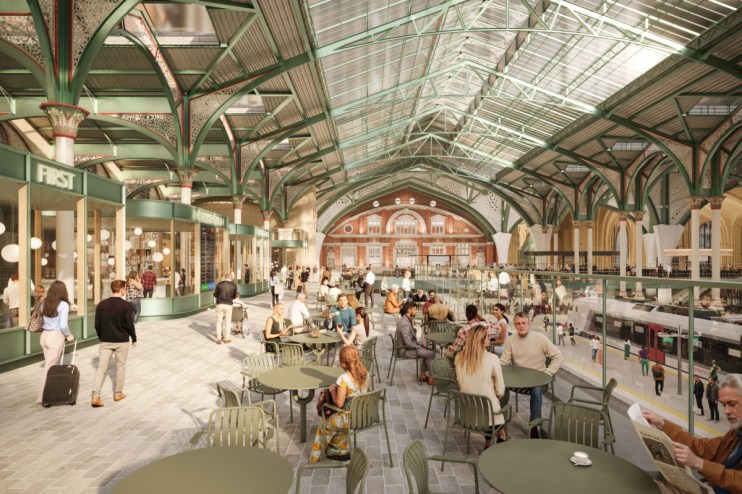
The City of London Corporation has granted planning permission to Network Rail’s controversial redevelopment of Liverpool Street station, with councillors saying it will be a “modern temple of transport”.
The proposals will help increase the capacity and accessibility of Britain’s busiest railway station, but objectors warned that the scheme was “unviable and undeliverable”.
In total, 19 members of the Corporation’s planning committee voted in favour of the scheme, with three voting against. Chris Hayward, policy chair of the Corporation, said the redevelopment was a “major step forward” for the Square Mile.
“As competition among global cities increases, we must demonstrate our openness to new investment that will enhance our urban environment and Liverpool Street station will now continue to do just that,” he said.
The scheme will introduce step‑free access at every station platform, including the London Underground, while an expanded concourse will greatly improve passenger congestion.
To help fund the scheme, a 19-storey block will also be constructed over the station concourse, the most controversial element of the proposals.
Heritage groups sound alarm
Heritage groups have warned that the proposals will cause substantial harm to heritage assets, including the Andaz Hotel, which abuts the station, and the fabric of Liverpool Street itself.
Speaking as an objector to the scheme, Sir Simon Jenkins, former editor of the Times and the Evening Standard, said “everything about it looks odd…I beg you to defer it”.
Objectors also highlighted that the scheme faces a funding shortfall of £200m, which does not include possible compensation costs for rail disruption.
John McAslan, an architect whose practice submitted an unofficial alternative design for the redevelopment, said Network Rail’s plans were “unviable and undeliverable”. He said his proposals showed that the station could be upgraded without damaging the station.
But Network Rail argued that the over-station development was the only possible way to fund the £1.2bn scheme, while committee members said that it was not unusual for major projects not to be fully balanced.
Gaby Robertshaw, a councillor for Cripplegate, also noted that the project did not have central government funding, unlike other station redevelopments at King’s Cross and London Bridge.
“I cannot fail to be moved by the objections from the heritage lobby which we have heard today,” she said.
“But Liverpool Street station has no brownfield site, it has no government handout…This scheme gives us the opportunity to provide a world class station for our workers, our residents, and our businesses.”
Tom Sleigh, chair of the planning committee, said it was vital for the City to back investment schemes which would keep London competitive. “Stasis kills cities,” he said.
“The soaring brick arches and bold architecture will cement Liverpool Street’s status as a modern temple to transport,” he said.
Passenger numbers at Liverpool Street are expected to rise to 158m by 2041, up from just under 100m entries and exits last year.