Celebrating Pan Am’s iconic legacy as airline plans return to the skies

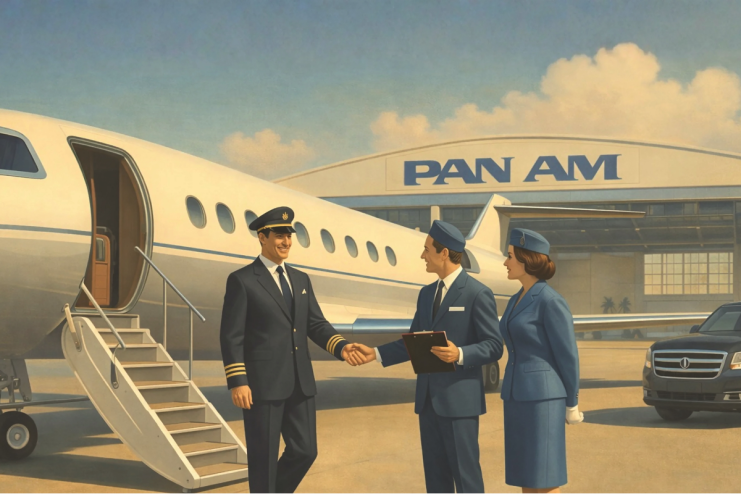
Pan Am was the airline that defined the jet-set timepiece. Sam Kessler asks what made Pan Am an icon and why it’s still catnip for watch collectors
It’s hard to talk about air travel without talking about Pan Am. Pan America Airways wasn’t just a big name in cross-continental flight: it was essentially a monopoly. The first and only operator when it was founded in 1927, its famous blue and red livery became synonymous with the golden age of air travel. Think cigarettes over perfectly mixed martinis halfway across the Atlantic.
It wasn’t always the luxury icon it became, though. Pan Am started life as a mail service between Florida and Cuba, using ‘flying boats’ that could land without runways rather than modern jets. By 1935 the airline was using these ‘Clipper’ aircraft across the Pacific and by the end of the decade it had expanded into transatlantic flight. It even transported uranium for allied forces during WWII. I’m guessing it wasn’t in hand luggage.
All of this is to say that Pan Am has had an oversized historical hand in our modern concept of air travel. Whether that’s a good thing likely depends on what class you fly, but if you look forward to a glass of champagne as you take your reclining seat, you have the red and blue to thank. And it’s not just aviation history Pan Am has influenced but horological history, too.
As flying across timezones became more and more common, pilots needed a way to keep track of not just the time where they were, but the time where they were going. It wouldn’t do for your watch to be out of sync with your landing time, and while pilots could sync up using radio signals, having a reference point on your wrist was much more efficient.
Pan Am and a fascinating chronograph history
To that end, Pan Am worked with a little-known Swiss watchmaker to build timepieces specifically for its pilots. Rolex had already released its first production watch with a rotating bezel, the 1953 Turn-O-Graph, which had been adopted by the US Air Force Acrobatic Team. It was also a bit of a looker: what better base to pair with a dashing pilots’ uniform?
The Turn-O-Graph, however, didn’t have any additional functionality beyond a rotating bezel. And so, Rolex added a fourth hand: a 24-hour GMT. This hand travelled at half the speed of the normal hour hand, using a 24-hour scale on the bezel. As that bezel could rotate, you simply set it to your timezone of choice. The finishing touch was both an aesthetic masterstroke and an additional bit of functionality: splitting the 24-hour bezel into day and night using Pan Am’s famous blue and red.
When it was originally released in 1954, the newly christened GMT-Master was an instant hit with pilots and watch lovers alike, so much so that it became more widely available in 1955. We have Rolex to thank for the ubiquitousness of the term “GMT” to mean a watch with a second timezone. A few years later it was refined with crown guards and a more practical aluminium bezel to replace the bakelite of old, but even in those early days it was the wrist-mounted expression of the golden age of international air travel.
It’s worth noting that Rolex didn’t make the first dual timezone watch. The Longines Zulu Time had similar functionality decades earlier. But that was a military watch; by tapping into commercial aviation, playing into the freedom and glamour of transatlantic flights aimed squarely at the most well-heeled of the well-travelled, it became truly iconic – perhaps more so than the airline that commissioned it.
After decades of struggling, Pan Am went under in 1992
Indeed, while most readers will recognise the Pan Am colours on a GMT, you’d probably call it “Pepsi”. That’s partly due to Rolex getting bigger than God (in watch terms), but also because the watchmaker outlasted the airline. During its heyday between the 1950s and 70s, Pan America Airways flew 11 million passengers to 86 countries. It famously had destinations on every continent bar Antarctica. It was the official US passenger airway and despite other airlines cropping up, it maintained its near monopoly until the 1970s. It was the chosen, the protected, the elite… until 1978’s Airline Deregulation Act.
It is telling when competition straight away leads to financial problems, and Pan Am almost immediately went through financial restructuring. Rolex, meanwhile, introduced its follow-up to the seminal GMT-Master, the GMT-Master II.
This included a 24-hour hand that could be independently set from the local time, rather than just being a slower hour hand. Paired with the rotating bezel, this meant you could track three timezones. The modern travellers’ watch was born.
After years of struggling to stay aloft, Pan America Airways went under in 1992. It was less the tragic end of an era, more a slow fizzling out of a once-iconic airline that just couldn’t compete anymore. The fact we’re left with Ryanair and Easyjet only twists the knife. And yet there’s still no better symbol of that bygone era of transatlantic glamour – something a fair few watchmakers have capitalised on over the years.
In 2019, Breitling introduced the Navitimer 1 B01 Chronograph 43 Pan Am Edition. This made a lot of sense, given Breitling’s flagship is still the quintessential pilots’ instrument, with its technical slide-rule bezel. The edition’s sexy, 1970s style made it look and feel like the official Pan America Airways watch it never was.
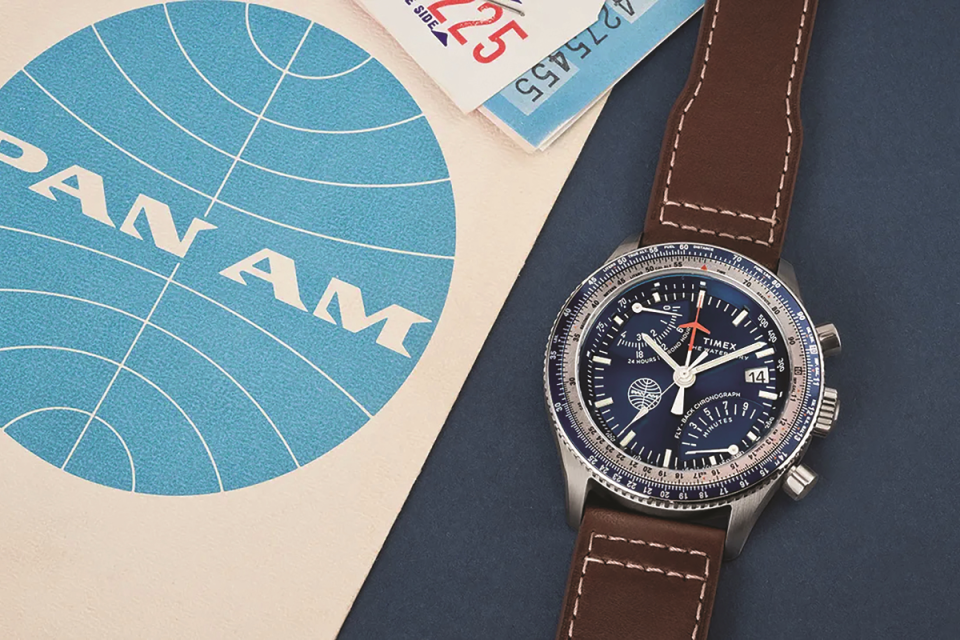
Timex’s fully-fledged Pan Am collection is a little different. It uses the airline’s logo – mostly blue and a few hints of red – but it veers into military-style pilots’ watches, more akin to budget IWCs than anything you’d see in a commercial cockpit. There’s nothing wrong with that necessarily – it’s temptingly affordable – but it doesn’t exactly scream martinis and cigarettes 30,000 feet up.
Until recently that would have been the end of Pan Am’s story: a place in the history books and a clutch of affordable watches using its name. But that would be a sad place to end things. The good news is: Pan America Airways is back, although ‘commercial’ might not be the best word to describe its new guise.
The first journey in over three decades
Back in June, Pan Am launched its first journey in over three decades, retracing its original transatlantic flights on privately-owned aircraft. This was more of a statement of intent than a genuine comeback, however, announcing to the world that, backed by AVi8 Capital, the airline has some serious plans. Since then, it has announced a series of journeys for 2027 – and I do mean “journeys” rather than flights: this is an end-to-end travel service encompassing safaris, cruises and even a trip to the Ryder Cup.
If Pan Am is starting to sound more like a lifestyle brand than an airline, that’s because it is. While it plans to return to a ‘major US airport’ at the end of this year (precisely which is unknown), there will also be a Pan Am Hotel and a Pan Am experience, of which details are thin on the ground.
As flight times have gotten shorter and flying has become cheaper, the lustre of air travel has been tarnished. Commercial airports are now hellscapes of confused tourists and invasive security guards. Perhaps the way to recapture the glamour of the ‘70s and earlier is to curate the entire experience.
Of course, this new era needs a fresh watch. Rolex has grown beyond these kinds of partnerships, and so British watchmaker Christopher Ward has stepped into the breach with its C60 Clipper GMT. Named after those early flying boats, the C60 leans into the airline vibe. It has a jet-shaped seconds hand and airport codes replace the hours on the rotating bezel. With a solid mix of blue and red livery, it wears its relationship quite literally on its sleeve. Sadly all 707 pieces (geddit?) have been sold.
That’s not a surprise: it was a great looking watch for £1,450. But it also goes some way to showing just how influential the idea of Pan America Airways still is.
Sure, it disappeared for a few decades, but its influence on the watchmaking canon did not and now it’s back in jet-set style. Here’s hoping we see more of the livery that defined the golden age of air travel. If it comes with that martini, all the better.