Buy now, sell-off later: Where did Klarna’s IPO go wrong?

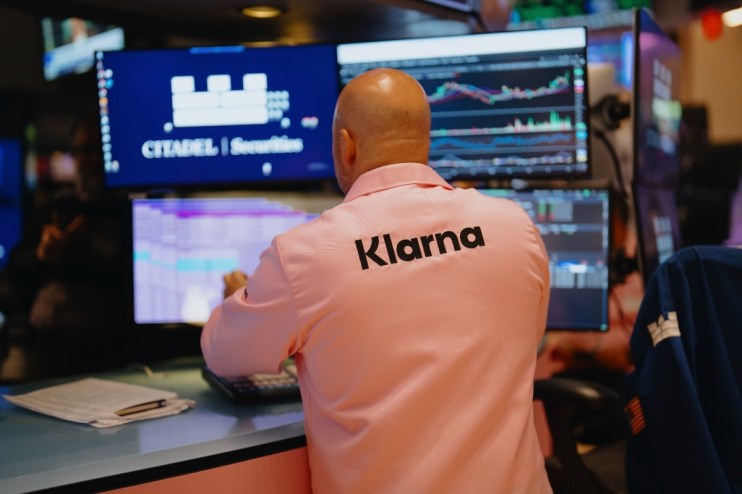
When Klarna finally kicked off its Wall Street listing in September chatter quickly emerged whether the move would open the floodgates to a fleet of fintech listings.
With the likes of Monzo, Zilch, Revolut and Starling all speculated to be eagerly waiting in the wings, all eyes were on the Swedish unicorn as a taster of investors’ appetite for fintech firms.
And for a moment the momentum looked to be on the pay later pioneer’s side. Klarna’s stock popped 15 per cent from its 20 times oversubscribed IPO and the firm closed its first trading session at $45.82, from $40 at open, after raising $222m.
While rumblings of an influx of fintech listings ran rife, it didn’t take long for cracks to rapidly start forming.
Six months after its IPO, Klarna’s stock has shed over 67 per cent, its share price has sunk to around $14 and the firm’s value has been slashed to just over $5.2bn (£3.9bn) from $15bn, a drop which could have pushed the firm out of the FTSE 100 index had it instead chosen to float in London.
The dire performance has left the fintech ecosystem with a bated breath for future listings as they conduct an autopsy on where it all went wrong for Stockholm’s hot pink payments giant.
Ahead of the New York float, analysts had raised concerns about the $15bn (£11.3bn) price tag. Philip Atkinson, analyst at Thirdbridge, told City AM the valuation was a major haircut “beneath experts’ estimations of £18.5bn to £22.15bn” and could be viewed as a “bargain price”.
Klarna swallows the cost of becoming a bank
The landmark listing – which was delayed to the second half of the year after President Donald Trump’s tariff offensive – came as Klarna ploughed onward with its transition to ditch its buy now, pay later label and become a digital bank.
But the costs in this endeavour have eaten away at the firm’s bottom line. Klarna made a loss of $62m in the final quarter of 2025 and $273m for the full-year.
“Klarna’s post-listing woes have gone from bad to worse with disappointing earnings today compounding an already poor start to life as a public company,” Samuel Kerr, head of global equity capital markets at M&A data service Mergermarket.
Blame was quickly put down to the growing fair finance product, which requires a lump of cash to be set aside for credit losses on day one of issuing a new banking loan.
Co-founder and chief executive Sebastian Siemiatkowski said growth outpacing expectations had meant those day-one provisions “temporarily weigh on margins, even when credit equality remains strong and lifetime economics are attractive”.
Though investors didn’t seem soothed by the comments – or the firm’s first $1bn quarter – with Klarna’s stock tumbling 27 per cent following the fourth-quarter release.
The bruising fall left a “challenge for company bosses to maintain investor confidence,” said AJ Bell head of financial analysis Danni Hewson.
“Whilst promises of jam tomorrow are frustrating for those who’d rather enjoy their jam today, the company is growing rapidly and navigating away from the short-term loans to cover retail purchases that it is best known for.”
Hewson added there would also be concern around the ability for consumers to keep up to date with payments due to “pressures from the uncomfortable cost of living”.
Klarna booked $250m in provisions for credit losses in the fourth quarter, whilst provisions as a percentage of GMV inched down to 0.65 per cent from 0.72 per cent. But this remained sharply elevated from the $156m recorded at the end of 2024 at 0.53 per cent of GMV following growth in customers.
As a European firm listed in the US, Kerr said Klarna would not be able to rely on a “homegrown fan base of investors to back what they saw as its true value” putting it at risk of being an “orphan stock”.
Fintech IPOs on pause?
Woes from the latest earnings update did find their way back to Europe and into London’s FTSE 250.
UK investment trust Chrysalis Investments – where Klarna and Starling combined make up around two thirds of the firm’s portfolio – tumbled two per cent on Thursday following the news.
Analysts at Panmure Liberum said much of Chrysalis future now rested with Starling with an outcome “overwhelmingly determined by the terms on which [the company] is eventually realised”.
But with Klarna’s battered share price serving as the main temperature check for the fintech IPO landscape, questions have been raised over the timeline for the next public debut.
The boss Zilch – widely considered a key rival to Klarna on the payments front – has been bullish on a London IPO, previously telling City AM: “Everything has some meaningful step towards that outcome”.
In November, the firm’s chief Philip Belmant shrugged off the fall in Klarna’s stock – which had topped a fifth at the time – as “a bit of downward pressure”.
But analysts are not so sure: “Unfortunately, when stocks disappoint after an IPO in the way that Klarna has, it can damage the prospects of other IPO candidates in the same sector,” Kerr said.
“It was a tough environment for fintech IPOs anyway with so much disruption in tech stocks due to the unknown impacts of AI on established business models and Klarna’s fall doesn’t make it any easier.”
US markets have been taken for a tailspin in the last few months with record highs followed by sharp contractions amid rising fears around AI.
The AI buzz is an area where Siemiatkowski tops his peers for bullishness, with the Klarna chief touting efficiency savings through automation.
The fintech is expected to shrink its workforce from 3,000 to 2,000 by the end of the decade, according to the top boss, who is a shareholder in OpenAI and Perplexity through his family investment vehicle Flat Capital.
On a call with analysts in November, Siemiatkowski the company had made a commitment to employees that all “efficiency gains” would come back “in their pay cheques so that they are fully incentivised… aligned with the investors”.
Though he promised swelling pay packets, the numbers didn’t quite manifest for investors. Klarna ended 2025 with a net loss per share of $0.79 and countless traders scouting for the exit door.