Ambassador Suzuki: Britain and Japan are partners for security and prosperity

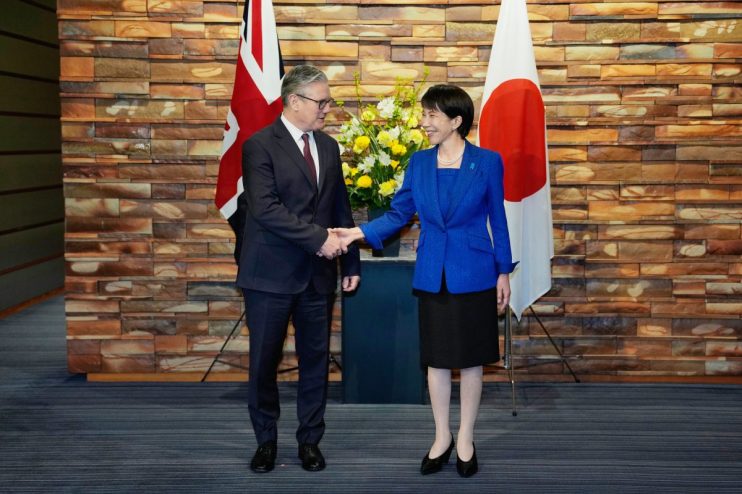
Japan remembers the vital assistance and friendship Britain gave after the devastating earthquake 15 years ago today. Together our countries will face the global challenges of today, says Hiroshi Suzuki
Today marks 15 years since the 2011 Great East Japan Earthquake and tsunami, which claimed over 19,700 lives and left over 2,500 people still unaccounted for. For Japan and Britain, the anniversary is also a reminder that the strongest strategic partnerships are not built on transaction, but on trust. Trust, however, is not only about sentiment. It is a strategic asset that underpins our ability to meet common challenges.
Britain’s response in 2011 is deeply remembered in Japan, and March 11th serves as a reminder of who stood alongside us during hardship. The United Kingdom was among the first to respond. British teams arrived to assist in the search for survivors. Drinking water and radiological equipment were dispatched, and millions were mobilised for donations. In 2015, HRH The Prince of Wales (the then-Duke of Cambridge) visited the disaster-affected communities, and I had the privilege of being present with Prime Minister Shinzo Abe for the occasion as his private secretary. I witnessed firsthand the significance such gestures carry for people still bearing the weight of grief.
As the Japanese Ambassador to the UK, I would like to reiterate our sincere gratitude to the unforgettable assistance we received from the British people. The Japanese people, encouraged by such support, have largely reconstructed the disaster-stricken areas, building stronger communities with infrastructure that is more resilient to future disasters.
The risks modern nations face are increasing: cyberattacks, supply chain disruption, pressure on food and energy systems, and the compounding impacts of climate change. In such a world, resilience is what enables societies to adapt rather than fracture. Japan has learned, time and again, that resilience must be built deliberately. In a world marked by diverse risks and persistent uncertainty, these challenges present an opportunity to renew and strengthen our investment.
Under Prime Minister Sanae Takaichi, who won a landslide victory in the recent general election, Japan will further intensify its strategic investment in crisis management to address various risks, including economic security, food security, energy security and cybersecurity, as well as in robust growth by fostering advanced technologies such as AI and semiconductors. In the UK, too, those priorities are moving to the centre of policy making. The challenge we share will serve as a catalyst for even closer and deeper cooperation.
The Japan-UK relationship has accordingly developed in practical and sustained ways, marked most recently by Prime Minister Keir Starmer’s visit to Japan. The two leaders committed themselves to advancing concrete cooperation in industrial strategy and economic security. They further affirmed the urgent need to work together to fortify supply chains, particularly those involving critical minerals, and agreed to upgrade cyber cooperation.
Shared resilience
Energy security is an equally urgent domain of resilience where our interests converge. Cooperation on offshore wind, civil nuclear power, and the broader energy transition demonstrates a shared understanding that energy transformation is inseparable from economic security and national resilience. Japan, with more than 920 companies creating more than 210,000 jobs in the UK, will build on the decades-long economic partnership and continue to work with the UK by advancing joint research with British institutions and supporting investment in the energy transition.
Our defence cooperation has also evolved as a central pillar of shared resilience, advanced with equal determination to enhance our posture and readiness. The Global Combat Air Programme, undertaken jointly by Japan, the UK and Italy, represents perhaps the most ambitious expression of our trust. It requires a multi-decade sustained alignment in coordinated industrial efforts, national strategy and political will, but even more importantly the confidence in one another’s integrity and reliability, especially when it matters most.
It is forged when partners act with resolve and solidarity in moments of crisis, and strengthened when they invest together in the capabilities that protect their citizens; from natural disasters to cyber threats, from energy shocks to geopolitical instability. That is precisely what the UK demonstrated in 2011. Such actions embody the very qualities that sustain strong and enduring partnerships.
As the Russian invasion of Ukraine has entered its 5th year, Japan is imposing severe sanctions on Russia and is a leading donor providing approximately £14.5bn of bilateral assistance for Ukraine. This embodies Japan’s conviction that the security of Euro-Atlantic and Indo-Pacific are inseparably intertwined, and we must restore/secure the rule-based international order. As we stand at a crossroads of history, it is now both natural and necessary for Japan and the UK to work closely across a wide range of fields, grounded in shared values and strategic interests. As Japan’s ambassador to this great country, I will devote my utmost efforts to advance this work, so that our partnership continues to deliver security, resilience and prosperity for both our peoples.
Hiroshi Suzuki is Japan’s Ambassador to the UK.