Jeremy King: My honest thoughts on The Ivy £1bn sale

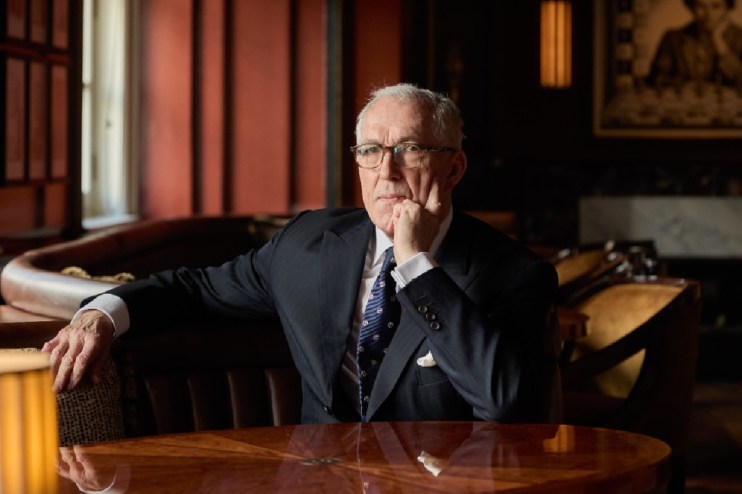
The Ivy and Simpson’s in the Strand restaurateur on holding his nerve, having no regrets and bringing fun back to London dining
“People come in crying,” says Jeremy King from a white tableclothed banquette in his new British restaurant, Simpson’s in the Strand. “They have so many stories: my father brought me here, my godfather brought me here…”
You’d think such displays of emotion would be unusual but weepy-eyed dinner guests have become old-hat for King. People would also burst into tears upon entering Le Caprice, which he also ran for 38 years.
Think of the original Ivy, The Delaunay, Brasserie Zedel and The Wolseley and you have Jeremy King to thank. Together with his former business partner Chris Corbin, the duo have run some of the most successful London restaurants of the latter half of the last century. Their formula for pairing 1980s opulence with affordability and quality appealed to the A-List and restaurant critics alike, although part of King’s success has been bringing fine dining to the masses. “If a restaurant becomes really expensive, it often becomes very boring,” he says. “A lot of the most interesting people are the less affluent.”
Simpson’s in the Strand: The Ivy restaurateur returns
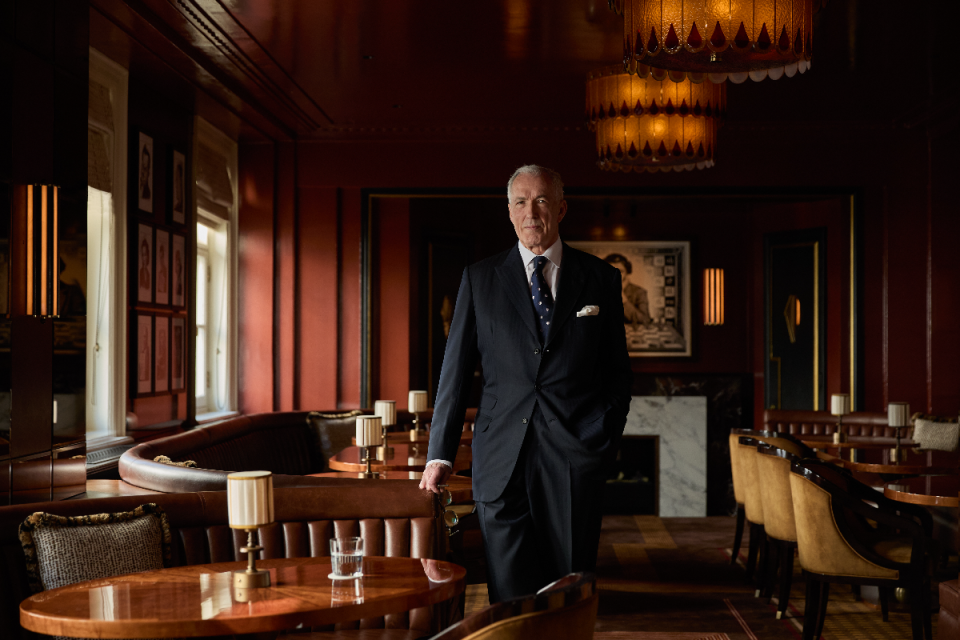
All of this is to say that the reopening of Simpson’s – which closed in 2020 after more than a hundred years of trading – is serious news. The dining room, which he describes as “effectively Edwardian”, retains its original oak panelling, triple-height ceilings and tableside carvery experience.
The fact it feels as if nothing has changed in a century is testament to the sensitive redesign, which is so convincing that it’s giving King grief. “One guy pointed at these booths and said that between 1995 and 2020, he sat there at least twice a week,” he laughs. “I didn’t want to embarrass him, but the booth didn’t exist during that period.”
How does King explain all this emotion? “People want to belong,” he says profoundly. “And my job is to make people feel that they do.”
Where does the man often dubbed the UK’s greatest restaurateur feel like he belongs? “I’ve never felt that I’ve belonged,” he says. “One might say it’s imposter syndrome, but it’s not so much. It’s more just not knowing.”
This feels like some confession from the man who enticed A-List royalty including Princess Diana, Laurence Olivier, Lauren Bacall and Lucien Freud to become regulars to The Ivy and Le Caprice.
Jeremy King’s restaurant secret: hold your nerve
What’s his secret, then, given half of restaurants opening in the capital close within two years? “People don’t hold their nerve,” he says of his competitors.
Another essential element – perhaps surprisingly – is affordability. There are three courses for £25 at Romano’s, the other restaurant within Simpson’s in the Strand. Investors were angry during the opening phase of Brasserie Zedel, his French restaurant near Piccadilly Circus, when he put a bowl of soup on the menu for £2.25, but low prices led to the restaurant gaining cult status. “The whole board ambushed me and said when are you going to realise this is never going to work? When are you going to realise your vanity project is potentially going to destroy the company? I had control so they couldn’t make me stop. We held our nerve, and it worked.”
He “bucks against” data from his marketing teams, preferring to follow his instincts. “Everything nowadays seems to need proof of concept and I lament the fact that we’re not allowed to use our instinct or intuition… I get presented with all sorts of marketing and return on investment advice and often it’s wrong.”
The proof is in the pudding, at least in food terms: he gives the impression that part’s a doddle. “People think what’s required is fussy food. Out comes this plate which is all finely chopped, dots around, drizzles, the one thing that’s missing is actually the piece of chicken is not very good.” What people actually want, he says, is ”very good quality ingredients, simply cooked. The discerning person wants a really good piece of fish with an excellent hollandaise and veg. We’ve started to learn that it’s fun to go out for dinner. It needn’t be fussy. For a long time the British lost that understanding.”
The Ivy London: rolling out the brand wasn’t in my capability
Simpson’s also seems in tune with our modern desire to escape our screens. It offers the opportunity to ‘buy’ cash to tip the meat carver, which feels deliciously analogue. There are suited servers and portraits of Victorian noblemen and women. He says of his longtime design collaborator Shane Brady, with whom he worked on Simpson’s: “We have this innate understanding that design should never shout for attention but should withstand scrutiny and I think it’s the same for food. Great food doesn’t have to be embellished.”
Despite his self belief, he doesn’t have a distinguishable ego, although he relishes telling stories from his half a century at the pass. During an hour and fifteen minutes together, he regales me with stories of racing cars with Princess Diana and fending off bomb threats from the IRA during service at Le Caprice. He often says pithy, poetic things like: “To sack, to seduce, to divorce – the restaurants I like are the ones that allow you to do all that.” Or: “Show me a restaurant with a fantastic view and you show me a boring restaurant. A third are looking out the window, the other two thirds are disgruntled they didn’t get the window view.”
Despite the challenges facing hospitality, he is resolutely positive about… well, just about everything. Before our interview I was told not to ask him about The Ivy, a brand that was sold last week for well over a billion pounds. After turning the restaurant into London’s hottest celeb magnet throughout the 1990s, Corbin & King sold it for £13million to the restaurateur Richard Caring in 2005. He franchised the venue and there are now over 50 Ivy restaurants across the UK, but the downside has been that the flagship has lost its clout now that there is an Ivy on every corner. However, there is no denying Caring’s financial achievement.
‘Have I been back to The Ivy? Only once’
When King brings up the himself, apropos of nothing, I can’t help but ask if it stung a little to see the billion pound sale, given he and Corbin sold it along with the rest of Caprice Holdings, (which included Le Caprice and J. Sheekey) for a smidgen of that? “It doesn’t worry me cause I couldn’t have done it. It’s not in my capability to have taken that brand and rolled it out: it takes a very, very different mentality. Things move on, things change. Everything is transitional.”
He says he’s only been back once, “for old time’s sake…” He’s affable as ever when he adds: “I imagine it’s still doing well…”
Over the years King has rolled with the punches. In 2022, he was ousted from Corbin & King after a bidding war to buy the firm out of administration. Winners Minor International renamed the group The Wolseley Hospitality Group, which retains The Wolseley, Delaunay and Brasserie Zedel. So he set up Jeremy King Restaurants, from which he operates Simpson’s alongside newcomers Arlington and The Park.
Ozempic, taxes and sober Gen Z… No problem!
Today the problems are people drinking less and ozempic and minimum wage hikes and the cost of living. But King seems unperturbed. “In the ‘80s I had bomb threats at Le Caprice. ‘The restaurant’s gonna blow at 8 o’clock!’ I’ve had worse… It’s painful but it’s going to be very positive.”
His stories of calling last food orders at 1am in the 1970s when he was working over the road at Joe Allen steakhouse seem unthinkable now. At five past one in the morning, diners would be dismayed at being turned away. Is the capital as fashionable today as it was back then? Yes, he says instantly. “That I know for sure.”
He seems to know much for certain, although he’s the first to acknowledge that holding his nerve doesn’t guarantee success in the future, only that it has so far. “I never for a second feel that it’s safe,” he says. “I just keep working at it.”
• Go to simpsonsinthestrand.co.uk