On this day: The death of JP Morgan

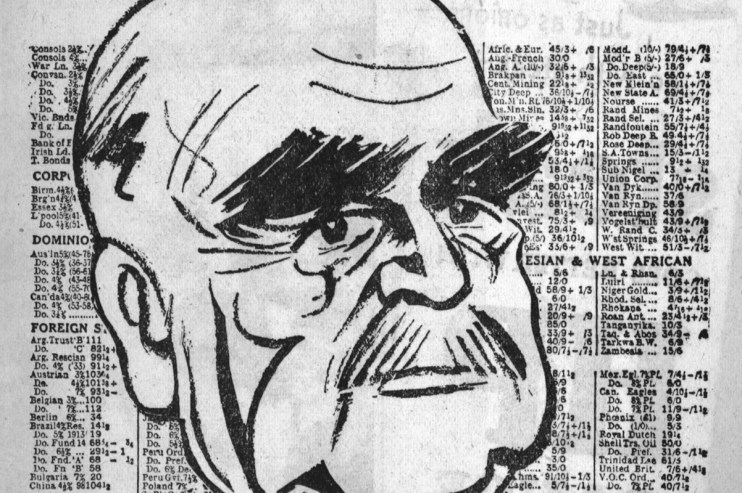
Today in 1913, John Pierpoint Morgan died in Rome having saved the United States from financial catastrophe not once but twice, writes Eliot Wilson
Today in 1913, in Rome’s Grand Plaza Hotel, a 75-year-old American died in his sleep. He was a big man, 6’2” and heavyset, with sharp, unsettling eyes and a purple, swollen nose, rosacea giving way to rhinophyma. The official cause of death was “nervous exhaustion”. He was a very rich man, perhaps worth $90m ($3bn today), but his financial clout was many times larger.
His name was John Pierpoint Morgan.
JP Morgan died on the cusp of the Great War. But the America into which he was born in 1837 had been a different world. Six weeks before his birth, Democrat Martin van Buren had been sworn in as the eighth President of the United States. It was a nation of perhaps 15m people, of whom 2.5m were chattel slaves, divided into 26 states.
America was still an adolescent in a growth spurt. Its population had grown by a third in the 1820s and did so again in the 1830s when Morgan was born. New York was comfortably the nation’s biggest city with over 250,000 inhabitants, but Philadelphia, Baltimore and New Orleans were all on the cusp of 100,000.
Morgan’s tale was not an idealised one of rags to riches. He was born in genteel Hartford, Connecticut, where his father, Junius Spencer Morgan, was a partner in the town’s largest dry goods business; his grandfather Joseph had made his fortune in fire insurance.
By the time he was 20, Morgan had raced through a degree in art history at Göttingen and spoke fair German. In the same year, after years of prosperity and expansion, the American economy shuddered and a railroad bubble began to deflate; the economic problems spread and became the Panic of 1857.
It was at this point that JP Morgan – he preferred “Pierpoint” to “John” – entered the family business. His father was by now a partner and effective head of the London-based banking house George Peabody & Co, and weathered the storm of the Panic by gambling on emergency credit from the Bank of England.
Pierpoint joined Peabody’s American representative Duncan, Sherman and Company of New York, but the real beginning was the early summer of 1861, when he opened J. Pierpoint Morgan & Co in a single-room office in Manhattan. The timing was inauspicious: on 21 July, more than 35,000 Americans in blue and grey clashed at the First Battle of Bull Run, leaving 868 dead. The Civil War had begun.
The war changed the shape of Morgan’s business. Cotton and iron importing diminished in importance and he mainly dealt in securities and foreign exchanges. In 1862, Junius Morgan took over as head of Peabody’s London office and promptly switched the handling of its American business from Duncan, Sherman to his son’s firm.
George Peabody retired in 1864 and Junius Morgan took control of the company, renamed JS Morgan & Co. Meanwhile in 1871 Pierpont joined with Philadelphia financier Anthony Drexel to form Drexel Morgan & Co. This new partnership became a major agent for European investment in the US and created a national capital market. It also fostered a close relationship with the government: to maintain investor confidence, Drexel Morgan underwrote the pay for the entire US Army in 1877; in the Panic of 1893 Pierpoint organised a syndicate to keep the federal government afloat with loans.
Drexel died in 1895 and the firm became JP Morgan & Co. It was one of the world’s biggest banking houses by the turn of the century, having profitably financed the booming railroad industry but also advised on streamlining and efficiency. Morgan then applied these methods to the steel sector, and in 1901 created United States Steel from the merger of Carnegie Steel, Federal Steel and National Steel. It was a behemoth with a capitalisation of $1.4bn: the first US billion-dollar enterprise, it represented four per cent of the country’s entire GDP.
Morgan’s power was demonstrated in the Panic of 1907. A run on New York banks forced the third-largest, the Knickerbocker Trust, into administration. Regional banks began to withdraw their reserves from New York’s institutions, and customers did the same with the regional banks. The stock market would lose a third of its value as banks stopped lending to brokers.
Treasury Secretary George Cortelyou realised that the government was not equipped to protect economic stability in a crisis like this – not least because the US had no central bank. Morgan was again besieged for advice and help. After examining the books of the Knickerbocker Trust, he concluded it could not have been saved, but that the panic could not spread to viable institutions.
Bank run
Now the Trust Company of America was threatened by a run. Morgan conferred with Cortelyou and the heads of First National and National City Bank of New York. The Treasury Secretary promised to place government funding with the Trust Company to shore up its deposits, while the bank presidents agreed with Morgan that the institution was fundamentally sound.
“This is the place to stop the trouble, then.”
The run began, and Morgan oversaw the liquidation of the bank’s assets to pay depositors. He then persuaded the heads of the other trust companies to provide a loan of $8.25m, and Cortelyou’s Treasury Department supplied $25m. Over the following days he bullied and cajoled the New York banking establishment into keeping funds available.
To demonstrate the soundness of the market, Morgan persuaded the vehemently anti-trust President Theodore Roosevelt to allow US Steel to buy the Tennessee Coal, Iron and Railroad Company. It worked. When the Stock Exchange opened on Monday 4 November, the panic abated and shares rallied.
Morgan had been central to saving America’s financial system and had lost $21m in the panic, but it had also demonstrated the enormous influence he and other bankers wielded. A congressional committee under Rep Arsene Pujo handled Morgan roughly in cross-examination and published a report critical of his company’s power.
Pierpoint Morgan was in his mid-70s and his health suffered under the strain. He was taken ill while travelling in Egypt in March 1913 and returned to his hotel in Rome but fell into a coma and slipped away on the last day of the month. The New York Times hailed the “Master of Finance”, carrying the headline “JP Morgan’s Life One of Triumphs”. The press seemed to agree on two facts: Morgan had saved the banking system in 1907, and his treatment by the Pujo Committee had hastened his death.
The mood for reform outlasted him. In December 1913 President Wilson signed the Federal Reserve Act. Assistant Secretary of the Treasury Charles Hamlin became Chair of the Federal Reserve System, while its largest component, the Federal Reserve Bank of New York, was entrusted to Benjamin Strong, one of Morgan’s few trusted advisers.
JP Morgan has often been portrayed as a plutocratic, Gilded Age robber-baron, manipulating a closed economic system for his own gain. He was a force of nature – meeting him was said to be “as if a gale had blown through the house”. But he believed in honour. He told the Pujo Committee that commercial credit rested not on money or property but on character.
“Before money or anything else. Money cannot buy it… a man I do not trust could not get money from me on all the bonds in Christendom.”
He was instrumental in saving the United States from financial catastrophe twice, and if he did become a very rich man, many others profited in his lifetime. Look at the companies his bank organised or underwrote: AT&T, Con Edison, DuPont, General Electric, GM, US Steel, Western Union.
It’s JP Morgan’s world. We’re just living in it.
Eliot Wilson, writer and historian; Senior Fellow for National Security, Coalition for Global Prosperity; Contributing Editor, Defence on the Brink