On this day: The death of Ronald Reagan

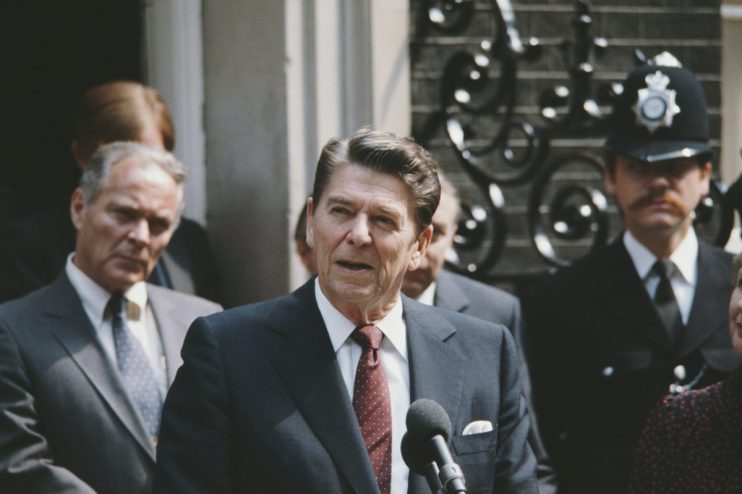
On this day, 5 June 2004, Ronald Reagan died of pneumonia at his home in Bel-Air aged 93, writes Eliot Wilson
At 12.41 am on 6 June 2004, President George W. Bush spoke to reporters at the Hôtel de Pontalba, the US Ambassador’s residence on the Rue de Faubourg Saint-Honoré. He was in Paris for the 60th anniversary of D-Day, but this was not part of his schedule.
“This is a sad hour in the life of America. A great American life has come to an end… Ronald Reagan won America’s respect with his greatness, and won its love with his goodness. He had the confidence that comes with conviction, the strength that comes with character, the grace that comes with humility, and the humour that comes with wisdom. He leaves behind a nation he restored and a world he helped save… His work is done, and now a shining city awaits him. May God bless Ronald Reagan.”
A few hours before, on 5 June, former President Ronald Reagan had died of pneumonia at his home in Bel-Air. He was 93, then the longest-lived President of the United States in history; his last public appearance had been in 1994 and he had since been suffering from Alzheimer’s disease.
To Americans still coming to terms with the terrorist attacks of 11 September 2001, with 145,000 US military personnel embroiled in Iraq and 20,000 in Afghanistan, Reagan recalled another era. It was only 15 years since he had left the White House, but for many his presidency had been a time of optimism, prosperity, self-confidence and purpose. It had been, in the words of his brilliant campaign commercial of 1984, prouder, stronger, better: it had been morning again in America.
Ronald Wilson Reagan had been in many ways an unlikely candidate for the White House. Born and educated in small-town Illinois, he had started his career in 1933 as a sports broadcaster for WHO radio in Iowa; his speciality was conjuring up play-by-play descriptions of baseball games from sparse details wired to the station during the game. In 1936 he had visited California and after a screen test he was offered a seven-year contract by Warner Bros. Pictures; so in his mid-20s he had taken the well-trodden path to Hollywood in hopes of stardom.
He made his film debut in 1937’s Love is on the Air, reviewed by The New York Times as “a modest little comedy-melodrama which makes no pretentions to class and even less to credibility”, and appeared in 30 films in five years. They were mostly B movies, but by the early 1940s Reagan was recognised as a rising star, his role as amputee Drake McHugh in Kings Row in 1942 reckoned his best. But then he was drafted by the US Army and spent the next three-and-a-half years in uniform.
After the Second World War, Reagan’s film career never regained its momentum. He served twice as President of the Screen Actors Guild and made a comfortable living as a spokesman for General Electric, but his career changed course dramatically in 1964.
Originally a New Deal Democrat, by the early 1960s Reagan’s political outlook was dominated by two themes driving him towards the right: an implacable opposition to communism, and passionate belief in individual liberty and free markets. Weeks before the 1964 presidential election, he made a televised speech in support of the Republican candidate, Senator Barry Goldwater of Arizona. Entitled A Time for Choosing, it was an electrifying song of praise for freedom and small government, and although President Lyndon Johnson overwhelmingly defeated Goldwater, the speech established Reagan in a new arena—politics.
In 1966, Reagan declared his candidacy for Governor of California. His old studio boss Jack Warner famously responded, “No, no. Jimmy Stewart for Governor, Reagan for best friend.” But Reagan beat incumbent Democrat Pat Brown by a million votes, was re-elected in 1970 and entrenched himself as an influential voice on the conservative wing of the Republican Party. In 1976 he came close to snatching the party’s nomination from incumbent President Gerald Ford, then won it by a landslide in 1980. At the presidential election that November, he crushed his Democratic opponent, President Jimmy Carter, to take the White House.
Reagan’s presidency changed everything. The 1970s had been dark and fractious, with Richard Nixon forced to resign over Watergate, America making a humiliating exit from Vietnam after a pointless and costly war, two energy crises and an economy crippled by stagflation: high inflation, low growth and high unemployment. The Reagan administration could not turn the tide immediately, but by 1983 the US economy was booming.
Ronald Reagan was at the time the oldest man ever to be sworn in as President, less than three weeks short of his 70th birthday. He was instinctively optimistic with a self-deprecating sense of humour, and gave the impression of a man who had learned not to sweat the small stuff. Yet at moments of national significance, he had a knack for finding the right words and delivery to express honest, unpretentious, deeply felt emotion: the 40th anniversary of D-Day, the loss of the Challenger Space Shuttle, his demand in Berlin to “tear down this wall”.
For millions of Americans, Ronald Reagan embodied the qualities they liked to see in themselves and considered characteristically American: straightforward, unaffected, resolute, quietly virtuous and possessed of an impregnable moral core.
How far that was true, of Reagan or of Americans in general, can be endlessly debated, but politics is a fusion of reality and narrative, and the 40th President of the United States told the country a story it needed and wanted to believe. The proof was in his 1984 re-election. He was already 73 but voters felt a corner had been turned in the nation’s fortunes. Nearly 55 million Americans were persuaded to go out and win one for the Gipper.
Eliot Wilson is a writer and historian, a senior fellow for national security at the Coalition for Global Prosperity and a contributing editor at Defence on the Brink