On This Day : Reagan declares: “We begin bombing in five minutes”

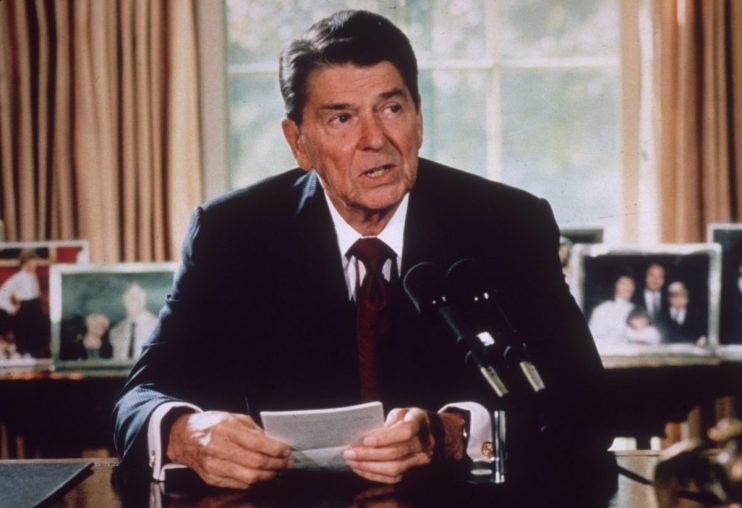
On this day in 1984, a lighthearted quip from Ronald Reagan nearly sparked World War Three, writes Eliot Wilson
Ronald Reagan was an old pro. By the summer of 1984, it was more than 50 years since he had made his radio debut as a sports broadcaster for WOC in Davenport, Iowa, commentating on baseball games.
In 1982, he had revived President Franklin Roosevelt’s routine of delivering weekly addresses to the nation on Saturday mornings, a practice which lasted until Donald Trump’s first presidency; it met its match in the 45th President’s New-York-minute attention span.
Let us go back 20 years. A week before the 1964 presidential election, Reagan had delivered an electrifying television address in support of Republican candidate Senator Barry Goldwater of Arizona. A Time for Choosing had presented the conservative case in honest, straightforward, fiercely heartfelt terms. Although President Lyndon Johnson had crushed Goldwater by a margin of 16m votes, it had allowed Reagan to vault into the first rank of Republican conservatism. He had also caught the attention of William A Rusher, the link man between Bill Buckley’s National Review and the wider conservative movement.
In March 1982, Rusher had written an article for Universal Press Syndicate entitled “Let’s Have ‘Fireside Chats’ by Ronald Reagan”, in which he explicitly linked Reagan to Roosevelt, and called him “a man of great personal charm and powerful qualities of leadership”. He argued, with that mild paranoia to which many conservatives are prone, that regular broadcasts would be an effective way for the President to communicate directly with the electorate, over the heads of the media.
“If he is to win, for all of us, the battle to change America’s direction, that voice will have to be raised, and raised regularly, where the American people can hear it.”
The format was perfect for Reagan. He could, with help from writers like Ken Khachigian, Peggy Noonan and Peter Robinson, match historic occasions with resonant phrases: “‘We the people’, this breed called Americans”; “These are the boys of Pointe du Hoc. These are the men who took the cliffs”; “Mr Gorbachev, tear down this wall”; “A tall, proud city built on rocks stronger than oceans”. But he could converse as well as orate.
Radio has an intimacy all its own. It also demands precision and craft; when there are no images on which to rely, every phrase, every beat has to be right, and a mistimed rhythm or a poorly ordered sentence will shriek its incongruity. Speaking directly to voters, unfiltered and unparsed by the media, the “fireside chats” were ideally suited to Reagan’s folksy charm, his natural, self-deprecating humour and his narrative gift.
This was the profession in which Reagan had grown up. “Talk to your audience,” he wrote later, “not over their heads or through them. Don’t try to talk in a special language of broadcasting or even of politics, just use normal everyday words.”
On Saturday 11 August 1984, less than two weeks before the Republican National Convention would confirm him as the party’s candidate for November’s election, President Reagan was at Rancho del Cielo, his holiday home near Santa Barbara in California’s Santa Ynez Mountains. He was due to begin his weekly radio address at 9.05 am and would talk about the Equal Access Act which he had signed into law that day.
Before he began his address, he was joking with the sound engineers. Asked to carry out a microphone check, he gave an impromptu parody of the speech he was about to make.
“My fellow Americans,” he declared, “I’m pleased to tell you today that I’ve signed legislation that will outlaw Russia forever. We begin bombing in five minutes.”
It was a joke, obviously so: but there was a live feed from Rancho del Cielo to radio stations across the country, many of which were already recording in anticipation of the President’s address. Broadcasters and reporters heard the quip, but – unimaginable today – both CBS and CNN kept the recording secret; after a rude remark about the Polish government in October 1982, the White House Correspondents’ Association had agreed not to publicise obviously off-the-record comments.
Nothing in politics is secret for long. The Associated Press and Gannett News Service had dared to report Reagan’s remarks, and on the Monday, The New York Times felt able to say sombrely that the President “reportedly made a joke about national security”.
Burt Reinhardt, President of CNN, refused to accept a light-heated construction, stating. “I’m told the President says a lot of funny things from time to time.”
When asked if he found the joke about outlawing Russia funny, he responded, “Not particularly”. Pearls were being clutched hard.
Former Vice President Walter Mondale, confirmed as the Democrats’ presidential candidate a few weeks earlier, attempted to gain political capital from the brouhaha. “A president has to be very, very careful with his words,” he told a press conference gravely. “I am willing to accept he saw it as a joke… but others will think it is serious… I don’t think it is very funny.”
There was a tiny flutter in Reagan’s poll lead, but voters preferred hot sauce to humbug: Mondale looked hypersensitive while the President seemed relaxed and human. America gave its final verdict on 6 November, and it was emphatic: Reagan won 49 of the 50 states—Mondale only carried his home state, Minnesota—and the President’s 525-13 victory in the Electoral College was (and remains) the second biggest in US history.
The reaction to Reagan’s humour embodied the potency of his weekly addresses to the nation. Journalists pretended to be scandalised, politicians shook their heads in anxious sorrow, but the American people shrugged off the overblown parsing of what they all understood was a joke. They were being asked if they wanted the nation’s affairs run by a liberal worrywort or an experienced incumbent with a sense of proportion, who had the ability to tell and take a joke. Their response was thunderous for Reagan. They went out on polling day with all they’d got, and won one for the Gipper.
Eliot Wilson, writer and historian; Senior Fellow for National Security, Coalition for Global Prosperity; Contributing Editor, Defence on the Brink