A hundred not out… yet: Why Veeraswamy is in trouble

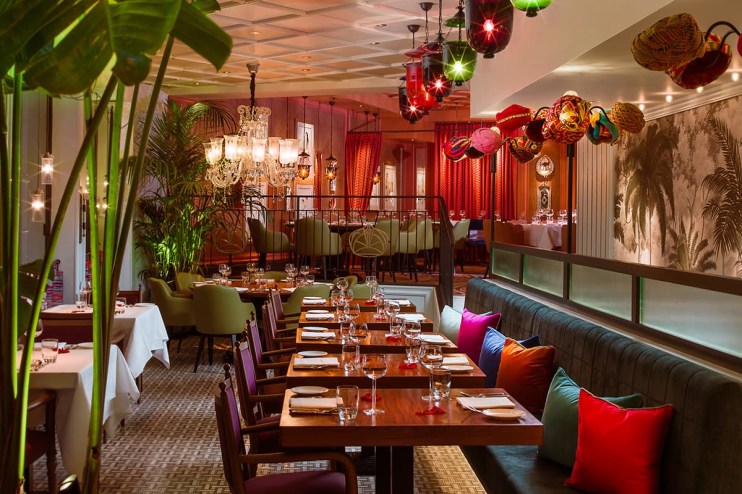
Veeraswamy, the Michelin-starred Indian restaurant on Regent Street, celebrated its centenary on 18 March. But it has found itself in the headlines for other reasons recently: glowingly reviewed by City AM’s own Adam Bloodworth two years ago, it is now in dispute with its landlord, the Crown Estate. Campaigners have even called for the King to intervene.
A much-loved British parlour game combines our love of random facts and our cynical passion for debunking received wisdom. One of the richest seams for this is what I’ll call “Indian cuisine”. The game can start with a deceptively simple hand-grenade of a question: where does curry come from?
The truth is that no-one can say definitively. We can’t even agree on the origin of the word: it could be Tamil, by way of Dutch, or one of the other Dravidian languages like Telugu or Malayalam; it could come from Portuguese; and it is almost certainly in part the misunderstanding of an unfamiliar word by Westerners. Yet 25 years ago, the then-foreign secretary, Robin Cook, told a think tank, “chicken tikka massala is now a true British national dish”.
A sharp, witty but occasionally absurd man, Cook had a point: what we bring together under the category of “Indian cuisine” is a British invention – or at least it would not exist without us.
Britain’s association with India goes back a long way. The East India Company was founded in 1600 to trade in the Indian Ocean, and ended up governing 750,000 square miles of India. Within my parents’ lifetime, it was still a single British possession, 400m people governed by an impossibly tiny Indian Civil Service of about 1,000. For three centuries, there was an ongoing connection at every level, and it is hardly surprising that one of the products of this was the food that we ate and still eat.
The story of Veeraswamy
The story of Veeraswamy begins with a man called Edward Palmer. He was Anglo-Indian, that is, of mixed British and Indian descent. His great-grandfather, a British general, had married a princess of the ruling house of Oudh in northern India. Born in Hyderabad, Palmer came to Britain in 1880, aged 20, and in 1896 founded EP Veeraswamy and Co in Hornsey, selling Indian produce and spices.
In 1924-25, the government staged a huge British Empire Exhibition at Wembley Park. It was essentially an 18-month advertisement for an empire bruised and financially embarrassed after the First World War. It was designed to show off Britain’s greatness and prosperity, but also to strengthen the links among her 58 dominions, colonies and other territories.
J Lyons & Co had won a contract to provide nearly all catering for the exhibition in its first year, running more than 100 restaurants, bars and other outlets. The vast India Pavilion, however, employed Indian cooks and Palmer was engaged as “Indian adviser” to the restaurant. The Anglo-Indian dishes he designed, like duck vindaloo and mulligatawny soup, proved enormously popular, and this was the springboard for his decision to open his own restaurant.
Veeraswamy opened in the premises it still occupies on Regent Street on Tuesday 16 March 1926. It was by no means the first Indian restaurant: that honour goes to the Hindoostane Coffee House, which opened in Marylebone in 1810.
Veeraswamy was different. The boast in its advertising may seem modest to our sensibilities: “Clean Indian and English Food, Good Wines and Oriental Coffee”. But there had never really been an attempt to create a high-quality restaurant which happened to serve Indian (or Anglo-Indian) food, nor had anyone taken the meticulous pride and almost academic approach that Palmer adopted.
Authenticity isn’t everything
The pinnacle of today’s restaurant culture is “authenticity”. But to imagine “authentic” Indian cuisine, at least imagining it in Britain, is to try to create a mental world in which the East India Company was never formed, the Raj never happened, and British monarchs were never Emperors and Empresses of India.
At the British Empire Exhibition and in Veeraswamy’s early days, Edward Palmer was drawing on a deep well of knowledge and bringing flashes of the princely courts in Oudh and Hyderabad that had come down through his family. But he was presenting these dishes in a way that a British audience would understand and enjoy, just as Tommies and traders who came home from India would remember hints of the food they had seen there and interpret it in their own ways.
The initial incarnation of Veeraswamy was what it seemed: it was Anglo-Indian. So was Edward Palmer, so, in a wider sense, were those who served or lived in India then came home to Britain. You could even argue that India itself, after 300 years, was in some ways “Anglo-Indian”, and even in 1926 the end of that connection could seem far off.
Let us hope Veeraswamy can find a way to survive. It is more than a restaurant, more than a landmark: it is an artefact.