Mandelson car crash shows Starmer’s Labour has no ideology, only in-fighting

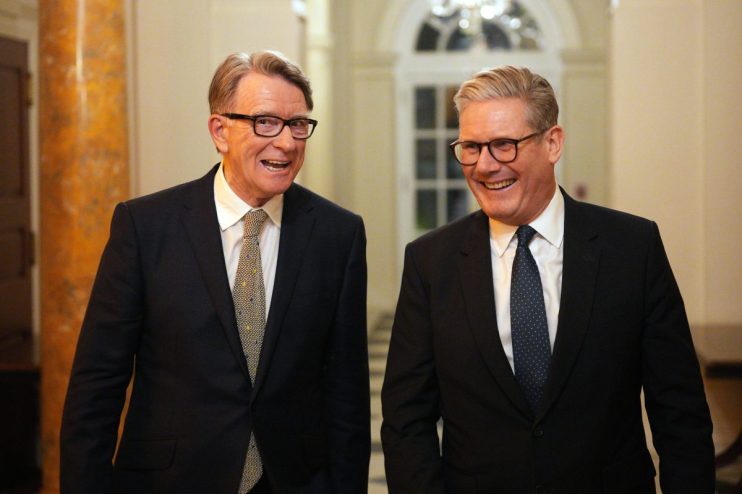
Peter Mandelson was given the job because he’s from the right faction of the Labour party. Keir Starmer’s government doesn’t believe in anything except fighting itself, says John McTernan
Politics is – at its best – a battle of ideas. Successful politicians need to be able to fight and think at the same time. Peter Mandelson, who has had a final and very visible fall from public life, famously said he was a “fighter not a quitter”. That worked for New Labour because Tony Blair and Gordon Brown had a clear ideology. The slow-motion tragedy of Keir Starmer’s government is that there is no ideology, no “Starmerism”, but plenty of fighting – almost all of it against people within the Labour party.
Factionalism is the besetting sin of the current Labour government. And is the answer to the fundamental question: why was Peter Mandelson made UK Ambassador to the United States? He was, in Margaret Thatcher’s term “one of us”. This was the test he passed that allowed the Prime Minister to appoint a man who had stayed in a paedophile’s town-house in New York after that paedophile had been convicted and served jail time. That fact was not only publicly known, it was published just over a year before the appointment was made.
This was not a failure of vetting, nor even a failure of reading, it was a failure of politics. It was enough that the faction that ran the Labour Party in opposition, and ran the government – including reshuffles – backed him.
Keir Starmer has long made halving Violence Against Women and Girls (VAWG) one of his personal political priorities. The association with Jeffrey Epstein should have disallowed Peter Mandelson to be considered. The argument that Mandelson lied makes it worse. This was a verifiable fact not an opinion. Why wasn’t it checked? Right faction? Right man!
High ideals v low politics
Of course, the victory of high ideals sometimes requires low politics. But the ideals – the purpose – should always be the driver. The inherent danger of factionalism in politics is that it gets detached from purpose and policies and becomes a defence of position and power. That was what was visible, so appalling and – for voters – so unforgivable about the Johnson administration, which in retrospect has many resonances with the current government. The elevation of staff over elected MPs. The use of punitive briefings against elected politicians and even suspensions from the parliamentary party. Most recently the entirely self-centred decision to block Andy Burnham – the most popular Labour politician in the country – from standing in a by-election in which Labour are threatened by insurgent populists of the left and right.
The informal deal in social democratic parties used to be that the left had instincts and insights which the right would have to make more pragmatic and more practical. Political parties – like planes – need two wings. A contract implicitly fulfilled by a radical soft left manifesto in the 2024 general election being accompanied by a ruthless party discipline. That direction was matched by an equal self-discipline because it was worth it for railway nationalisation, renters rights, rebalancing workplaces in favour of labour not capital. All parties are coalitions of individuals with competing, sometimes conflicting, ambitions.
The tragedy for loyal party members, activists and MPs is that the internal compromises which make parties possible are anathema to factionalism.
There will be many more investigations into this whole scandal – though that seems too small a word to use. A light has been shone onto the way in which this Labour government conducts its business. That has to change. Which is the ultimate and most savage irony – Labour were elected on a single word platform “Change”.
John McTernan is a political strategist and commentator and former adviser to Tony Blair