If you think it’s bad for Henry on £100k, spare a thought for his Gen Z brother

Life may be tough if you’re a High Earner, Not Rich Yet – but at least Henry has hope. His younger counterpart Nick, 30, has only known bad times and he’s fuelling the rise of populist parties, says William Atkinson
Last week, Eliza Filby profiled the plight of the Henry: a High Earner, Not Rich Yet. They are millennials in the top tax bracket on six-figure salaries, living disproportionately in London, for whom middle-class aspirations appear to have broken down. Henrys may well still live in a grotty flat, shop in Aldi, and barely be able to afford holidays. Crushed by a stifling tax system and absurd rental payments, they aren’t saving and feel far less well-off than their salary would have them hope.
Henry’s plight will have some reaching for the world’s smallest violin. But, as Filby pointed out, we need Henrys for public services to function. The Economist has estimated that Henrys account for five per cent of taxpayers but nearly half of all income tax receipts. If Henrys decide to join the record number of millionaires fleeing the country, Rachel Reeves will face an ever-growing headache when funding our bulging welfare state on the backs of an ever-shrinking number of taxpayers.
And yet even if Henry feels his prospects are bleak, he looks comfortable from the view of the generation coming after him. At least he and his fellow millennials have hope; at least they had a sniff of the pre-Covid good times. He still thinks that once he makes his way through a few promotions, if the housing market settles down, if can convince his girlfriend to move in, things will work out, and his lifestyle will finally reflect his salary. The social contract will still deliver.
A broken compact for Gen Z
But for a growing number of Generation Z, that compact appears to have fundamentally broken down. Where Henry is merely frustrated, they see only a dark, bottomless, and inescapable pit of despair. They are Britain’s equivalent of the quarter of German men under 25 who voted for the AfD in the recent German elections or the 30 per cent of young French people who voted for the National Rally. They see Britain as going to the dogs, crushed by feckless politicians, mass immigration, and a bloated and inescapable welfare state.
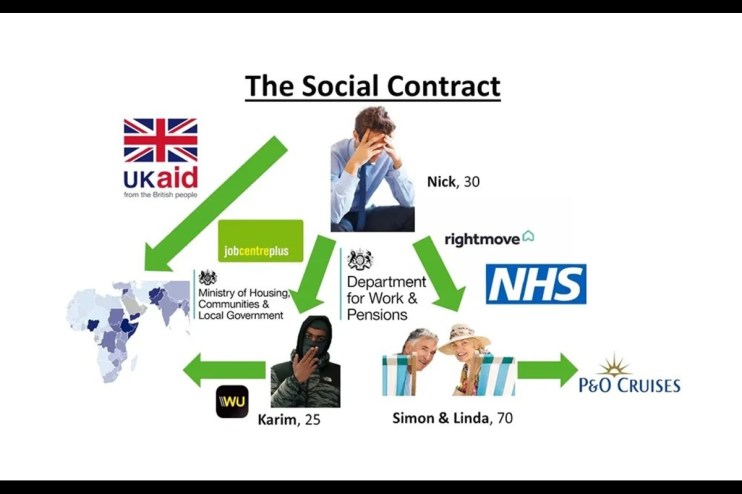
They explain the recent popularity of the ‘Nick, 30 ans’ meme on X: a young professional with his head in his hands, tired of seeing his salary disappear to pay for the social housing of Karim, 25 ans and the pensions of round-the-world cruise enthusiasts Simon and Linda, 70 ans. This is a Britain in which the young have no hope. Career progression is meaningless when every new penny earned is swallowed up by landlords, retirees, or migrants. Henry doesn’t know how well off he really is.
If he lives in London, Nick faces the same challenges as Henry on half the income
The stock responses to Nick’s plight are eminently predictable. Don’t you know that Simon and Linda have paid in all their lives? Couldn’t you move somewhere cheaper? Why blame migrants for your own failure to have performed better educationally, achieved a higher-earning job, or married young and well? But pinning blame back on the disillusioned young will only increase their anger. These are the Sensitive Young Men for whom Robert Jenrick’s recent war on fare dodging resonated deeply.
If they live in London, they face the same challenges as Henry, on half the income. If they live in the provinces, their lower rents are balanced out by poorer job opportunities, negligible transport links, and the inescapable reality that MPs care about their concerns even less than those of the bleak young things they might meet in the capital. They are alienated from the mainstream. When a recent poll suggested 61 per cent of the young wanted a leader who didn’t have to bother with elections, those who knew the doomers would not have been surprised. For them, things can only get worse.
William Atkinson is assistant content editor at The Spectator