Women-only Tube carriages are a terrible, unworkable idea

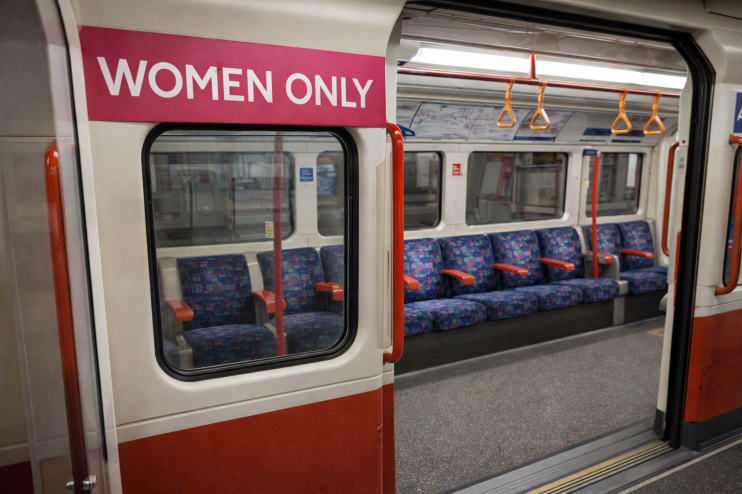
Sex offences on public transport in London are soaring, but the solution is better policing and security across the network not voluntary gender segregation, argues James Ford
Harold Macmillan, in a speech in 1961, said that the Liberals (as they were still then called) “offer a mixture of sound and original ideas…unfortunately none of the sound ideas is original and none of the original ideas is sound”. Some of us would argue that what was true of the Liberals in the 1960s remains true of the Lib Dems and, arguably, all parties of the left today. But, when it comes to considering public policy ideas for London espoused by any party, there are not only unsound original ideas and unoriginal sound ideas, but some ideas that manage the unique feat of being both unoriginal and unsound. One such egregious-yet-perennial bad ideas is women-only carriages on the London Underground.
Every few years this dubious proposal is dusted off and recycled for public consideration. The latest effort is a change.org petition that has been signed by nearly 15,000 people since September.
Of course, I understand why the idea gets refloated so often. Using public transport anywhere, not just the often heavily crowded network in our capital, can be a dangerous, scary experience for women and girls. And it is a problem that is getting worse. In 2025, sexual offences on London Underground averaged 2.6 assaults per day, the highest level for five years. There are international precedents, most notably in Japan but also Brazil, India, Egypt, the UAE, Saudi Arabia and Mexico.
However, I would argue that if the answer to any problem of undesirable behaviour or criminality is segregation, you are probably asking the wrong question. Segregation of any kind is seldom a good idea and never a good look. And this precedent – that segregation based on a protected characteristic – is ok is probably not something any society should be in a rush to set.
Segregation of any kind is seldom a good idea and never a good look
But, more important than the dubious morality and bad optics of such a policy, women-only carriages on the tube are also totally impractical and unworkable. Anyone that has tried to fight their way down a packed tube platform during rush hours knows how difficult it would be to get to the designated boarding area. And, without TfL staff present in strength – either on the platform or in the women-only carriage – how would you prevent men from boarding? (Predators and perverts are not noted for their adherence to the honour system). And there is nothing to prevent sex offenders shifting their efforts from onboard trains to instead prey on crowded platforms, concourses or even escalators. Moreover, what do we do about other bits of the transport network, like the buses, riverboats or the cable car?
Tighter security
The best way to protect women and girls on the tube is through better policing and physical security. In fact, a stronger, more visible uniformed presence across the Underground will not just be able to detect, catch and ultimately deter sex predators but be able to address a range of other criminal activity and anti-social behaviours that make the tube feel unsafe and unpleasant. These would include fare evasion, graffiti, drunkenness, fighting, begging and even ‘bare beating’. Investing in policing and security would protect everyone, not just women and girls.
I appreciate that naysayers will argue that it is cheaper to slap a few ‘women only’ stickers on one carriage of every tube train and hope for the best, but that misses the point. According to TfL surveys in the first half of last year, 39 per cent of passengers reported that they had felt worried while using the capital’s transport network. Nearly one in 10 Londoners said they had been deterred from using public transport (either temporarily or permanently) after experiencing a ‘worrying incident’ on the transport system. If TfL is not only experiencing rising levels of sexual assaults, but losing passengers, spending £11m to clean up graffiti and missing out on an estimated £190m in lost revenue per year, can it really afford to do nothing? (For reference, £190m could pay for 4,500 newly qualified police officers or 5,400 PCSOs)
We need a step change in safety and security on the Underground. The current regime – where an insufficient number of police and enforcement officers are spread thinly with blurry CCTV left to fill in the gaps – is not cutting it. Passengers, trains and fare revenues are not being protected. Suggesting that TfL properly police the London Underground may be a rather simple proposal – maybe even an unoriginal idea – but it is certainly a sound one.
James Ford is a former adviser to Boris Johnson on transport during his time as Mayor of London