The student loan book is disguising the real size of the national debt

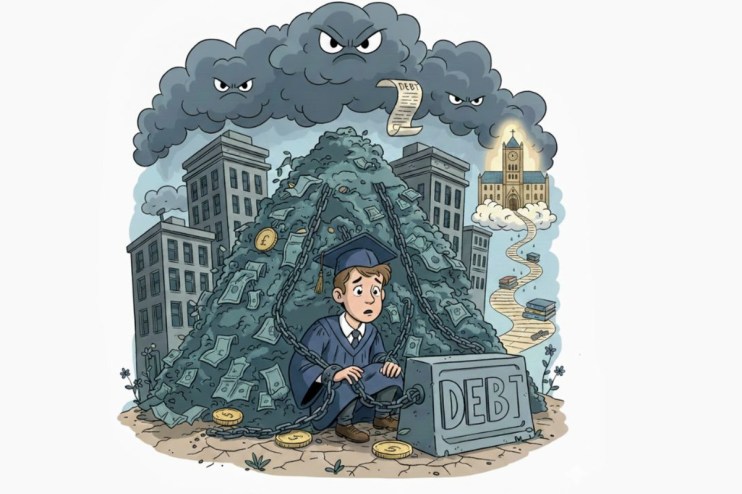
The market value of the student loan book is approximately £33bn lower than official government accounts suggest. As a result, our national debt is higher than we’re being told – disguised by billions in loans that are much less valuable than they appear, says Sebastian Charleton
Britain’s young are the most educated generation in our history. Nearly half of all school leavers now attend university. While students may picture dreaming spires propelling them into high-flying jobs, the reality of a modern degree, even from a prestigious Russell Group university, is far less glamorous.
The arbitrary goal of pushing half of the population into higher education was misguided. It has burdened a generation of Brits with a lifetime of debt and low pay, and partly contributed to the graduate earnings premium vanishing into thin air.
This overeducation wouldn’t be quite so damaging if it were properly funded –- in fact, the collapse in graduate earnings has not been replicated in other countries with similar graduate shares of their working-age population. But, as it stands, the UK’s dysfunctional student finance system supports unproductive degrees while saddling the state with more debt each year.
ASI research shows that the market value of the student loan book is approximately £33bn lower than official government accounts suggest. This is because the state uses an artificially low discount rate to value these loans, one that doesn’t properly reflect their riskiness. As a result, our national debt is higher than we’re being told – disguised by billions in loans that are much less valuable than they appear.
While the overall system desperately needs fixing, the Plan 2 regime – covering English and Welsh students who started undergraduate courses between 2012 and 2023 – is especially broken. It imposes an enormous cost on the taxpayer while creating a fiscal trap for the borrower. (And I’m not just saying that because I’ve been lumped with one.)
Under Plan 2, the government writes off unpaid debt after 30 years. This means productive graduates, who do pay their student loans back in full, are forced to subsidise degrees that do not lead to high-paying jobs. Engineers and medics effectively fund their peers’ often less useful degrees.
When you combine loan repayments with income tax and National Insurance, some high-earning graduates face an effective marginal tax rate of 77 per cent. At a time when the UK is losing young talent abroad, the state is seizing more than three-quarters of every pound they earn. This is exactly the kind of perverse incentive that explains why our GDP per capita has been stagnant since 2008.
Meanwhile, for the 70 per cent of borrowers not expected to repay in full, interest rates of RPI plus three per cent cause balances to balloon into six figures. The debt is effectively imaginary, written off eventually, but it causes genuine psychological distress. Certainly, such a system is not sustainable.
How to reform Plan 2
The fix needn’t be complicated. Cutting the real interest rate to zero, while extending the write-off period from 30 to 40 years, would stem the spiral of phantom balances and align the repayment window with a modern working life. Crucially, it would ensure that low and middle-earning graduates actually pay off some of what they owe.
With the tax burden at a post-war high, we must also ease the squeeze on productive graduates. Lowering the repayment threshold alongside cutting the repayment rate from nine per cent to five per cent would smooth the cliff-edge tax traps that discourage overtime and promotion. Taken together as a package, this is a genuine win-win – increasing the value of the loan book for the Treasury while reducing the burden on borrowers.
Reforming Plan 2 is not, of course, a panacea. In the long run, we must shift risk away from taxpayers and onto universities. Currently, institutions bear none. They receive tuition fees upfront, whether a graduate becomes a brain surgeon or a barista. If we are serious about value for money, universities must have skin in the game. If a degree consistently fails to lead to decent employment, the institution should be liable for a portion of the unpaid loan.
Some universities peddling low-value degrees would close as a result. In an era where AI is already displacing lower-rung white-collar work, this is no tragedy. Britain would be better served by fewer wasteful degrees and more vocational mastery. I’ve long believed that the Swiss model, where technical skill commands the same respect as academic credentials, is worth emulating.
Getting Britain growing again will take more than fixing student finance – supply-side reform, anyone? But making the financial lives of graduates simpler and fairer is a good place to start. Until policymakers get around to rewiring the planning and tax systems, they can at least do this.
Sebastian Charleton is head of programmes and partnerships at the Adam Smith Institute