The Conservative Party is losing voters on legacy, not leadership


On the reasons to not vote Conservative, very few blame Kemi. Instead, legacy, and earning back trust, remains the Tories’ biggest obstacle, writes Matthew Lesh
The Conservatives face astronomical challenges, from a renewed Labour government under Prime Minister Andy Burnham through to a sticky Reform vote despite recent scandals. Yet the Tories arrived in Birmingham for their annual jamboree with a skip in their step and a vengeance in their mouths. This is partly driven by a significant improvement in vibes, certainly since a year ago when it felt to many that Kemi Badenoch was on her last legs.
Even with the improved mood, the party should still not underestimate the challenge ahead. A deeper analysis of our City AM / Freshwater Strategy Poll indicates that Badenoch still has hurdles to overcome before voters will return.
How do the Conservatives fare in new polling?
The poll shows some improvement. The Conservatives’ vote share has risen from 17 per cent to 20 per cent since September last year. But they are still sitting behind Labour and Reform, albeit the gap with Reform has shrunk to just five percentage points, down from 16. Meanwhile, Kemi’s personal approval rating has risen sharply from -16 to +3, making her one of the more popular major political figures and surpassing Farage, albeit behind Burnham. Notably, she also polls far ahead of her party, with the Conservative Party’s net favourability still negative at −12.
The first large-scale poll predicting individual constituencies, known as an MRP, since Burnham took office put the Conservatives ahead of Reform, while another flipped the order, with Reform second. Both put Labour ahead and pointed to how the split on the right could deliver David Cameron’s much-warned-about ‘coalition of chaos’: a government made up of Labour, Lib Dems and the SNP.
On the issues, the Tories are marginally ahead of Reform on who is best to reduce the cost of living and strengthen the economy, but on both fronts Burnham’s Labour Party is now significantly ahead. Reform beats everyone on who is best to reduce migration, while Labour’s relative strengths are building housing, improving wages and job security and health and social care. This effectively leaves the Tories squeezed from all sides, without a significant lead on any issue.
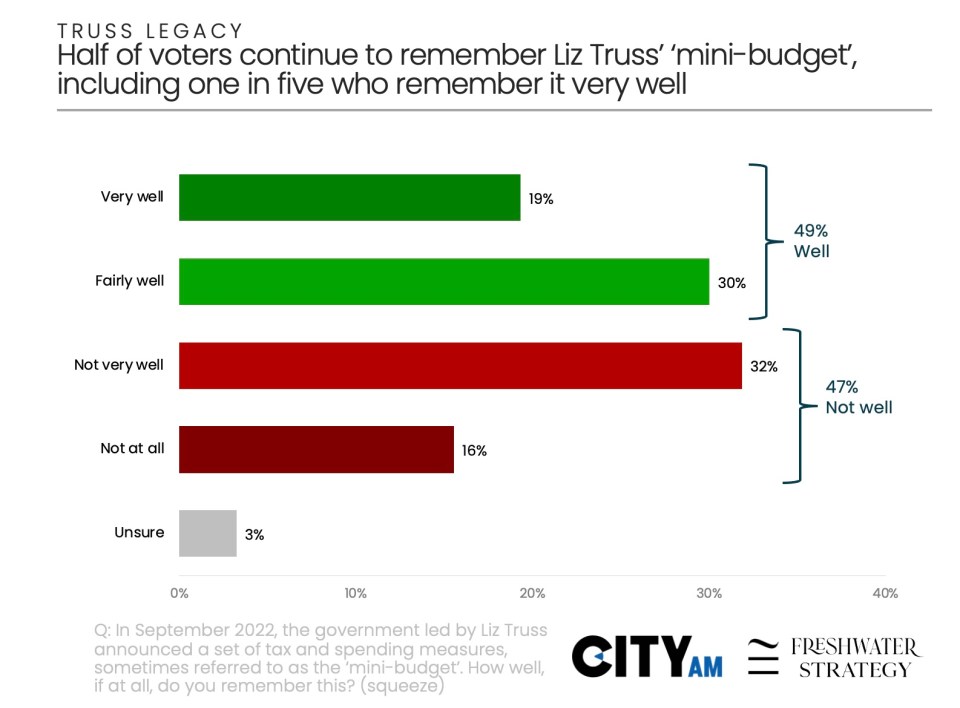
Andrew Griffith’s appointment as shadow chancellor last month led to renewed attacks on the Tories’ record. Labour quickly pointed out that Griffith was a Treasury minister during Liz Truss’ mini-budget to undermine the opposition’s credibility, even though Griffith said he hadn’t seen it until the night before.
What are voters’ main concerns?
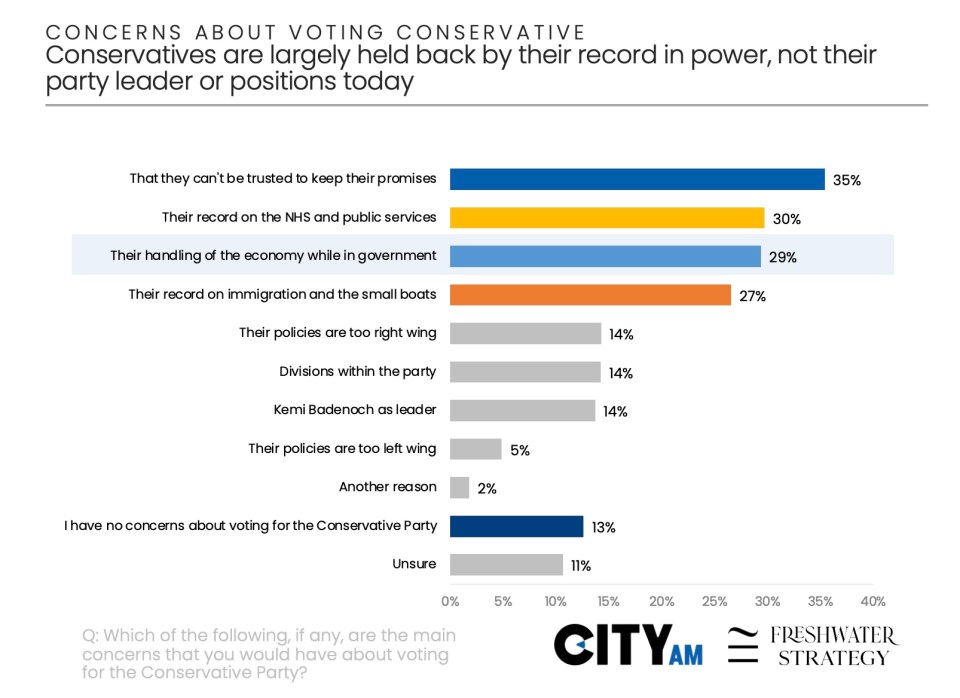
The City AM / Freshwater Strategy Poll asked last month what voters’ main concerns would be about voting for the Conservative Party. Overall, the top concern was that they cannot be trusted to keep their promises (35 per cent), followed by their record on the NHS (30 per cent). The handling of the economy while in government came in third (29 per cent). A separate question found the electorate evenly split on how well they remember the mini-budget, with 49 per cent saying well, and 47 per cent saying not well.
But there are splits in interesting ways among voters. The economy is more likely to be a reason not to vote Tory among centrist and centre left voters, including Lib Dems (42 per cent) and Labour voters (38 per cent), but matters far less to Reform (28 per cent) or Tory (19 per cent) backers. Voters on the right are most likely to cite their record on immigration as a main concern. In other words, a pro-growth, tax-cutting pitch aimed at Reform-leaning voters faces little resistance from the Truss legacy, but it does raise some risks among potential Lib Dem/Labour switchers.
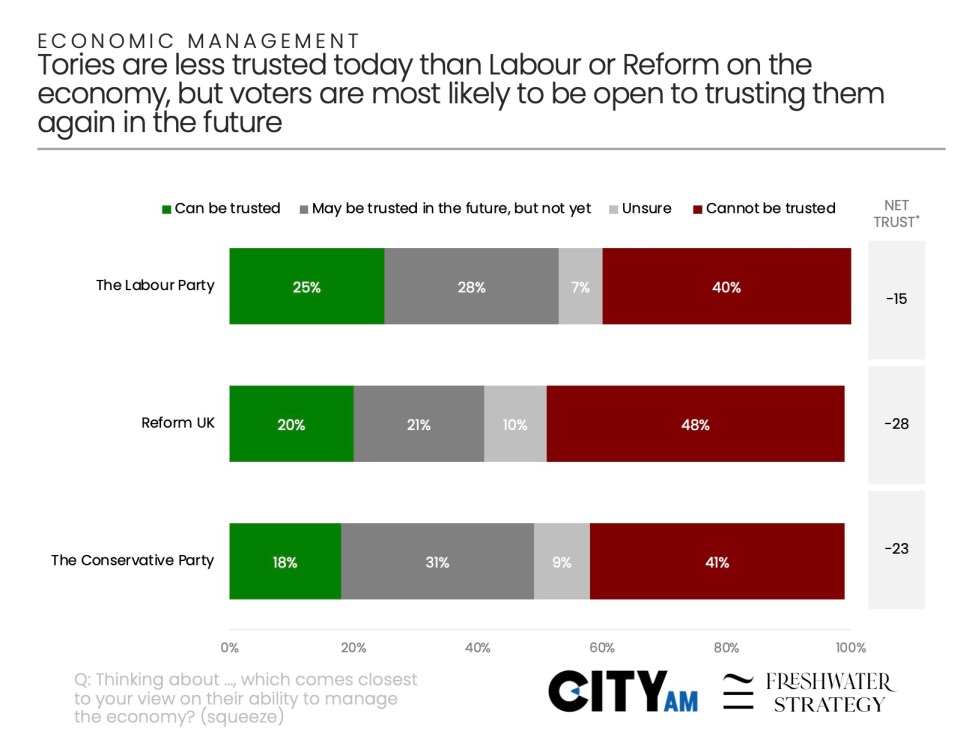
In a separate question about whether the Tories can be trusted on the economy, the figure comes back at just 18 per cent, compared to 20 per cent for Reform and 25 per cent for Labour. This is pretty frightening for the Conservatives. But the same question also finds that voters say the Tories are the party most likely to be trusted again in the future on the economy, just not yet (31 per cent), a particularly strong view among younger voters and Reform. Here sits the opportunity to rebuild what is lost.
On the reasons to not vote Tory, relatively few say policies are too right wing (14 per cent) or left wing (five per cent) or blame Kemi as leader (14 per cent). Taken together, this indicates that the hierarchy of concerns about voting Conservative is a legacy story, not a leadership one. The Tories have yet to earn back the electorate’s trust that they will deliver, but it’s not an impossibility.
This dynamic helps explain Kemi’s pitch. “The Conservative Party is different,” she declared in an interview ahead of the conference. “We have changed. We have new policies, new plans, new people coming on board.” This reflects the central challenge for the Tories: presenting a credible alternative, one that people not only back in principle, but one that is shown to be actually deliverable, a leadership that can deliver it, and together is a meaningful break from the past.
Matthew Lesh is a director at Freshwater Strategy and a public policy fellow at the Institute of Economic Affairs