Supermarkets pile pressure on government to cut energy costs

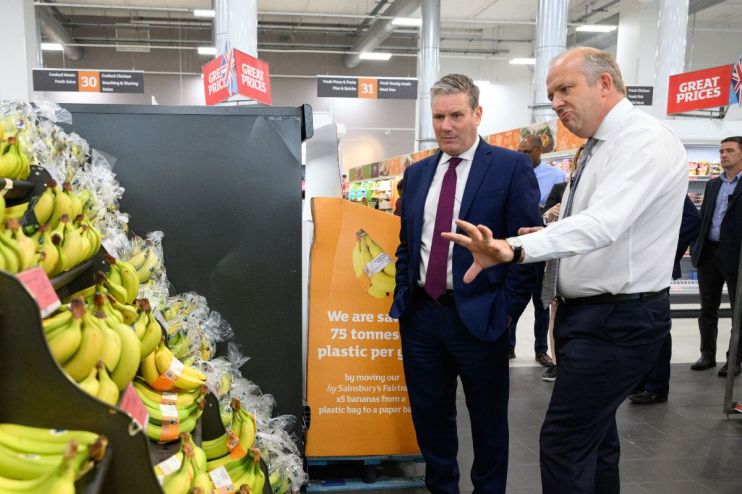
Supermarkets are calling on the government to cut taxes on energy to help retailers dodge looming food inflation, with Sainsbury’s, Tesco, M&S and Asda piling pressure on Labour.
The boss of Sainsbury’s, the UK’s second-largest grocer, became the latest industry figure to call for the Treasury to step in.
On Thursday, the supermarket said it is expecting the Iran war to weigh on profit, as the FTSE 100 company said the conflict will “impact both our customers and our businesses”.
The Food and Drink Federation, which represents food manufacturers, says food inflation will hit between nine and 10 per cent this year but supermarkets have been reluctant to align with forecasts as they hope to prevent the worst price rises.
Supermarkets ‘doing everything’ to halt food inflation
Simon Roberts, chief executive of the grocer, said on Thursday: “The single biggest thing the government could do to help keep food prices down is to make sure that energy costs to the industry are not rising faster.
“We do everything we can to mitigate those through hedging where we can, but that would be a key area where [the] government could support the sector to make sure we keep down the impacts of inflation and mitigate as far as possible.”
Roberts’ intervention came after the bosses of Tesco, Asda and Marks & Spencer called for the government to cut energy costs in recent weeks.
Last week, Tesco boss Ken Murphy said “anything the government can do to help us keep prices low for customers is welcome”.
High street retailer M&S, which also has a food branch, became the first industry leader to lay responsibility at the door of the government for preventing shoppers’ weekly food bill from going up.
M&S attacks policy costs on energy
Chief executive Stuart Machin said in March that energy bills have “skyrocketed” in recent years, due to policy costs which have “nothing to do with the price of oil or gas”.
A day later the executive chair of budget supermarket Asda said it was time for the government to “stand up and start doing stuff” to support farmers and ease the price of fuel.
Food price rises are an inevitable result of the blockage to the Strait of Hormuz, which has sent fuel and supply chain costs soaring, Allan Leighton said.
“[The] government has a big role to play and it stands there pointing fingers at everybody. It’s total camouflage,” he said, reacting to the Treasury’s concerns over petrol retailers “profiteering” from the crisis.
Announcing his supermarket’s results on Thursday, Simon Roberts said the Iran war will “no doubt” result in “pressure on food prices,” but said Sainsbury’s is focused on “keep[ing] inflation at bay”.
Sainsbury’s refuses to be drawn
Similarly, Tesco boss Ken Murphy said last week that his grocer will do “everything in [its] power to minimise the impact on customers.”
But Murphy said he “does not recognise” the Food and Drink Federation’s warning of double-digit food inflation, though Roberts was hesitant to take as hard a line as his rival.
Asked whether he agrees with the inflation forecast, Roberts said prices will face upward pressure: “You wouldn’t expect me to speculate on where food inflation might or might not go.
“What we’re focused on is making sure we work with our suppliers to mitigate, as far as possible, the impacts of the conflict on food prices.”
Supermarket bosses met with Chancellor Rachel Reeves earlier this month and lower taxes on energy were a key ask of these industry figures.
Grocers are yet to be told whether the government will be acting on these demands and Helen Dickinson, chief executive of the British Retail Consortium, told City AM this delay is a source of “frustration” in the industry.