Starmer and Macron face a shared Waterloo

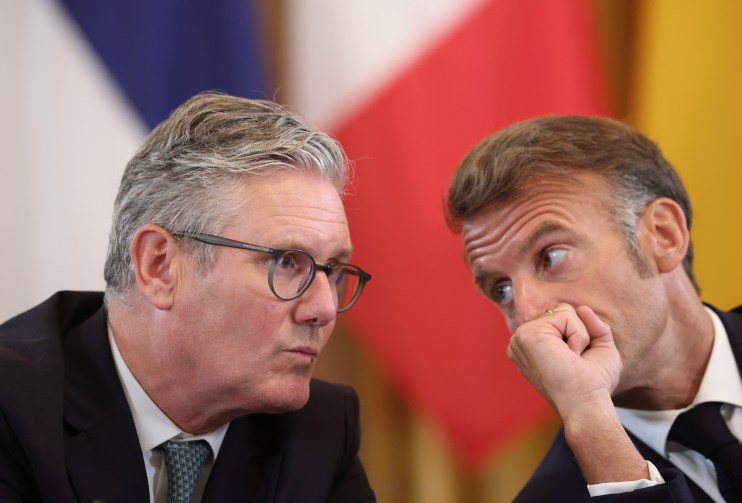
Facing crippling national debt and a politically divided public, both Keir Starmer and Emmanuel Macron have proved unable to implement necessary economic reforms, and both are heading for a downfall driven by market forces, says Helen Thomas
A country gripped by the highest debt levels since the Second World War; an unpopular leader facing a restive public; high taxes and high government spending alongside stagnant GDP growth – the position of our fragrant neighbour across the Channel isn’t far removed from what we face on these benighted shores. This similarity is striking, not least because Keir Starmer has a commanding majority in parliament that Emmanuel Macron can only envy. And yet both petits Napoleons appear to be facing their own Waterloo.
Après Fitch, le déluge. France has just had its credit rating cut by Fitch as its fifth prime minister in two years attempts the impossible task of putting together a budget by 7 October 2025. An election is inevitable – or even two, if Macron has to resign over “the political deadlock” that Fitch expects to persist into the years ahead. The voters, and by extension, the politicians, are simply too divided to agree on the necessary medicine required to return France’s debt/deficit dynamics to a sustainable path.
The French parliament is currently split roughly three ways between the left, the right and Macron’s crumbling centrists. This means every attempt to turn policy towards either left or right raises such ire that the other side then threatens censure, booting out the government in a parliamentary vote. Budgets have been either too left wing or too right wing – or just too painful – for either side to countenance.
The previous French prime minister, François Bayrou, tried to get ahead of this by bringing a confidence vote in himself. This apparently cunning ruse simply led to his prompt ejection and the elevation of Macron loyalist, the 39-year old former armed forces minister, Sébastien Lecornu. In his first interviews since taking office Lecornu jettisoned Bayrou’s deeply upsetting plans to cancel two public holidays (sacre bleu!) but suggested he might be open to a wealth tax. The Socialists have demanded this as a precondition not to vote the prime minister down; just as the former Interior Minister from the conservative Republican party said such demands would “only make matters worse”.
Wealth taxes
A recent survey by Ifop found almost three-quarters of the French public would back a tax on the super-rich. The economist Gabriel Zucman has proposed a minimum 2 per cent tax on individuals with assets above €100m. Zucman claims it would apply to 1,800 households and raise up to €20bn per year. In an interview with Le Monde he summed up the mood of many in the country when he said “one cannot expect the French to accept belt-tightening measures so long as billionaires pay so little tax”. An exasperated MP from Macron’s party admitted: “we are radically opposed to this and think it’s utter nonsense, but we’ll have to give in. Even our voters want it”.
We are radically opposed to this and think it’s utter nonsense, but we’ll have to give in. Even our voters want it
In words that are likely to echo the current debate within the UK Labour Party, the same French MP remarked: “we understand that if we want to get a budget passed, we have to offer the left a symbolic victory on taxing the wealthiest”. Except in the UK, the offer to the left is happening within one party. This is a function of our electoral system, where usually the new and small parties are disproportionately weak as they fail to be the “first past the post” in winning a seat. This had traditionally left the UK with a two-and-a-half party system, with voters having little choice but to back one of the big parties or waste their vote. But now the electorate has fragmented in multiple directions, meaning a lower vote share is required to win seats.
Voters have splintered across the world. Disenfranchised by the financial crisis, buffeted by the pandemic and traumatised by inflation, they have turned to alternative solutions. Elections can no longer be won from the centre. Parties pivot to the extremes.
This causes a problem once a government emerges. It will struggle to please all of the people all of the time, or even some of the people some of the time. This makes it even harder to address a challenging economic situation where debt is greater than GDP and growth is stalling, as it is in France and the UK. Both Starmer and Macron cannot deliver the fiscal consolidation required, meaning both countries will have it forced upon them by financial markets. At which point, their time as leader will be up. A small change to the latest Labour Party rule book no longer requires a party conference to be called to bring a confidence vote in the leader; now it can be triggered at any time by 20 per cent of Labour MPs nominating an alternative. Starmer is not far away from declaring as General Pierre Cambronne did in the final stand of the Imperial Guard, “Merde”.
Helen Thomas is CEO and founder of Blonde Money