On this day: Tony Blair’s New Labour landslide

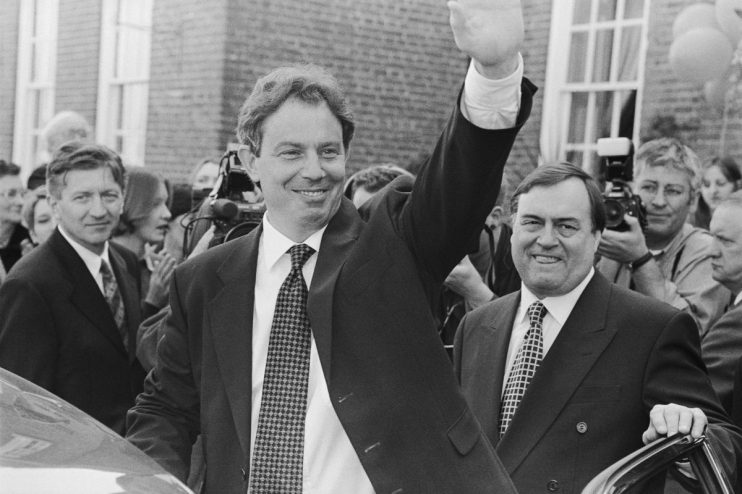
A new dawn broke on this day in 1997, ushering in an era of Cool Britannia, writes Eliot Wilson
Do you remember where you were on Thursday 1 May 1997? It was 20°C in London that afternoon: Michael Jackson headed the singles chart for the seventh time with “Blood on the Dance Floor”, while the Star Wars Special Editions were filling cinemas.
John Grisham’s The Partner was the big seller in Waterstones, Dillons and WHSmith, but there was a frisson of curiosity about a forthcoming novel by an unknown writer about a child wizard. Would anyone read a book called Harry Potter and the Philosopher’s Stone?
If you were one of 43,846,152 registered electors in the UK, there is a three-in-four chance you voted that day, because there was a general election.
Prime Minister John Major had strung it out almost as far as he could. He had led the Conservative Party to an unexpected fourth victory in April 1992, barely 18 months after Margaret Thatcher had been shockingly defenestrated, and the very last possible day for the next election, because a parliament can only last for five years, was 22 May 1997. He announced the election on 17 March and requested a dissolution of Parliament for 8 April, ensuring an unusually long, six-week campaign.
This was not happenstance. The Conservatives had been in power for 18 years, Major, only 55, had been Prime Minister for six years, and in Cabinet for 10. It’s hard to remember, but he was a tough political streetfighter who had learned the moves in south London in the late 1960s. He calculated that an extended campaign would favour experience, allow the Conservative message to chime with the voters and put pressure on the young, relatively inexperienced Leader of the Opposition.
True, Tony Blair was just 43 and had only been at the head of his party for three years. Apart from Neil Kinnock, no leader of a major party had gone into a general election without any ministerial experience since Ramsay MacDonald in 1923, and at that point some newspapers referred to Blair as “Bambi”, evoking Disney’s wide-eyed, vulnerable cartoon deer. They failed to grasp that society was changing profoundly, and politics with it.
Any party seeking a fifth consecutive election victory faced a tall order, unprecedented in modern times. But Major’s task was immeasurably greater than that. He had won a majority of 21 in 1992, narrow but, it was thought, manageable. But he would face two problems.
The first was that the Tories would not win a by-election anywhere in the UK between 1989 and 1997. By the mid-1990s, the loss of a Conservative-held seat for whatever reason automatically led to the government’s majority falling by two – and there would be 18 by-elections in the course of the parliament, eight of them in Conservative constituencies.
In July 1993, Christchurch in Dorset saw a Conservative majority of 23,105 at the general election turned into a Liberal Democrat advantage of 16,427.
The economy was doing well by 1997. The recession of the early 1990s had abated, GDP had been growing since 1991; inflation, nearly 10 per cent when Major succeeded Thatcher in 1990, had fallen to around two percent; unemployment was also consistently down.
This was overshadowed by one single day, 16 September 1992, Black Wednesday, when Britain had been forced out of the European Exchange Rate Mechanism at a cost of more than £3bn. Refocusing the economy on keeping inflation and unemployment down may in the end have been beneficial, but the unseemly panic shredded the Conservatives’ reputation for economic management.
Maastricht
Then there was Europe. The Treaty on European Union, transforming the EEC into the EU and moving towards greater integration, was signed in Maastricht in February 1992. Parliament still had to amend the European Communities Act 1972, however, and getting what became the European Communities (Amendment) Act 1993, became a blood feud. The Conservative Party began, in a way it never had before, to splinter and crack over the issue of Europe. With Major’s majority dwindling, Eurosceptic Tory MPs could wield disproportionate influence – and they did.
Yet in a sense Tony Blair changed everything.
After 18 years in power, the Conservatives were always likely to lose. Had a heart attack not claimed him in 1994, John Smith would probably have become Labour’s next Prime Minister. But it was Blair, with the guiding hand of Peter Mandelson, who turned an inevitable, inherited victory into a generational, existential Conservative rout.
Smith was a gradualist. Mandelson and Blair understood that Labour needed to reimagine itself as a party standing for social justice and welfare but attuned to aspiration. Critically, they grasped that swathes of traditional Labour voters were small-c conservatives. From that sprang a classic New Labour mantra: “tough on crime, tough on the causes of crime.”
By 1 May, only the most true-believing Conservatives expected victory. Labour had led virtually every major opinion poll since Black Wednesday – a Gallup poll in 1995 had shown a preposterous 43.5 per cent advantage – and Blair seemed set to win his party’s first working majority for 30 years. ITN’s exit poll suggested an overwhelming Labour triumph but felt exaggerated. Then results began to come in.
Tony Blair was lucky – but successful politicians must be. Britain in 1997 wanted change, but was not driven to it by misery
Labour held 418 seats to the Conservatives’ 165, while the Liberal Democrats surged from 18 MPs in the previous Parliament to 46. Tony Blair won a majority of 179, the third-largest single party advantage since the Great Reform Act. Seven Conservative Cabinet ministers lost their seats, the party was wiped out in Scotland and Wales and it recorded its worst performance ever.
Tony Blair was lucky – but successful politicians must be. Britain in 1997 wanted change, but was not driven to it by misery. Surveys suggested four out of five people were happy with their lives: it was the era of “Cool Britannia”, given Vanity Fair’s imprimatur weeks before the election. Yet we were just free enough of cynicism to be charmed by a youthful premier with a young family, who had been in a band at Oxford and could walk with Kings nor lose the common touch – but would sooner quote King Crimson than Kipling.
However you voted, that sense of change resonated. Blair, of course, felt and expressed it. At a victory party at the Royal Festival Hall in the early hours of the following day, the words seemed obvious.
“A new dawn has broken, has it not?”
Eliot Wilson is a writer and historian; senior fellow for National Security, Coalition for Global Prosperity; contributing editor, Defence on the Brink