On This Day : the birth of ‘Mr Five Per Cent’ Calouste Gulbenkian

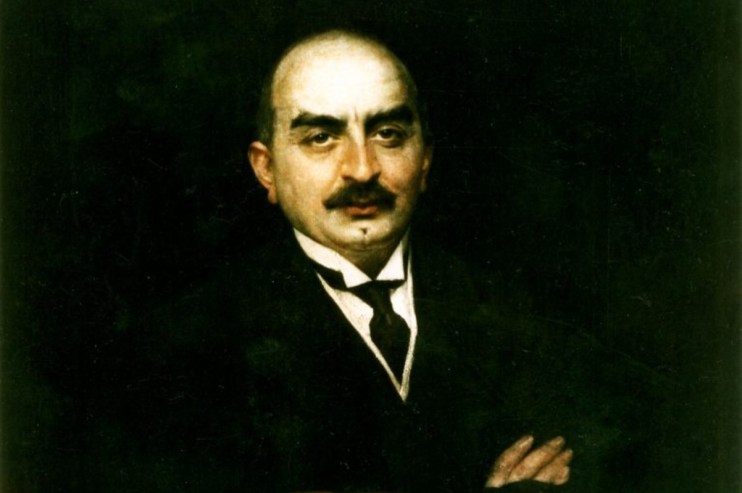
Today in 1869, the man who would go on to shape global oil markets was born in Turkey, writes Eliot Wilson
Conflict in the Persian Gulf continues to seethe, threatening a global energy crisis. The Middle East is so synonymous with oil that it is easy to think the world was always this way, that it is woven into the geopolitical fabric. But fabrics do not weave themselves.
Today in 1869, Calouste Sarkis Gulbenkian was born in Constantinople, the capital of the Ottoman Empire: even formal Ottoman documents called it Kostantiniyye, not İstanbul, until the beginning of the 20th century. His family lived in the district of Scutari (now Üsküdar), where only 15 years before, during the Crimean War, Florence Nightingale had established her hospital.
Gulbenkian’s family was Armenian. His father, Sarkis Gulbenkian, became rich importing kerosene from Russia and collecting tax revenue for the Sultan’s Hazine-i Hassa, the Privy Purse, in the vilayets of Baghdad, Mosul and Basra; he had that entrepreneurial spirit of the amira, the wealthy but precarious Armenian merchant elite of the Ottoman Empire.
The French Lycée Saint-Joseph and the American Robert College gave Gulbenkian a cosmopolitan education before he was sent to Marseille to finish his schooling at the École de Commerce. His impatient father quickly moved him to Britain and, aged 15, he enrolled at King’s College London to read engineering and applied sciences. A brilliant student, he graduated three years later with an Associateship with distinction (King’s did not yet award its own degrees and few of its students were registered with the degree-awarding University of London).
Gulbenkian’s father had left formal education at nine or 10 and he was ambitious for his son. The engineering and scientific knowledge was to be offset with cosmopolitan grace and social polish. By his mid-twenties, Calouste Gulbenkian was a rising player in the nascent oil industry, having spent a year in Baku where Russia’s black gold was flowing from the ground; his fellow Armenian, Hagop Kazazian Pasha, having become the Sultan’s Minister of Finance, had commissioned him to conduct an oil survey of Mesopotamia. But to be Armenian in Ottoman Turkey was always to walk a tightrope.
Unrest among Armenians in Anatolia in 1894 spiralled out of control. Sultan Abdul Hamid II set his face against political reform in favour of repression, and the Muslim population across the empire turned on the Christian Armenians. The numbers are fiercely debated, but by the time the violence burned itself out in 1897, perhaps 200,000 Armenians had been slaughtered. A New York Times headline in 1895 described “Another Armenian Holocaust”.
Sarkis Gulbenkian had died just before the unrest began, and the conflagration of violence drove Calouste and his family to leave Constantinople and seek refuge in London, establishing himself at 38 Hyde Park Gardens in 1900. Two years later he was naturalised as a British subject, an important statement of intent and belonging. Gulbenkian now had a solid foundation from which he could parlay his connections, expertise and ambition – and he did so with astounding success.
The genuine article to Donald Trump’s gold-plated self-conception, Gulbenkian was a consummate deal-maker, effortlessly effective at bringing parties together and bringing them success. In April 1907, he facilitated the merger of the “Shell” Transport and Trading Company with the Royal Dutch Petroleum Company; the resulting Royal Dutch Shell Group was big enough to take on John D. Rockefeller’s Standard Oil.
His masterstroke came in 1912. Convinced that there were huge untapped oil reserves in Ottoman-ruled Mesopotamia, but aware that exploitation would need foreign capital, Gulbenkian courted British and German investors to create the Turkish Petroleum Company. Half the shares were held by the National Bank of Turkey (NBT), a creation of three British financiers: Sir Ernest Cassel, such a close friend of Edward VII he had been nicknamed “Windsor Cassel”; Lord Revelstoke, senior partner of Barings; and Sir Alexander Henderson, a Liberal Unionist MP and railway financier.
The other 50 per cent of the new company was divided between Deutsche Bank and Anglo-Saxon Petroleum, a subsidiary of Shell. Initially 15 per cent of NBT’s shares were held for Gulbenkian. Two years later, just before the First World War erupted, ownership was rearranged: NBT made way for the Anglo-Persian Oil Company, which owned a refinery at Abadan and in which the British government had just taken a controlling stake.
Nom de guerre
Gulbenkian obligingly reduced his allocation to a discreet but profitable scale from which he would acquire his nom de guerre as a fixer: “Mr Five Per Cent”.
This nimble but complex corporate footwork had profound global consequences. The Ottoman Empire was dismembered after the First World War and Mesopotamia, intended to be a League of Nations mandate, instead became the Kingdom of Iraq, under British supervision. The Turkish Petroleum Company agreed a 75-year oil concession with Iraq in 1925, and on 14 October 1927, it struck oil at Baba Gurgur in northern Iraq.
Gulbenkian had been right. Today Iraq is the fifth-largest producer of oil and has the fifth-largest reserves in the world.
In 1928, the Turkish Petroleum Company was renamed the Iraq Petroleum Company, having been restructured to admit an American alliance, the Near East Development Corporation; Deutsche Bank’s previous stake was already held by France’s Compagnie Française des Pétroles (now Total). The new partners all signed the so-called Red Line Agreement by which they committed not to seek new oil interests independently within a red line drawn around the former Ottoman possessions of the Middle East.
Some suggest Gulbenkian engineered this agreement; certainly it suited his interests. He had created Iraq’s oil industry and placed it in the hands of the great western powers without a shot being fired.
His reward? Five per cent.
Calouste Gulbenkian died in July 1955, at the age of 86. He was widely believed to be the richest man in the world, his fortune perhaps as much as $840m ($10.2bn today). The Iraq Petroleum Company’s monopoly lasted until forced nationalisation in 1972, overseen by the 35-year-old vice-president of the Ba’athist régime, a tall, well-dressed and effective politician called Saddam Hussein.
Gulbenkian remains an enigmatic, unknowable figure who gave away little about himself. But Mr Five Per Cent knew one great truth of power and success: as he would remark modestly, “Better a small piece of a big pie, than a big piece of a small one”.
Eliot Wilson, writer and historian; Senior Fellow for National Security, Coalition for Global Prosperity; Contributing Editor, Defence on the Brink