Northumberland’s bold producers reinventing English whisky and gin

To celebrate the introduction of geographical indications for English Whisky, Rupert Hargreaves takes a look at two innovative producers shaking up England’s spirits market.
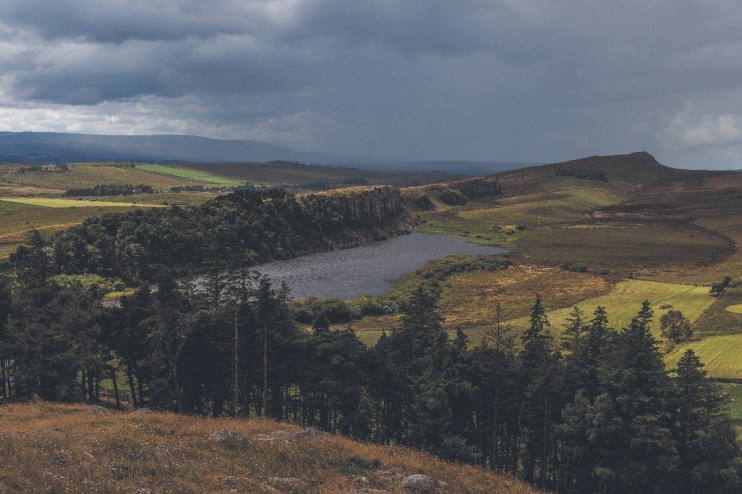
When you think of Northumberland, images of rugged landscapes, heather-covered hills, fir trees and ancient ruins spring to mind. Nestled between Scotland and England, the region is steeped in history, from Hadrian’s Wall to the Vikings to the Anglo-Saxon golden age, when the regional kingdom became one of the most powerful in early Britain, stretching from the Humber to the Firth of Forth. The region has been defined not only by its wild landscapes, but by centuries of conflict between kingdoms, empires, and raiders.
Against this backdrop, two of England’s most innovative spirits producers have emerged.
English whisky and culture
Ad Gefrin is the world’s first whisky distillery and contemporary museum in one. Stationed at the gateway to the Cheviot Hills in Wooler, the campus celebrates the region, from the archaeology of a nearby 7th-century royal palace to the locally grown barley used in its Single Malt.
As England’s northernmost whisky distillery, Ad Gefrin draws Cheviot water from beneath the site. Its spirits have already won three International Wine & Spirits Competition awards (2024), including a Silver Medal (90 Points) for its Tácnbora Northumbrian Blended Whisky. It now looks ahead to its first Northumbrian single malt: the Crǣft Series (Old English for “art” or “skill”), launched 31 July 2026 as a highly limited release of roughly 1,200 bottles ahead of a wider planned 2027 release.
As of 11th September, Ad Gefrin’s whisky, along with all other whiskies produced in England, is now officially protected under Geographical Indication (GI) status, joining Welsh and Scotch counterparts. GI status means whisky labelled “English Whisky” or “English Whiskey” must meet specific geographic and manufacturing rules under HMRC’s Spirit Drink Verification Scheme, including using 100 per cent UK-grown cereal grain and English-sourced water.
While the news hasn’t been received entirely positively by the Scottish whisky and the wider spirits industry, it signals a coming of age for English Whisky as a category. The number of distilleries in operation has roughly doubled since 2022 to more than 70 today, with exports now reaching 30 countries. In this increasingly competitive market, distilleries need an edge – something Ad Gefrin has built from the outset.
It isn’t the only distillery blazing a trail in Northumberland’s rugged landscape. Hepple Gin is also carving out a niche, thanks to its unique distillation process and focus on the natural environment.
Hepple Gin’s process
Hepple grew from a desire to do more with the Hepple Estate, home to one of the largest, most exclusive juniper collections in North-East England. Having access to this fantastic resource means the estate has the most essential ingredient for any high-quality gin on its doorstep. The creators of Heppel Gin, master distiller Chris Garden (formerly of Sipsmith), chef Valentine Warner, bartender Nick Strangeway, and estate owner Walter Riddell, crafted the product around the land and the juniper trees that populate it.
Junipers are more interesting than the average tree. The trees can take up to seven years to reach maturity and reveal their sex. While male plants release wind-borne pollen, female junipers develop green, fleshy cones. Over a two- to three-year ripening process, these cones gradually transform into the iconic blue-purple “juniper berries” used in cooking and gin.
Curiously, male and female plants often grow apart; males frequently form distinct clusters away from females, relying entirely on the wind to carry their pollen. It can take around a decade for female plants to reach maturity and produce berries. However, once mature, these plants can survive for hundreds of years. Single plants can even expand into new, long-lasting clusters that are estimated to persist for up to 1,000 years.
As a result, crafting a high-quality, juniper-led gin has many similarities to creating a high-quality whisky: time is the critical factor.
For most drinkers, gin is a spirit that’s usually cheap and plentiful. The flavour is pretty basic, and you know what you’ll get each time. It’s also relatively easy to manufacture, which is why we’ve seen such a boom in craft and small-batch gins over the past decade.
Hepple takes a different approach entirely. Its distillery, housed in an old barn on the estate, is part science lab, part traditional distillery. A standard copper pot still handles the heavier base botanicals, while vacuum distillation – replicating conditions at roughly 7,000 metres altitude – extracts delicate floral and citrus notes at around 40°C. Finally, there’s the Supercritical CO₂ Extraction Method. This technique, borrowed from the perfume industry, replicates the pressure found 2,000 metres below sea level to extract a vibrant, fresh juniper flavour from the berries into a concentrated liquid.
A base for explorers
For English gin and whisky enthusiasts, Northumberland is a must-visit destination, offering not just Ad Gefrin and Hepple but breathtaking scenery and rich history.
Matfen Hall is the perfect base. Situated in the village of Matfen, about 15 miles west of Newcastle upon Tyne, the current mansion was built in 1832 for Sir William Blackett. The Blackett Baronetcy dates back to 1673, and there has been a house on the site since the 13th century. The Jacobean-style mansion was converted into a hotel and country club, which opened in 1999 and the Blacketts now live at Halton Castle, a few miles west of Matfen.
The 63-room hotel is surrounded by The Douglas, an 18-hole championship course, plus the 9-hole Dewlaw Course and a Himalayan putting green. Also on site is a new spa complex, ideal for unwinding after a long day of distillery visits. Maften Hall is also perfect for exploring the region’s distilleries. The hotel offers the Hepple Getaway experience: a chauffeur to Hepple Spirits’ distillery for a personal tour, a personalised tasting, dinner at the hotel’s five-star Emerald Restaurant, and an overnight stay. Ad Gefrin is a 25 min drive from Hepple and can be visited on the same day.