A Dram with Paddy Fletcher

Instead of erecting yet another Highland whisky ’shed’, Paddy Fletcher and Ian Stirling hit the scene with their dramatic, vertical Port of Leith distillery in 2023. This restless pair have also embraced gin, Scotch RTDs and launched a new whisky bar as Ian Fraser discovers …
Despite developing an early taste for Tè Bheag, the blended Scotch bottled by the late Sir Ian Noble on Skye, Paddy Fletcher spent the first 15 years of his career in journalism, accountancy, housebuilding and technology startups. It wasn’t until his mid-thirties that he ventured North to co-found Port of Leith Distillery with school friend Ian Stirling.
On leaving Durham University with an economics degree, Paddy became a reporter at Risk Magazine, where he wrote about the alphabet soup of financial instruments – RMBS, CDO, CDO2, CDS – which three years later triggered the 2008 financial crash. He quit journalism and, following an MSc in economic history at the London School of Economics, joined the accountancy firm BDO. “That was a bit like doing an MBA, but being paid to do it,” says Paddy.
When he and Ian were sharing a flat in London, they began getting seriously into Scotch, initially as hobbyists. They attended tastings and even built a whisky still in their back garden.
“What frustrated us at the time was all the interesting and innovative things in whisky seemed to be happening in Tasmania, Sweden, and Brooklyn – not in Scotland”. Even as they vowed to do something to address this, Paddy’s next career move was to ride-hailing app Hailo. Having raised £120m from investors, the app was being rolled out internationally. “Everything was on fire… My main job was to work out when we were going to run out of cash”.
The pair were hatching a plan to build a Scotch whisky distillery as Paddy moved between London-based finance roles with startups including YPlan and WeWork, while Ian was working in retail and international sales at Kensington-based wine merchants Robeson Wine.
They revisited their maths and double-checked their sums after a meeting with Mark Reynier, fresh from the £58m sale of Bruichladdich, who somewhat brutally told them: “Everything you know about whisky is wrong, you’ve got no idea what you’re doing and this business plan’s a joke.”
The whisky business
Paddy has been able to apply some of the lessons he had learned in tech startups to the whisky business. “Seeing startups from the inside meant I could watch where the mistakes were being made – and work out how to avoid them.”
Soon afterwards they set up Muckle Brig Ltd to launch their distillery, and signed a lease on a one-third-of-an-acre site overlooking Leith Docks’ Western Harbour and the Royal Yacht Britannia. But they soon realised they’d have to buy the plot to have credibility with investors.
So why did they choose such a restricted site, where building a distillery was almost certain to be difficult and expensive?
“The whole point was that everyone was building sheds in the Highlands [as whisky distilleries] but that’s a me-too product. If you’re playing in the Scotch whisky game, you’re playing against 800lb gorilla organisations with legacy, heritage, tradition, stock, consumers – none of which you can chip away at.”
They decided that having a ‘vertical’ distillery, just two-miles north-east of Edinburgh’s city centre, would give them sufficient ‘Wow!’ factor to stand out from the crowd. They were also attracted by Leith’s historical role as a whisky-industry hub and growing reputation as a cool and edgy neighbourhood.
Buying the land, constructing the nine-storey tower, and purchasing the distilling equipment came to £15m – more than envisaged. However, it seems to be working. Even though it still lacks a single malt, the Port of Leith Distillery had 100,000 visitors through the door last year.
Paddy Fletcher explains that the Port of Leith Distillery brand has been reserved for their single malt (due to launch in October 2027), while other products come under Muckle Brig subsidiaries Leith Bond (independent bottlers) and Lind & Lime (a gin brand launched in 2018).
He says Fraser Thornton, the former Burn Stewart MD who joined Muckle Brig as a non-exec in 2022, and became its chairman in 2025, has been an invaluable sounding board. “He latched onto the enthusiasm that Ian and I had for the category, and for what we were trying to do, and helped ensure we don’t do dumb things.”
Table Whisky
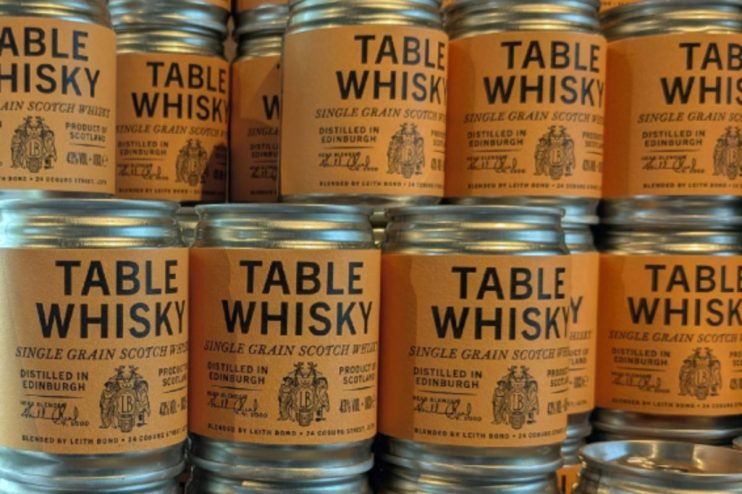
To generate revenue before the single malt hits the shelves, Muckle Brig has launched Table Whisky, an innovative single-grain whisky. “Ian and I were always joking that we stole lots of things from the wine industry. And we thought there’s ‘table wine’ – why isn’t there ‘table whisky’ – something you can drop on the table and share?”
He credits ex-colleague Sam Travers, now at Compass Box, with making it happen. “Sam found that putting single grain whisky from the North British distillery into new American oak and sherry casks, creates something which is quite smooth with a hint of prickliness. It was a genuine Eureka moment for us.”
Paddy says the product’s joys, available since 2023 in wine-like bottles and since July in 100ml cans, include its broad appeal and ability to draw in those who claim to eschew whisky. In August, Muckle Brig cemented its reputation for innovation by launching a whisky bar in Edinburgh’s old town – Whisky Quay.
As we savour our table whiskies and admire the panoramic views of the Firth of Forth, Paddy reflects on the challenges facing the sector, which has lately been buffeted by overstocking, reduced production, and geopolitical and energy-price shocks such as Donald Trump’s war on Iran.
Even so, in the long-term, he sees a rosy future for the sector. “I believe that Scotch whisky is the best industry in the world. First, you’ve got barley, which has the perfect chemical structure to create flavour. Then you’ve got 300 years of industrial heritage, which means you can launch a whisky distillery and have immediate access to all parts of the supply chain and associated expertise. Then there’s the Scottish climate, which is really conducive to the production of Scotch whisky.”
On the demand side, he strongly believes that parts of the world with large and growing populations of people aged under 30, and which lack locally-produced alternatives to Scotch – including sub-Saharan Africa – are going to offer fantastic opportunities for growth.
Ian Fraser is a financial journalist, a former business editor of Sunday Times Scotland, and author of Shredded: Inside RBS The Bank That Broke Britain. This content has been produced in collaboration with WhiskyInvestDirect, the Scotch whisky trading platform for distillers, independent bottlers, and private investors.